Starlink rival Amazon Leo has launched a waitlist for many countries, including Nigeria, to collect details of would-be…Starlink rival Amazon Leo has launched a waitlist for many countries, including Nigeria, to collect details of would-be…

Starlink rival, Amazon Leo launches waitlist for many countries, including Nigeria

Starlink rival Amazon Leo has launched a waitlist for many countries, including Nigeria, to collect details of would-be early users of its satellite Internet service when it eventually rolls out. Recall that the company recently began its first public testing with select enterprise customers ahead of an anticipated wider commercial rollout in 2026.

The list provides for three broad categories of users:

  1. Government: Government agencies and service providers like schools, hospitals, etc.
  2. Personal: individual users like you
  3. Business: corporate users and business owners

It also provides three different router types:

  • Ultra: It will support download speeds of up to 1Gbps and upload speeds of 400Mbps. Amazon boasts that it will be the world’s fastest satellite Internet antenna.
  • Nano: the smallest and lightest antenna, and most likely going to be the most affordable. The antenna weighs around 1kg. It will have a square dish panel that measures less than 18cm from side to side. It supports download speeds of up to 100Mbps.
  • Pro: Bulkier and heavier, measuring approximately 28cm across and weighing 2.4kg. It will offer download speeds of up to 400Mbps.

To apply, simply click here to start.
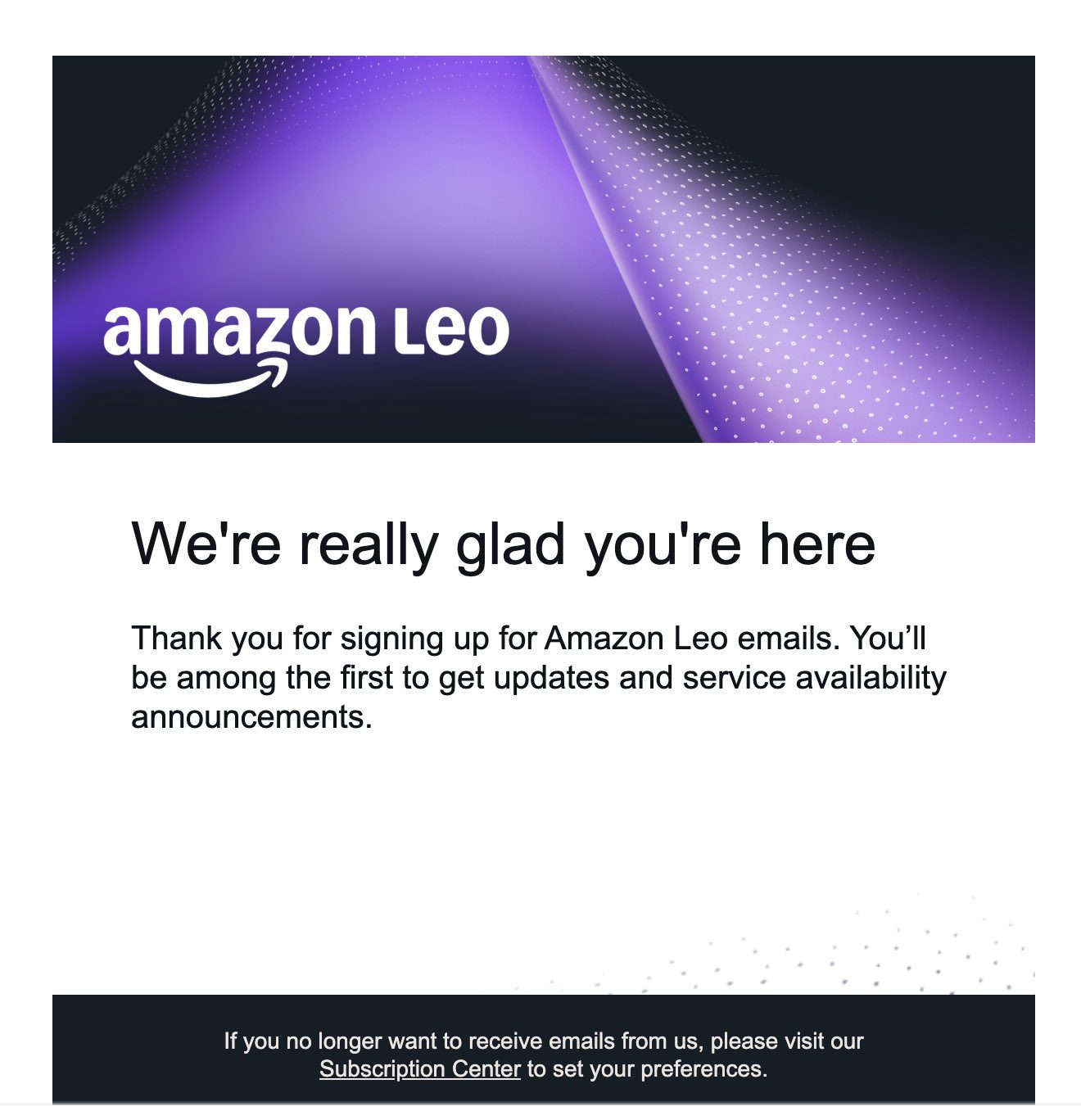
Starlink rival, Amazon Leo launches waitlist for many countries, including NigeriaYou will get a welcome email, like this, after you join the waitlist…

Recall that Amazon has partnered with Vanu, a US-based company, to deploy cellular towers in far-flung and rural parts of Southern Africa. There isn’t an announcement for a distribution structure for West Africa yet.

What you need to know about Amazon Leo

Previously known as Project Kuiper, Leo launched its first operational batch of internet satellites into low Earth orbit (LEO) last year. The mission, dubbed “KA-01” (Kuiper Atlas 1), saw 27 satellites lifted off aboard a United Launch Alliance (ULA) Atlas V rocket from Cape Canaveral Space Force Station in Florida in September.

The project now has a fleet of 153 production satellites in orbit and aims to expand to 1,618 satellites by 30 July 2026. Although this pales when compared with Starlink’s 10,000 satellites, the Amazon-owned company claims that its top-end product will offer speeds of up to 1Gbps.

Amazon’s ambitious initiative to provide global broadband access has been at least 10 years in the making. The company aims to deploy a constellation of more than 3,200 LEO satellites to deliver fast, reliable internet to customers worldwide, including underserved regions.

The first phase of the deployment will consist of 578 satellites orbiting around 630km above the Earth’s surface, slightly higher than Starlink’s fleet. Using these satellites, Amazon is rolling out 12 ground stations to provide backhaul connectivity to the Internet.

While SpaceX’s Starlink has a head start with its reusable Falcon 9 rockets and a licensed capacity for 12,000 first-generation satellites (plus 7,500 more for its second generation), Amazon is betting on its technological prowess and global reach to carve out a competitive niche.

The company has secured 80 launch missions with multiple providers, including ULA, Arianespace, and Jeff Bezos’ Blue Origin, to build out its initial constellation.

Experts believe that the setup process is likely to take at least one more year, with the earliest optimistic global launch date being late 2026 or early 2027.

Disclaimer: The articles reposted on this site are sourced from public platforms and are provided for informational purposes only. They do not necessarily reflect the views of MEXC. All rights remain with the original authors. If you believe any content infringes on third-party rights, please contact service@support.mexc.com for removal. MEXC makes no guarantees regarding the accuracy, completeness, or timeliness of the content and is not responsible for any actions taken based on the information provided. The content does not constitute financial, legal, or other professional advice, nor should it be considered a recommendation or endorsement by MEXC.

You May Also Like

Pepeto vs Blockdag Vs Layer Brett Vs Remittix and Little Pepe

Pepeto vs Blockdag Vs Layer Brett Vs Remittix and Little Pepe

The post Pepeto vs Blockdag Vs Layer Brett Vs Remittix and Little Pepe appeared on BitcoinEthereumNews.com. Crypto News 18 September 2025 | 05:39 Hunting the best crypto investment in 2025? Presales can flip a portfolio fast and sometimes change a life overnight when you choose well, which is why we start with receipts instead of slogans and cut straight to what’s live, audited, and usable today, not vague aspirations likely to drift as cycles turn and narratives fade for months. In this head-to-head we put Pepeto (PEPETO) up against Blockdag, Layer Brett, Remittix, and Little Pepe using simple yardsticks, team intent and delivery, on-chain proofs, tokenomics clarity, DEX and bridge readiness, PayFi rails, staking, and listing prep, so you can act on facts, not hype, and decide confidently before the next leg higher catches you watching from the sidelines. Pepeto’s Utility Play: Zero-Fee DEX, Bridge, And StrongPotential Pepeto treats the meme coin playbook like a platform brief, not a joke. The team ships fast, polishes details, and shows up weekly, aiming for staying power rather than a momentary pop. A hard-capped design anchors PepetoSwap, a zero-fee exchange where every trade routes through PEPETO for built-in usage instead of buzz. Already 850+ projects have applied to list, fertile ground for volume if listings follow. A built-in cross-chain bridge adds smart routing to unify liquidity, cut extra hops, and reduce slippage, turning activity into steady token demand because every swap touches PEPETO. Pepeto is audited by independent experts Solidproof and Coinsult, a trust marker reflected in more than $6,7 Million already raised in presale. Early momentum is visible. The presale puts early buyers at the front of the line with staking and stage-based price increases, and that line is getting long. Utility plus purpose, culture plus tools, the combo that tends to run farther than hype alone. Translation for you: Pepeto is graduating from noise to usage. If…
Share
BitcoinEthereumNews2025/09/18 10:41
Ethereum Name Service price prediction 2025-2031: Is ENS a good investment?

Ethereum Name Service price prediction 2025-2031: Is ENS a good investment?

Key takeaways: The Ethereum Name Service is a network that enables crypto enthusiasts to rename their cryptocurrency addresses into something simpler, making them easier to remember. Renaming crypto addresses through ENS will enable users to recollect and write them quickly. Even though Ethereum Name Service is based on the Ethereum blockchain, it uses its cryptocurrency, […]
Share
Cryptopolitan2025/09/18 01:38
Why IPO Genie ($IPO) Is Being Called a Top Crypto Presale by Analysts

Why IPO Genie ($IPO) Is Being Called a Top Crypto Presale by Analysts

IPO Genie ($IPO) is being called a top crypto presale by analysts, offering AI-driven market insights, robust tokenomics, and data-backed investor growth.
Share
Blockchainreporter2025/12/18 22:00