

Ethereum price rallies into resistance while bearish structure holds: Dead-cat bounce?
Ethereum price is rallying into a major resistance cluster, raising concerns that the move may simply be a dead-cat bounce rather than a true bullish reversal.
- ETH’s rally is testing a multi-layered resistance zone including VWAP, Fibonacci levels, and a bearish order block.
- Market structure still shows lower highs, signalling that bearish momentum dominates.
- Failure to reclaim resistance increases the likelihood of a return to $2,800 support or even deeper downside targets.
Ethereum’s (ETH) recent price action has sparked renewed market attention after a sharp reaction from the $2,800 support zone pushed the asset into a major resistance cluster. While the rebound has offered short-term relief, the broader market structure remains decisively bearish.
Analysts are now questioning whether this rally represents genuine recovery, or whether Ethereum is printing another lower high within an ongoing downtrend.
With key technical indicators converging around current price levels, Ethereum is approaching a decisive moment that will determine whether bullish momentum can regain control or if another leg down is imminent.
Ethereum price key technical points
- Major resistance at $3,400: Confluence of the 0.618 Fibonacci, VWAP resistance, and a bearish order block.
- Macro trend remains bearish: Current move resembles a potential lower high within the larger downtrend.
- Critical support at $2,800: Losing this level could trigger a deeper correction toward the $2,199 region.
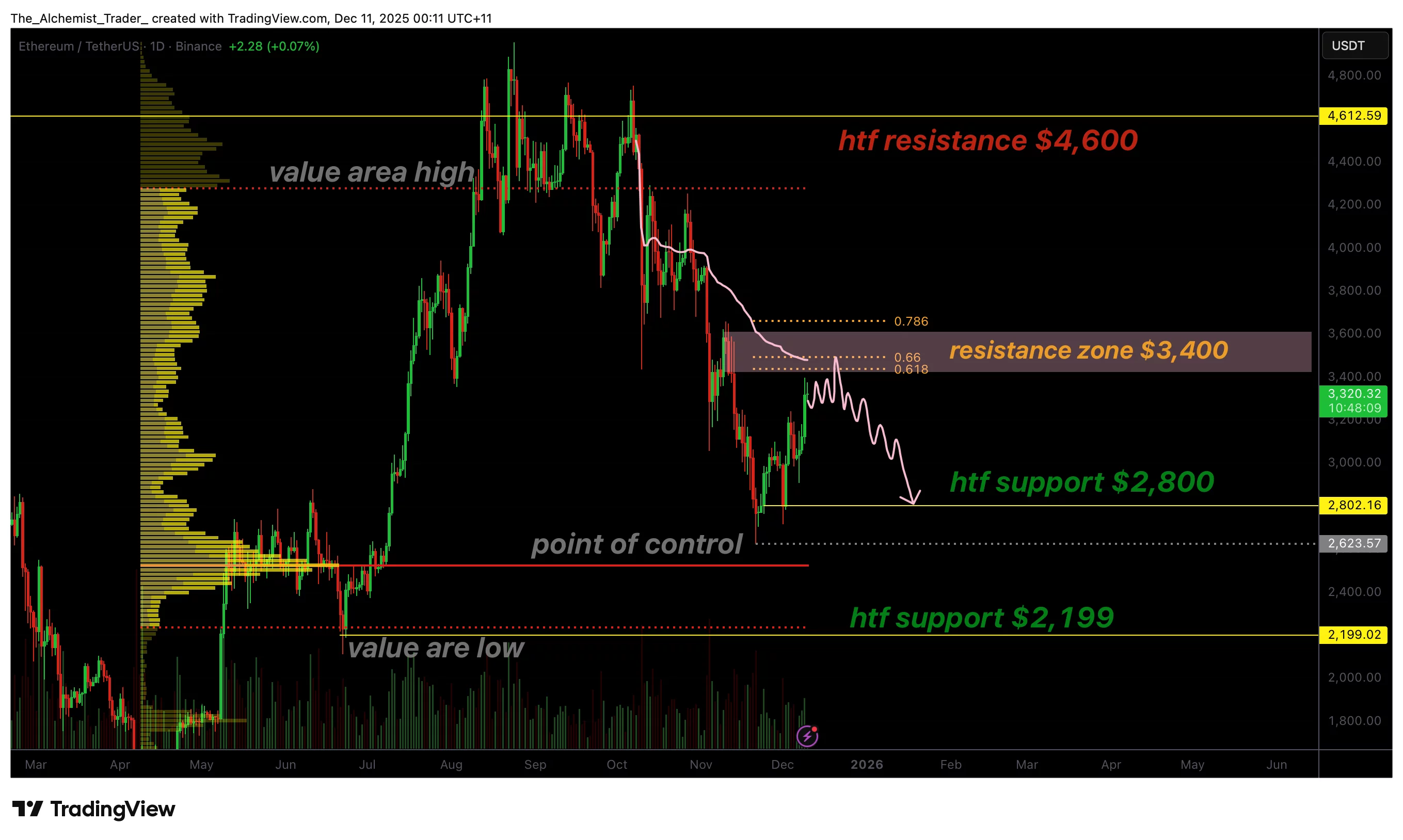
Ethereum’s rebound from the $2,800 support zone has been one of the more notable developments in recent trading sessions. This level has historically served as a significant high-time-frame support, and the latest reaction shows that buyers were willing to absorb selling pressure at this price point.
The bounce also front-ran the point of control, adding weight to the idea that liquidity concentration contributed to the recent upward movement. This move arrives just as WisdomTree launches Europe’s first fully staked Ethereum ETP on Lido, further highlighting growing institutional attention around ETH despite its broader downtrend.
However, the bullish movement faces a major challenge. Ethereum has now entered a resistance zone filled with high-confluence technical barriers. The 0.618 Fibonacci retracement of the previous decline intersects with the VWAP resistance, while a bearish order block around the $3,400 region creates additional overhead pressure. Together, these levels represent a historically strong rejection cluster where price tends to struggle.
If Ethereum fails to break above this region with conviction, the market could be witnessing nothing more than a “dead-cat bounce”, a brief recovery before trend continuation to the downside. This scenario is supported by the broader market structure, where the asset continues to print lower highs and lower lows on higher time frames.
Rejection at current levels would likely trigger a rotational move back toward the $2,800 support. If Ethereum returns to this zone, price reaction will be critical. A strong defense could stabilize the structure, but losing $2,800 on high-time-frame closes would open the door to a deeper breakdown.
The next significant support sits at $2,199, a level aligned with prior liquidity zones and the next Fibonacci retracement, especially relevant now as Ethereum ETFs have seen $75 million in outflows with zero new inflows, reflecting fading confidence at the $3,000 area.
Such a move would confirm that the overall trend remains bearish and that recent upward momentum was merely corrective.
What to expect in the coming price action
Ethereum is now at a pivotal moment. A clean break and reclaim above the $3,400 resistance cluster would invalidate the dead-cat bounce narrative and introduce the possibility of bullish continuation.
However, the more probable scenario, based on current volume, structure, and trend, is rejection and a pushback toward $2,800.
If $2,800 fails to hold, Ethereum could enter a steeper correction targeting the $2,199 region. Until the asset prints a clear higher low and shifts out of its declining structure, caution remains warranted despite short-term rallies.
You May Also Like

China’s EV insurance market bleeds billions as claims surge

Tokenized Assets Hit All-Time High of $330B Market Cap, Spanning Stablecoins and Stocks
