

Bitcoin Stalls Below $90K as Fresh Sellers Thwart Bulls

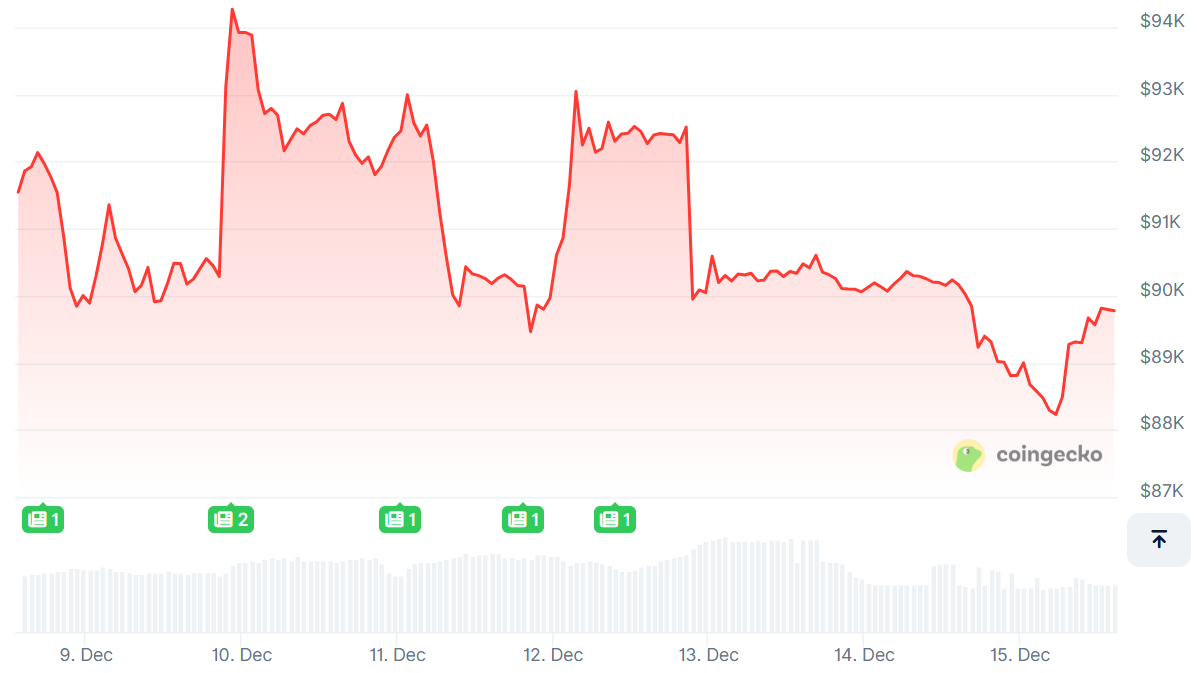
Bitcoin dropped below $90,000 late last week and languished below that level on Monday as the Asian markets started the last trading week of 2025 on a downbeat note, with growing worries about tech earnings influencing risk sentiment in stocks and cryptocurrencies alike.
A renewed selling activity is balancing out any Bullish push for gains in value, and the price of Bitcoin is currently treading towards the lower end of its recent trading range since hitting an all-time high of almost $126,000 in early October.
 Source: CoinGecko
What's not helping is the recent selloff in AI shares, weighing on broader risk sentiment.
Investors are losing faith in the ability of technology firms to maintain their inflated valuations and ambitious AI spending after seeing their stock prices increase by more than 300% since the beginning of the current bull market three years ago, which sent global indices to record highs.
Glassnode, an analytics firm focused on cryptocurrency, has reported that several indicators suggest a "mild bearish phase," characterized by minimal capital inflows being overshadowed by ongoing selling pressure from larger investors.
Although prices are currently in a "weak but bounded range," the analytics firm highlighted that the passage of time serves as a detrimental factor because of the buildup of unrealized losses.
Following a period of staying under 2%, relative unrealized losses skyrocketed to 4.4%, signaling a shift from optimism to heightened anxiety and unpredictability.

The incoming chief of the Federal Reserve will probably try to lower interest rates, according to US President Donald Trump, who added to the larger economic discussion.
The dollar's most recent losing streak since August continued last week as market participants’ estimates for two rate cuts by the Fed in 2026 soared, surpassing the central bank’s current signals.
A weaker dollar, coupled with growing expectations of future interest rate cuts, would normally give assistance for individuals involved in bitcoin trading. Stock market volatility and the long-term viability of AI investments, however, have once again taken center stage.
Due to the growing importance of technology in relation to digital assets and stock indexes, even a small change in profits can have a significant effect on risk markets.
As we near the end of 2025, the market activity for Bitcoin is generally slowing, as it is currently oscillating within a tight range slightly under the $90,000 mark.
The market has been pretty quiet as of late, with the leading cryptocurrency selling at around $89,700, marking a drop of about 1.2%.
Major trading firms are cutting back in preparation for the holidays, which has led to the current stability, which in turn implies a wider period of consolidation.
Traders don't seem eager to put money into new directions investments because liquidity is decreasing and risk tolerance is low. There is a cautious vibe now that the market has recently corrected after October.
The current lateral moves in Bitcoin's price reflect the significant drop experienced since the peaks of October. Prior to a significant market downturn that shifted expectations on October 10, Bitcoin's value had exceeded $113,000. The recent decline has prompted a more prudent approach, especially as the market approaches a phase characterized by diminished liquidity.
The cryptocurrency is anticipated to conclude the week largely stable, having declined 3.6% to $89,502 during New York trading hours on Friday. Since hitting an all-time high on October 6, it has fallen nearly 30%.
According to on-chain and derivative data, engagement has been steadily going down over the past three months.
A new study shows that trade activity has been falling from November into December, and implied volatility is expected to continue contracting as we near the end of the year.
Institutional Weakness and a Market in Waiting were pointed out by Glassnode.
Market analysts have highlighted indications of “institutional fatigue.” Even with significant inflows into spot Bitcoin ETFs earlier this year, those investments have not resulted in lasting gains, leading funds to reduce risk and finalize their positions as the year comes to a close.
Most analysts agree that the conditions are not right for a major breakout right now due to the low level of retail participation. There has been little change in institutional stance, even though the Fed has just taken a neutral stance on interest rates.
Market players are holding off on buying Bitcoin until the new year, when they expect clearer indications and more liquidity. In the meantime, the cryptocurrency looks to be settling into a range.
Key Numbers
After failing to hold levels over $92,000 and $92,500, the price of Bitcoin experienced a steep fall.
Following the sell-off, Bitcoin's price fell below the $90,500 support level and temporarily fell below $88,000. However, buyers started to re-enter the market around the $87,500 mark, restoring the price to its previous level.
After briefly falling to $87,582, prices have started to rise again.
Thanks to its recent upswing, Bitcoin is above the 23.6% Fibonacci retracement level, which marks the beginning of the drop from the $93,561 peak to its most recent low.
Bitcoin (BTC) remains trading below $90,000 and below the 100-hourly simple moving average, suggesting persistently gloomy sentiment, despite continued market volatility.
Near $90,000, there is present resistance, and at around $90,500, there is a more considerable obstacle.
The hourly chart shows a declining trend line, which further indicates that there is resistance around $90,650. Assuming Bitcoin manages to break over the $90,500 mark, the next upside objectives are between $92,000 and $92,500.
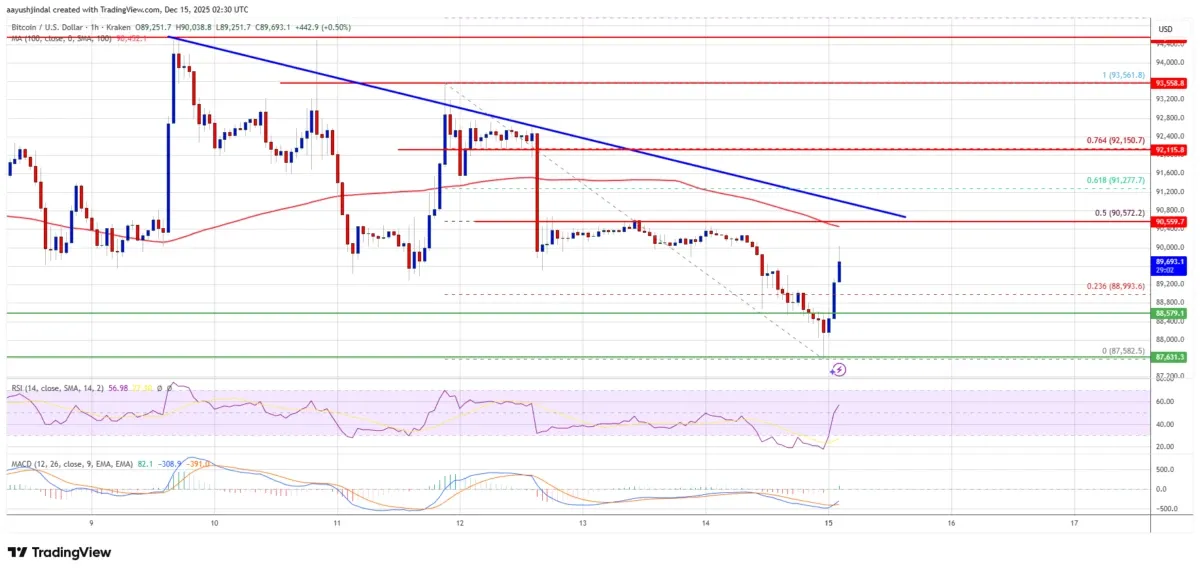
With upper resistance lines at $94,000 and $94,500, further advances toward $93,200 could be possible after a close above $92,000.
Negatively, if Bitcoin does not hit more than $90,500, the decline could be even more. Near $88,550, the token finds the first level of support; the next two levels are at $88,000 and $87,500.
If prices continue to fall, we could see the $86,500 level, with $85,000 remaining the key support level.
Momentum in the near term has been boosted, as indicated by the hourly MACD, which is currently displaying increasing strength in positive territory, and the RSI, which has increased over 50.
With the help of improved momentum indicators, Bitcoin is now showing cautious signs of stabilization.
However, whether the current recovery attempts develop into more lasting rising trends or deteriorate into another downward phase will likely depend on its ability to surpass nearby resistance levels.
Elsewhere
 Blockhead
Blockhead
Blockhead
 Blockhead
 Blockhead
Podcast
Decentralization and Privacy: Insights from TEN Protocol's Cais Manai
In this episode of Blockcast, host Takatoshi Shibayama sits down with Cais Manai, co-founder of TEN Protocol, to delve into the intricacies of blockchain privacy and decentralization. Cais shares his journey from discovering Bitcoin in 2012 to co-founding TEN Protocol, a project focused on integrating privacy into Ethereum's Layer 2 solutions.
Tune in at blockcast.blockhead.co or on Spotify, Apple, Amazon Music, or any major podcast platform.

Blockhead is a media partner for Consensus Hong Kong 2026. Readers can save 20% on tickets using exclusive code BLOCKDESK at this link.
You May Also Like

CME Unleashing XRP Options After $16B Futures Rally Signals Strong Institutional Demand

What Devs Are Actually Doing
