Ethereum is once again attempting to reclaim the $3,000 level after several failed efforts this month. ETH briefly pushed higher during early trading but continuesEthereum is once again attempting to reclaim the $3,000 level after several failed efforts this month. ETH briefly pushed higher during early trading but continues

Ethereum Nears $3,000 as Bitmine Expands Holdings to 4 Million ETH

Ethereum is once again attempting to reclaim the $3,000 level after several failed efforts this month. ETH briefly pushed higher during early trading but continues facing resistance amid fragile broader market conditions. 

Despite muted momentum, on-chain data suggests investors may be positioning to support a potential recovery.

Ethereum Holders Continue To Grow

Ethereum’s network growth has surged to a four-year and seven-month high. This metric reflects the pace at which new addresses are joining the network. The increase signals renewed interest at current price levels, even as ETH struggles to break higher.

Rising network growth often introduces fresh capital. New participants expand liquidity and strengthen demand foundations. For Ethereum, this trend is particularly important as price recovery depends on sustained inflows rather than short-term speculative trading. Strong address growth suggests long-term confidence remains intact.

Want more token insights like this? Sign up for Editor Harsh Notariya’s Daily Crypto Newsletter here.
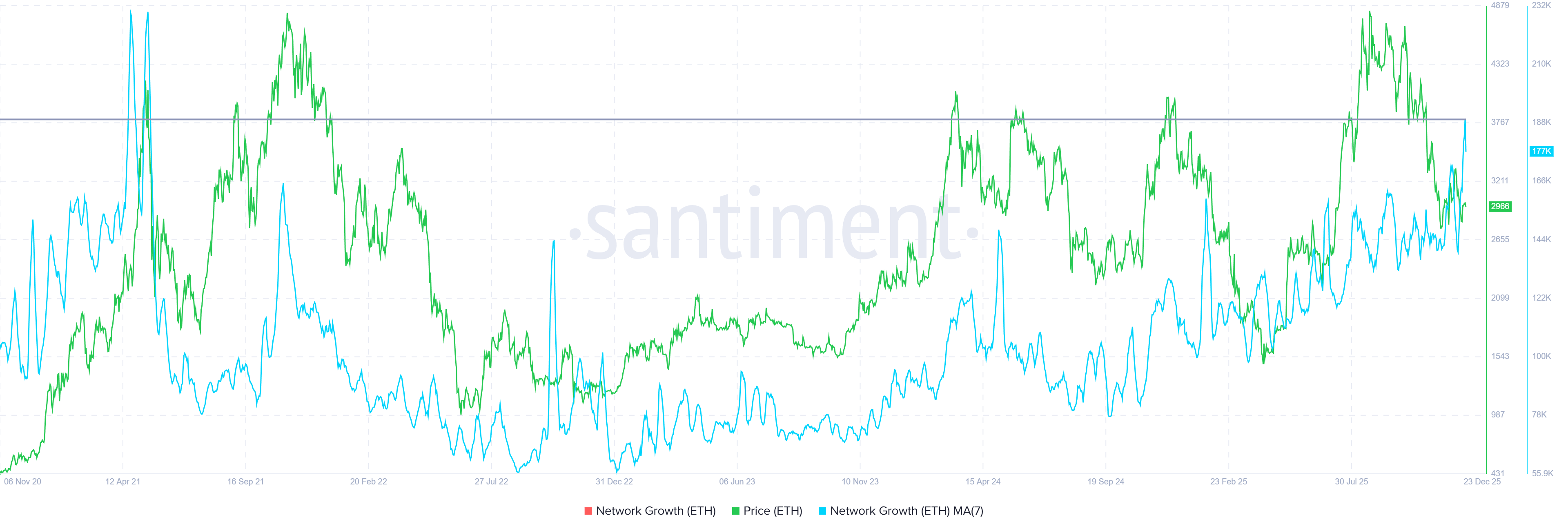
Ethereum Network GrowthEthereum Network Growth. Source: Santiment

Bitmine Could Be Aiding Price Recovery

A major contributor to this growth is Bitmine. The firm has quickly accumulated Ethereum through its treasury strategy. Bitmine now holds approximately 4.066 million ETH, representing 3.37% of the total supply within six months.

The company has publicly targeted ownership of 5% of all ETH, a move that could further tighten circulating supply and support price appreciation.

Macro indicators present a mixed backdrop. The MVRV Long/Short Difference remains at low negative levels, indicating neither long-term holders nor short-term traders are currently in profit. This lack of profitability often slows transaction activity, as participants hesitate to move assets at a loss.

Low profit conditions can suppress velocity across the network. However, such environments also reduce sales pressure. If broader macro conditions improve, long-term holders typically act as stabilizers. Their reluctance to sell at unfavorable prices can provide a base for recovery when demand returns.

Ethereum’s current setup reflects this balance. Weak profitability limits enthusiasm, yet it also prevents aggressive distribution. A positive external catalyst could shift sentiment quickly, allowing stronger hands to absorb supply and push ETH higher.
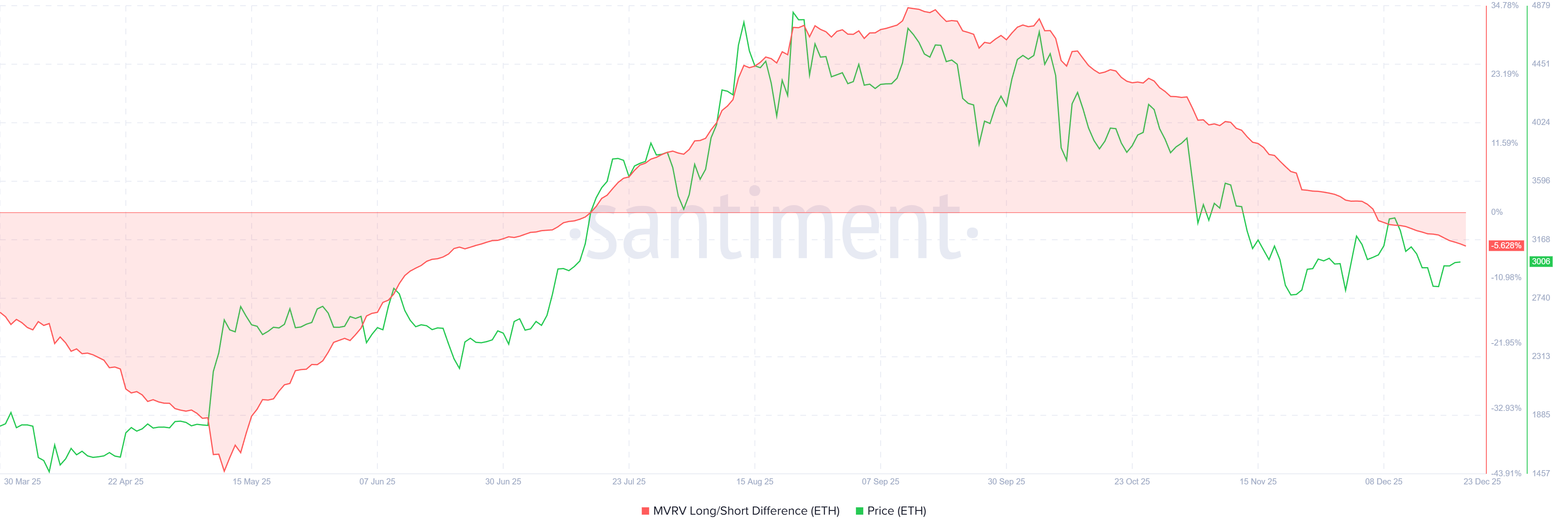
Ethereum MVRV Long/Short DifferenceEthereum MVRV Long/Short Difference. Source: Santiment

ETH Price Faces Its Challenge

Ethereum trades near $2,968 at the time of writing, sitting just below the $3,000 resistance. The level has capped price action repeatedly in recent weeks. Continued failure to reclaim it keeps ETH vulnerable to volatility and short-term pullbacks.

To revisit December’s high of $3,447, ETH requires a recovery of roughly 16%. The first hurdle remains $3,131, a key resistance zone. Sustained network growth and continued accumulation by large entities like Bitmine could provide the buying pressure needed to reach this level.
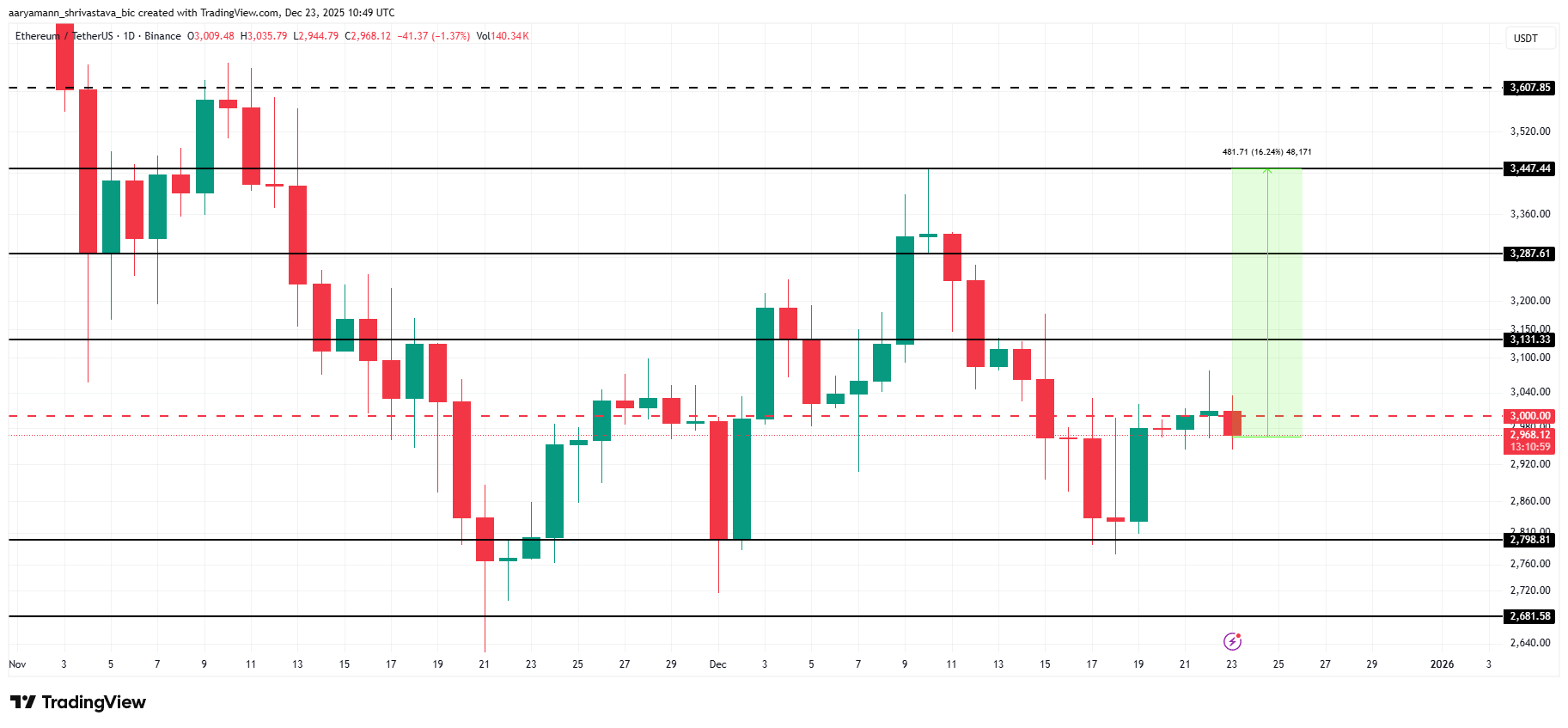
ETH Price Analysis. ETH Price Analysis. Source: TradingView

Downside risks persist if Ethereum fails to secure $3,000 as support. A rejection could send the price back toward $2,798, a level previously tested. Given ETH’s tendency for sharp moves in this range, a breakdown could accelerate losses before stability returns.

Market Opportunity
4 Logo
4 Price(4)
$0.02044
$0.02044$0.02044
+0.14%
USD
4 (4) Live Price Chart
Disclaimer: The articles reposted on this site are sourced from public platforms and are provided for informational purposes only. They do not necessarily reflect the views of MEXC. All rights remain with the original authors. If you believe any content infringes on third-party rights, please contact service@support.mexc.com for removal. MEXC makes no guarantees regarding the accuracy, completeness, or timeliness of the content and is not responsible for any actions taken based on the information provided. The content does not constitute financial, legal, or other professional advice, nor should it be considered a recommendation or endorsement by MEXC.

You May Also Like

The Channel Factories We’ve Been Waiting For

The Channel Factories We’ve Been Waiting For

The post The Channel Factories We’ve Been Waiting For appeared on BitcoinEthereumNews.com. Visions of future technology are often prescient about the broad strokes while flubbing the details. The tablets in “2001: A Space Odyssey” do indeed look like iPads, but you never see the astronauts paying for subscriptions or wasting hours on Candy Crush.  Channel factories are one vision that arose early in the history of the Lightning Network to address some challenges that Lightning has faced from the beginning. Despite having grown to become Bitcoin’s most successful layer-2 scaling solution, with instant and low-fee payments, Lightning’s scale is limited by its reliance on payment channels. Although Lightning shifts most transactions off-chain, each payment channel still requires an on-chain transaction to open and (usually) another to close. As adoption grows, pressure on the blockchain grows with it. The need for a more scalable approach to managing channels is clear. Channel factories were supposed to meet this need, but where are they? In 2025, subnetworks are emerging that revive the impetus of channel factories with some new details that vastly increase their potential. They are natively interoperable with Lightning and achieve greater scale by allowing a group of participants to open a shared multisig UTXO and create multiple bilateral channels, which reduces the number of on-chain transactions and improves capital efficiency. Achieving greater scale by reducing complexity, Ark and Spark perform the same function as traditional channel factories with new designs and additional capabilities based on shared UTXOs.  Channel Factories 101 Channel factories have been around since the inception of Lightning. A factory is a multiparty contract where multiple users (not just two, as in a Dryja-Poon channel) cooperatively lock funds in a single multisig UTXO. They can open, close and update channels off-chain without updating the blockchain for each operation. Only when participants leave or the factory dissolves is an on-chain transaction…
Share
BitcoinEthereumNews2025/09/18 00:09
Egypt to invite investors for projects in ‘golden triangle’

Egypt to invite investors for projects in ‘golden triangle’

Egypt is preparing a list of projects to show potential investors in its promising “golden triangle” area, home to nearly half the Arab country’s gold deposits.
Share
Agbi2025/12/25 04:09
OpenVPP accused of falsely advertising cooperation with the US government; SEC commissioner clarifies no involvement

OpenVPP accused of falsely advertising cooperation with the US government; SEC commissioner clarifies no involvement

PANews reported on September 17th that on-chain sleuth ZachXBT tweeted that OpenVPP ( $OVPP ) announced this week that it was collaborating with the US government to advance energy tokenization. SEC Commissioner Hester Peirce subsequently responded, stating that the company does not collaborate with or endorse any private crypto projects. The OpenVPP team subsequently hid the response. Several crypto influencers have participated in promoting the project, and the accounts involved have been questioned as typical influencer accounts.
Share
PANews2025/09/17 23:58