Bitcoin’s Year-End Stability and Future Outlook Despite a lackluster year-end rally, Bitcoin’s subdued performance may serve as a stabilizing factor, potentiallyBitcoin’s Year-End Stability and Future Outlook Despite a lackluster year-end rally, Bitcoin’s subdued performance may serve as a stabilizing factor, potentially

Bitcoin Stability and Pomp’s Insight: No Drawdown Expected in 2026
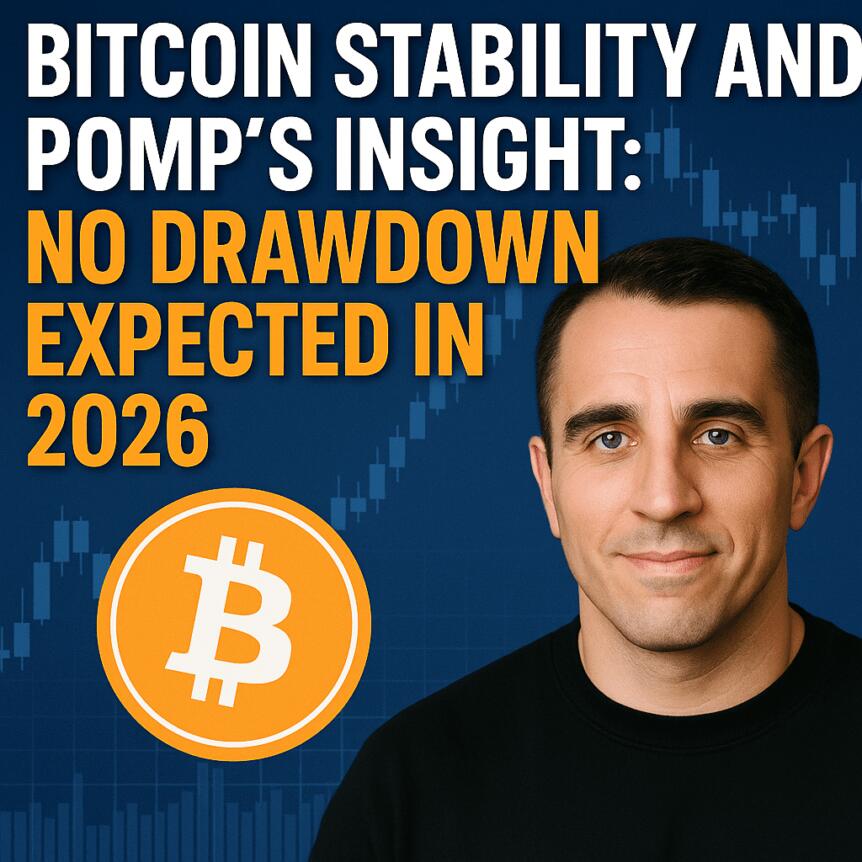
Bitcoin Stability And Pomp's Insight: No Drawdown Expected In 2026

Bitcoin’s Year-End Stability and Future Outlook

Despite a lackluster year-end rally, Bitcoin’s subdued performance may serve as a stabilizing factor, potentially reducing the likelihood of a significant crash in the early months of next year. Principal industry figure Anthony Pompliano suggests that recent price movements and declining volatility indicate a resilient asset that, while missing some bullish targets this year, remains a strong performer over the longer term.

Key Takeaways

  • Bitcoin has experienced an almost 7.4% decline from its January opening price, currently trading around $87,436.
  • Despite missing the predicted $250,000 target, Bitcoin has doubled in value over two years and nearly tripled over three, reflecting strong cumulative growth.
  • Bitcoin’s volatility has decreased significantly, offering a form of downside protection even as some investors express disappointment over the lack of a blow-off top.
  • While some analysts forecast a drop to $60,000 by 2026, more conservative outlooks see prices stabilizing around $65,000, illustrating divergent opinions on Bitcoin’s long-term trajectory.

Tickers mentioned: Bitcoin

Sentiment: Neutral

Price impact: Negative. The recent price decline reflects short-term volatility and investor caution, but long-term prospects remain intact.

Trading idea (Not Financial Advice): Hold. The current stabilization suggests a prudent approach amid mixed market signals.

Market context: Broader macroeconomic uncertainties and evolving regulatory landscapes influence Bitcoin’s future performance, emphasizing cautious optimism.

Market Insights and Expert Opinions

In an interview on CNBC, Anthony Pompliano highlighted that Bitcoin has not experienced the dramatic 80% drawdowns many investors feared, despite the year’s volatility and the asset’s failure to reach some bullish targets such as $250,000. He emphasized that Bitcoin remains a remarkable performer in financial markets, with a 100% increase in two years and nearly 300% over three years, driven by its compound growth model.

Pompliano pointed out that Bitcoin’s volatility is now at levels that provide some safety from severe downturns, contrasting with the heavy focus many investors have placed on price declines since the start of the year. He noted the absence of a blow-off top this year, although the anticipated massive correction has yet to materialize.

Despite the cautious optimism, some market analysts remain bearish in their forecasts. Veteran trader Peter Brandt warned that Bitcoin could decline as low as $60,000 by 2026’s third quarter. Conversely, Jurrien Timmer, Fidelity’s director of global macroeconomic research, predicts the asset may bottom at around $65,000 in 2026, suggesting a more moderate outlook amid macroeconomic uncertainties.

As Bitcoin continues to mature, divergent predictions highlight the ongoing debate about its long-term potential. Nonetheless, the current environment indicates a shift towards stability, possibly paving the way for future growth amid cautious investor sentiment.

This article was originally published as Bitcoin Stability and Pomp’s Insight: No Drawdown Expected in 2026 on Crypto Breaking News – your trusted source for crypto news, Bitcoin news, and blockchain updates.

Market Opportunity
FUTURECOIN Logo
FUTURECOIN Price(FUTURE)
$0.12347
$0.12347$0.12347
-2.80%
USD
FUTURECOIN (FUTURE) Live Price Chart
Disclaimer: The articles reposted on this site are sourced from public platforms and are provided for informational purposes only. They do not necessarily reflect the views of MEXC. All rights remain with the original authors. If you believe any content infringes on third-party rights, please contact service@support.mexc.com for removal. MEXC makes no guarantees regarding the accuracy, completeness, or timeliness of the content and is not responsible for any actions taken based on the information provided. The content does not constitute financial, legal, or other professional advice, nor should it be considered a recommendation or endorsement by MEXC.

You May Also Like

The Channel Factories We’ve Been Waiting For

The Channel Factories We’ve Been Waiting For

The post The Channel Factories We’ve Been Waiting For appeared on BitcoinEthereumNews.com. Visions of future technology are often prescient about the broad strokes while flubbing the details. The tablets in “2001: A Space Odyssey” do indeed look like iPads, but you never see the astronauts paying for subscriptions or wasting hours on Candy Crush.  Channel factories are one vision that arose early in the history of the Lightning Network to address some challenges that Lightning has faced from the beginning. Despite having grown to become Bitcoin’s most successful layer-2 scaling solution, with instant and low-fee payments, Lightning’s scale is limited by its reliance on payment channels. Although Lightning shifts most transactions off-chain, each payment channel still requires an on-chain transaction to open and (usually) another to close. As adoption grows, pressure on the blockchain grows with it. The need for a more scalable approach to managing channels is clear. Channel factories were supposed to meet this need, but where are they? In 2025, subnetworks are emerging that revive the impetus of channel factories with some new details that vastly increase their potential. They are natively interoperable with Lightning and achieve greater scale by allowing a group of participants to open a shared multisig UTXO and create multiple bilateral channels, which reduces the number of on-chain transactions and improves capital efficiency. Achieving greater scale by reducing complexity, Ark and Spark perform the same function as traditional channel factories with new designs and additional capabilities based on shared UTXOs.  Channel Factories 101 Channel factories have been around since the inception of Lightning. A factory is a multiparty contract where multiple users (not just two, as in a Dryja-Poon channel) cooperatively lock funds in a single multisig UTXO. They can open, close and update channels off-chain without updating the blockchain for each operation. Only when participants leave or the factory dissolves is an on-chain transaction…
Share
BitcoinEthereumNews2025/09/18 00:09
What is the Outlook for Digital Assets in 2026?

What is the Outlook for Digital Assets in 2026?

The post What is the Outlook for Digital Assets in 2026? appeared on BitcoinEthereumNews.com. The crypto market cap reached $4.3 trillion in 2025 as institutions
Share
BitcoinEthereumNews2025/12/25 03:23
Pudgy Penguins’ Non-Crypto Display Wraps Las Vegas Sphere, Potentially Elevating PENGU Brand Reach

Pudgy Penguins’ Non-Crypto Display Wraps Las Vegas Sphere, Potentially Elevating PENGU Brand Reach

The post Pudgy Penguins’ Non-Crypto Display Wraps Las Vegas Sphere, Potentially Elevating PENGU Brand Reach appeared on BitcoinEthereumNews.com. Pudgy Penguins,
Share
BitcoinEthereumNews2025/12/25 03:41