Author: Heechang Compiled by: TechFlow xStocks offers a tokenized stock service, allowing investors to trade tokenized versions of popular US stocks like Tesla in real time. While still in its early stages, it’s already showing some interesting signs of growth. Observation 1: Trading is concentrated in Tesla (TSLA) As in many emerging markets, trading activity has quickly concentrated on a handful of stocks. Data shows a high concentration of trading volume in the most well-known and volatile stocks, with Tesla being the most prominent example. This concentration is not surprising: liquidity tends to accumulate in assets that retail investors already favor, and early adopters often use familiar high-beta stocks to test new infrastructure. Observation 2: Liquidity decreases on weekends Data shows that on-chain equity trading volume drops to 30% or less of weekday levels over the weekend. Unlike crypto-native assets, which trade seamlessly around the clock, tokenized stocks still inherit the behavioral inertia of traditional market trading hours. Traders appear less willing to trade when reference markets (such as Nasdaq and the New York Stock Exchange) are closed, likely due to concerns about arbitrage, price gaps, and the inability to hedge positions off-chain. Observation 3: Prices move in line with the Nasdaq Another key signal comes from pricing behavior during the initial launch period. Initially, xStocks tokens traded at a significant premium to their Nasdaq counterparts, reflecting market enthusiasm and potential friction in bridging fiat liquidity. However, these premiums gradually diminished over time. Current trading patterns show that the token price is at the upper limit of Tesla's intraday price range and is highly consistent with the Nasdaq reference price. Arbitrageurs appear to be maintaining this price discipline, but there are still small deviations from the intraday highs, indicating some market inefficiencies that may present opportunities and risks for active traders. New opportunities for Korean stock investors? South Korean investors currently hold over $100 billion in US stocks, with trading volume increasing 17-fold since January 2020. Existing infrastructure for South Korean investors to trade US stocks is limited by high fees, long settlement times, and slow cash-out processes, creating opportunities for tokenized or on-chain mirror stocks. As the infrastructure and platforms supporting on-chain US stock markets continue to improve, a new group of South Korean traders will enter the crypto market, which is undoubtedly a huge opportunity.Author: Heechang Compiled by: TechFlow xStocks offers a tokenized stock service, allowing investors to trade tokenized versions of popular US stocks like Tesla in real time. While still in its early stages, it’s already showing some interesting signs of growth. Observation 1: Trading is concentrated in Tesla (TSLA) As in many emerging markets, trading activity has quickly concentrated on a handful of stocks. Data shows a high concentration of trading volume in the most well-known and volatile stocks, with Tesla being the most prominent example. This concentration is not surprising: liquidity tends to accumulate in assets that retail investors already favor, and early adopters often use familiar high-beta stocks to test new infrastructure. Observation 2: Liquidity decreases on weekends Data shows that on-chain equity trading volume drops to 30% or less of weekday levels over the weekend. Unlike crypto-native assets, which trade seamlessly around the clock, tokenized stocks still inherit the behavioral inertia of traditional market trading hours. Traders appear less willing to trade when reference markets (such as Nasdaq and the New York Stock Exchange) are closed, likely due to concerns about arbitrage, price gaps, and the inability to hedge positions off-chain. Observation 3: Prices move in line with the Nasdaq Another key signal comes from pricing behavior during the initial launch period. Initially, xStocks tokens traded at a significant premium to their Nasdaq counterparts, reflecting market enthusiasm and potential friction in bridging fiat liquidity. However, these premiums gradually diminished over time. Current trading patterns show that the token price is at the upper limit of Tesla's intraday price range and is highly consistent with the Nasdaq reference price. Arbitrageurs appear to be maintaining this price discipline, but there are still small deviations from the intraday highs, indicating some market inefficiencies that may present opportunities and risks for active traders. New opportunities for Korean stock investors? South Korean investors currently hold over $100 billion in US stocks, with trading volume increasing 17-fold since January 2020. Existing infrastructure for South Korean investors to trade US stocks is limited by high fees, long settlement times, and slow cash-out processes, creating opportunities for tokenized or on-chain mirror stocks. As the infrastructure and platforms supporting on-chain US stock markets continue to improve, a new group of South Korean traders will enter the crypto market, which is undoubtedly a huge opportunity.

How is the xStocks tokenized stock market developing?

2025/09/18 08:00
2 min read
For feedback or concerns regarding this content, please contact us at crypto.news@mexc.com

Author: Heechang

Compiled by: TechFlow

xStocks offers a tokenized stock service, allowing investors to trade tokenized versions of popular US stocks like Tesla in real time. While still in its early stages, it’s already showing some interesting signs of growth.

Observation 1: Trading is concentrated in Tesla (TSLA)
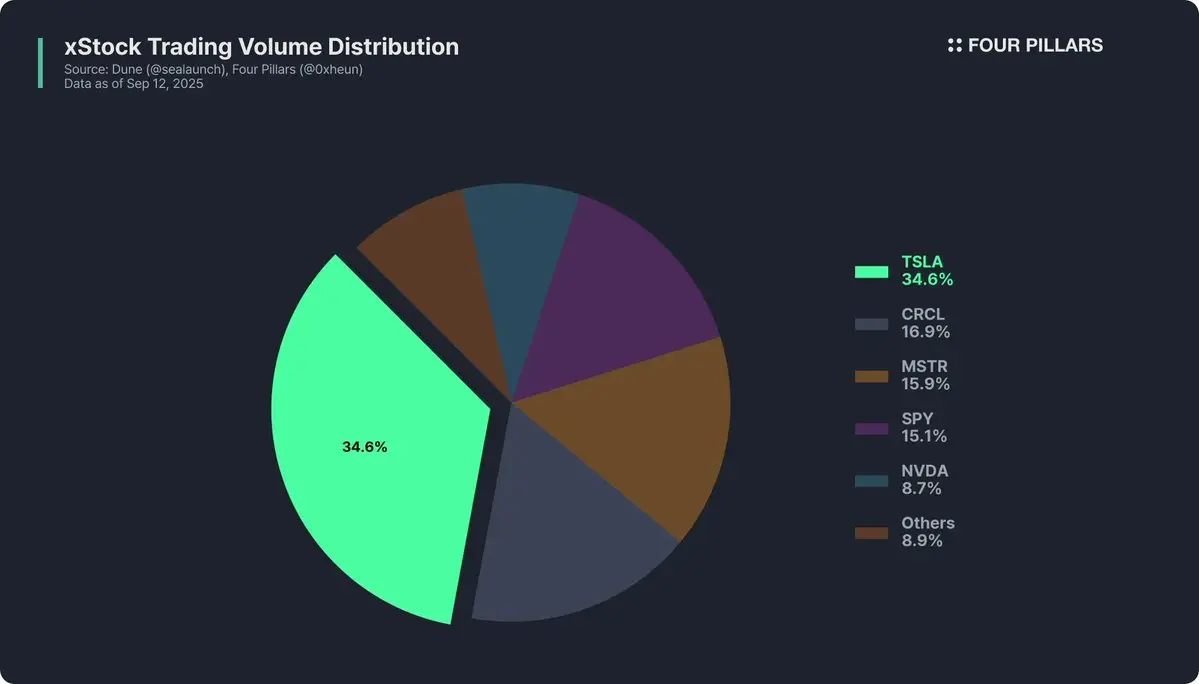
As in many emerging markets, trading activity has quickly concentrated on a handful of stocks. Data shows a high concentration of trading volume in the most well-known and volatile stocks, with Tesla being the most prominent example.

This concentration is not surprising: liquidity tends to accumulate in assets that retail investors already favor, and early adopters often use familiar high-beta stocks to test new infrastructure.

Observation 2: Liquidity decreases on weekends
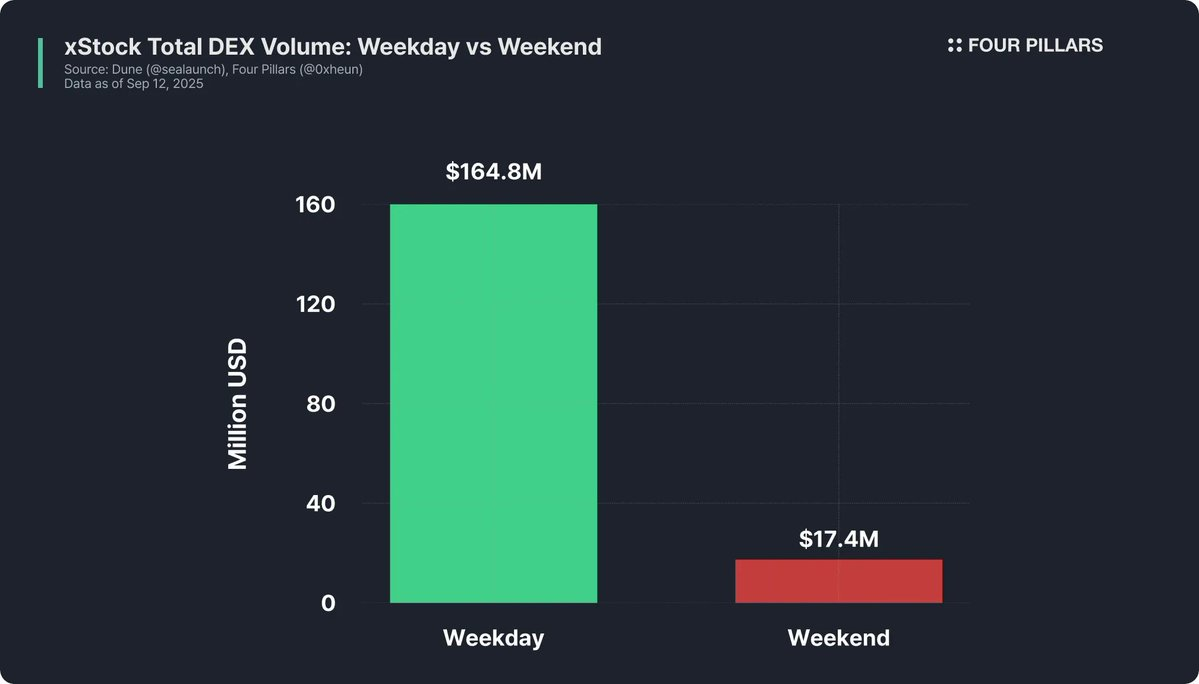
Data shows that on-chain equity trading volume drops to 30% or less of weekday levels over the weekend. Unlike crypto-native assets, which trade seamlessly around the clock, tokenized stocks still inherit the behavioral inertia of traditional market trading hours. Traders appear less willing to trade when reference markets (such as Nasdaq and the New York Stock Exchange) are closed, likely due to concerns about arbitrage, price gaps, and the inability to hedge positions off-chain.

Observation 3: Prices move in line with the Nasdaq

Another key signal comes from pricing behavior during the initial launch period. Initially, xStocks tokens traded at a significant premium to their Nasdaq counterparts, reflecting market enthusiasm and potential friction in bridging fiat liquidity. However, these premiums gradually diminished over time.

Current trading patterns show that the token price is at the upper limit of Tesla's intraday price range and is highly consistent with the Nasdaq reference price.

Arbitrageurs appear to be maintaining this price discipline, but there are still small deviations from the intraday highs, indicating some market inefficiencies that may present opportunities and risks for active traders.

New opportunities for Korean stock investors?

South Korean investors currently hold over $100 billion in US stocks, with trading volume increasing 17-fold since January 2020. Existing infrastructure for South Korean investors to trade US stocks is limited by high fees, long settlement times, and slow cash-out processes, creating opportunities for tokenized or on-chain mirror stocks. As the infrastructure and platforms supporting on-chain US stock markets continue to improve, a new group of South Korean traders will enter the crypto market, which is undoubtedly a huge opportunity.

Disclaimer: The articles reposted on this site are sourced from public platforms and are provided for informational purposes only. They do not necessarily reflect the views of MEXC. All rights remain with the original authors. If you believe any content infringes on third-party rights, please contact crypto.news@mexc.com for removal. MEXC makes no guarantees regarding the accuracy, completeness, or timeliness of the content and is not responsible for any actions taken based on the information provided. The content does not constitute financial, legal, or other professional advice, nor should it be considered a recommendation or endorsement by MEXC.

You May Also Like

PayPal USD Goes Live on Stellar, Expanding Access to Stablecoin Payments

PayPal USD Goes Live on Stellar, Expanding Access to Stablecoin Payments

PayPal USD (PYUSD), the fully regulated U.S. dollar-backed stablecoin, is now live on the Stellar network, announced on Thursday. The launch marks a milestone for both PayPal and Stellar, extending PYUSD’s reach into new wallets, platforms, and business use cases across global payments. The announcement was made at the Stellar Meridian event in Copacabana, Rio de Janeiro, on September 18, a flagship annual gathering of blockchain leaders, investors, and policymakers. Expanding Access Through Stellar’s Ecosystem By deploying on Stellar, PYUSD integrates with wallets and platforms including Bitcoin.com, Chipper Cash, Decaf, Arculus, Meru, CiNKO, COCA, Lobstr, and others. This expansion alllows millions of users to access a stablecoin option designed for low-cost payments. “Expanding PYUSD to the Stellar network is an exciting step toward making stable, trusted digital dollars more accessible and useful worldwide,” said Corbin Fraser, CEO of Bitcoin.com. “By supporting PYUSD on Stellar, we’re enabling our millions of users to enjoy fast, low-cost transfers while strengthening the role of stablecoins in real-world payments.” Empowering Businesses and SMEs Beyond consumer payments, PYUSD on Stellar offers small and medium-sized businesses access to near-instant settlement and real-time working capital. Companies can use PYUSD to pay suppliers, manage inventory, or cover operational costs without the delays typically associated with traditional finance. According to Paypal liquidity providers can participate by backing these financing opportunities and earning potential returns linked to real-world commerce. This creates a virtuous cycle of faster payments, improved liquidity, and enhanced financial inclusion, explains PayPal. PYUSD’s fully backed reserves—held in U.S. dollar deposits, U.S. Treasuries, and similar cash equivalents—add trust and transparency. Oversight from the New York State Department of Financial Services (NYDFS) ensures a high regulatory standard. PayPal Deepens Onchain Presence “PayPal continues to be at the forefront of payments, meeting our customers where they are — online, offline, and now onchain,” said May Zabaneh, Vice President of Crypto at PayPal. “Expanding PYUSD to Stellar broadens access to PYUSD and opens up new use cases and opportunities for seamless transactions for customers.” With this move, PayPal strengthens its role in the stablecoin ecosystem, offering consumers and enterprises a digital currency that bridges traditional finance with blockchain-powered efficiency. Stellar’s Growing Role in Digital Payments Stellar, which has processed over 20 billion operations across nearly 10 million accounts, provides a proven network for innovation in payments. Developers can integrate PYUSD into programmable payment solutions and enterprise-grade platforms using Stellar’s open-source SDKs and Soroban smart contracts. “Having a global leader like PayPal bring PYUSD to the Stellar network is a major step forward in how stablecoins can power real-world payments,” said Denelle Dixon, CEO of the Stellar Development Foundation. “This milestone sets the stage for broader adoption and innovation.”
Share
CryptoNews2025/09/19 01:00
MEXC Expands Zero Fee Tokenized Equities With Ondo Batch

MEXC Expands Zero Fee Tokenized Equities With Ondo Batch

TLDR MEXC lists 17 ERC20 tokenized US equities with 30-day zero fees All pairs trade in USDT and use MEXC proprietary liquidity tech Launch marks ninth Ondo Finance
Share
Coincentral2026/03/05 14:02
On the eve of Web4, a guide for ordinary workers to avoid being left behind.

On the eve of Web4, a guide for ordinary workers to avoid being left behind.

Author: TT3LABS, Web3/AI/SaaS Remote Recruitment Platform On February 26, 2026, fintech giant Block announced layoffs of over 4,000 employees, reducing its team
Share
PANews2026/03/05 14:22