On-chain data shows the short-term holder Bitcoin whales have recently increased their Realized Cap share to the highest level ever. Bitcoin Is Currently Being Dominated By New Capital In a new post on X, CryptoQuant community analyst Maartunn has talked about the latest trend in the share of the Bitcoin whale Realized Cap held by the short-term holders. The Realized Cap here is an on-chain indicator that measures, in short, the total amount of capital that the BTC investors as a whole have put into the cryptocurrency. Changes in this metric reflect the incoming or outgoing of capital. Related Reading: Bitcoin Retests STH Cost Basis Again: Is This Where Support Flips? In the context of the current topic, the Realized Cap of only a portion of holders is of interest: the whales. These are the entities carrying more than 1,000 BTC (about $111.4 million) in their balance. Whales can be further broken down into cohorts on the basis of holding time. Whale-sized holders who bought their coins within the past 155 days are known as the short-term holder (STH) or new whales. Similarly, those who have a holding time higher than this cutoff are called the long-term holder (LTH) or old whales. Now, here is the chart shared by Maartunn that shows how the Bitcoin Realized Cap dominance of these two groups has changed over the past decade: As displayed in the above graph, new whales have rapidly gained ground in the Bitcoin Realized Cap recently and hit a dominance of 44%. The STH whales represent the big-money capital that has come into the coin over the last 155 days. Thus, it would appear that 44% of the capital stored on the BTC network is currently “fresh.” This is the largest share of the whale Realized Cap that the STHs alone have occupied in the cryptocurrency’s history. To put things into perspective, the 2021 bull run topped out at a value of 31%. The STH whales gain Realized Cap dominance through two means: a transfer of coins between members of the cohort at a higher price and selling from the LTH whales. LTH whales are the resolute hands of the market who hold out through volatile periods in wait for profitable exit opportunities. These smart-money investors usually ramp up their selling during bull runs and transfer their coins to new money coming into Bitcoin. As long as demand is high enough to absorb this distribution, the rally continues, but once capital inflows drop off, the asset hits a top. Related Reading: Bitcoin Crash Unlike LUNA & FTX Collapses, Says Glassnode: Here’s Why So far, the growth in the STH whale Realized Cap share has maintained, but it only remains to be seen how much room is still left. BTC Price Bitcoin has been struggling to recover since Friday’s crash as its price is still trading around $111,400. Featured image from Dall-E, CryptoQuant.com, chart from TradingView.comOn-chain data shows the short-term holder Bitcoin whales have recently increased their Realized Cap share to the highest level ever. Bitcoin Is Currently Being Dominated By New Capital In a new post on X, CryptoQuant community analyst Maartunn has talked about the latest trend in the share of the Bitcoin whale Realized Cap held by the short-term holders. The Realized Cap here is an on-chain indicator that measures, in short, the total amount of capital that the BTC investors as a whole have put into the cryptocurrency. Changes in this metric reflect the incoming or outgoing of capital. Related Reading: Bitcoin Retests STH Cost Basis Again: Is This Where Support Flips? In the context of the current topic, the Realized Cap of only a portion of holders is of interest: the whales. These are the entities carrying more than 1,000 BTC (about $111.4 million) in their balance. Whales can be further broken down into cohorts on the basis of holding time. Whale-sized holders who bought their coins within the past 155 days are known as the short-term holder (STH) or new whales. Similarly, those who have a holding time higher than this cutoff are called the long-term holder (LTH) or old whales. Now, here is the chart shared by Maartunn that shows how the Bitcoin Realized Cap dominance of these two groups has changed over the past decade: As displayed in the above graph, new whales have rapidly gained ground in the Bitcoin Realized Cap recently and hit a dominance of 44%. The STH whales represent the big-money capital that has come into the coin over the last 155 days. Thus, it would appear that 44% of the capital stored on the BTC network is currently “fresh.” This is the largest share of the whale Realized Cap that the STHs alone have occupied in the cryptocurrency’s history. To put things into perspective, the 2021 bull run topped out at a value of 31%. The STH whales gain Realized Cap dominance through two means: a transfer of coins between members of the cohort at a higher price and selling from the LTH whales. LTH whales are the resolute hands of the market who hold out through volatile periods in wait for profitable exit opportunities. These smart-money investors usually ramp up their selling during bull runs and transfer their coins to new money coming into Bitcoin. As long as demand is high enough to absorb this distribution, the rally continues, but once capital inflows drop off, the asset hits a top. Related Reading: Bitcoin Crash Unlike LUNA & FTX Collapses, Says Glassnode: Here’s Why So far, the growth in the STH whale Realized Cap share has maintained, but it only remains to be seen how much room is still left. BTC Price Bitcoin has been struggling to recover since Friday’s crash as its price is still trading around $111,400. Featured image from Dall-E, CryptoQuant.com, chart from TradingView.com

Newbie Bitcoin Whales Now Control 44% Of Realized Cap, Highest Ever

2025/10/16 16:00

On-chain data shows the short-term holder Bitcoin whales have recently increased their Realized Cap share to the highest level ever.

Bitcoin Is Currently Being Dominated By New Capital

In a new post on X, CryptoQuant community analyst Maartunn has talked about the latest trend in the share of the Bitcoin whale Realized Cap held by the short-term holders.

The Realized Cap here is an on-chain indicator that measures, in short, the total amount of capital that the BTC investors as a whole have put into the cryptocurrency. Changes in this metric reflect the incoming or outgoing of capital.

In the context of the current topic, the Realized Cap of only a portion of holders is of interest: the whales. These are the entities carrying more than 1,000 BTC (about $111.4 million) in their balance.

Whales can be further broken down into cohorts on the basis of holding time. Whale-sized holders who bought their coins within the past 155 days are known as the short-term holder (STH) or new whales. Similarly, those who have a holding time higher than this cutoff are called the long-term holder (LTH) or old whales.

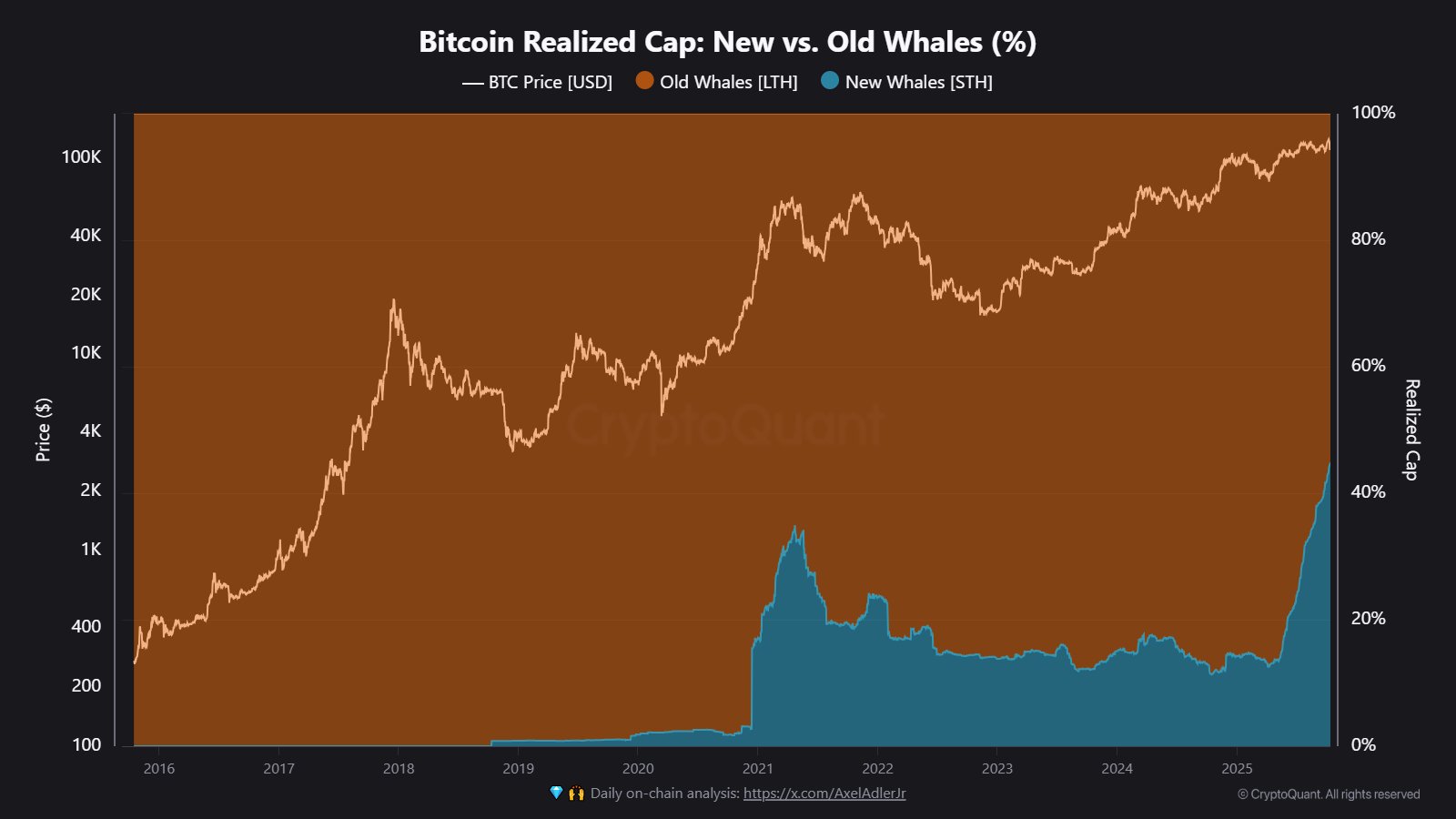
Now, here is the chart shared by Maartunn that shows how the Bitcoin Realized Cap dominance of these two groups has changed over the past decade:
Bitcoin Whale Realized Cap

As displayed in the above graph, new whales have rapidly gained ground in the Bitcoin Realized Cap recently and hit a dominance of 44%. The STH whales represent the big-money capital that has come into the coin over the last 155 days. Thus, it would appear that 44% of the capital stored on the BTC network is currently “fresh.”

This is the largest share of the whale Realized Cap that the STHs alone have occupied in the cryptocurrency’s history. To put things into perspective, the 2021 bull run topped out at a value of 31%.

The STH whales gain Realized Cap dominance through two means: a transfer of coins between members of the cohort at a higher price and selling from the LTH whales.

LTH whales are the resolute hands of the market who hold out through volatile periods in wait for profitable exit opportunities. These smart-money investors usually ramp up their selling during bull runs and transfer their coins to new money coming into Bitcoin. As long as demand is high enough to absorb this distribution, the rally continues, but once capital inflows drop off, the asset hits a top.

So far, the growth in the STH whale Realized Cap share has maintained, but it only remains to be seen how much room is still left.

BTC Price

Bitcoin has been struggling to recover since Friday’s crash as its price is still trading around $111,400.

Bitcoin Price Chart
Market Opportunity
Nowchain Logo
Nowchain Price(NOW)
--
----
USD
Nowchain (NOW) Live Price Chart
Disclaimer: The articles reposted on this site are sourced from public platforms and are provided for informational purposes only. They do not necessarily reflect the views of MEXC. All rights remain with the original authors. If you believe any content infringes on third-party rights, please contact service@support.mexc.com for removal. MEXC makes no guarantees regarding the accuracy, completeness, or timeliness of the content and is not responsible for any actions taken based on the information provided. The content does not constitute financial, legal, or other professional advice, nor should it be considered a recommendation or endorsement by MEXC.

You May Also Like

The Channel Factories We’ve Been Waiting For

The Channel Factories We’ve Been Waiting For

The post The Channel Factories We’ve Been Waiting For appeared on BitcoinEthereumNews.com. Visions of future technology are often prescient about the broad strokes while flubbing the details. The tablets in “2001: A Space Odyssey” do indeed look like iPads, but you never see the astronauts paying for subscriptions or wasting hours on Candy Crush.  Channel factories are one vision that arose early in the history of the Lightning Network to address some challenges that Lightning has faced from the beginning. Despite having grown to become Bitcoin’s most successful layer-2 scaling solution, with instant and low-fee payments, Lightning’s scale is limited by its reliance on payment channels. Although Lightning shifts most transactions off-chain, each payment channel still requires an on-chain transaction to open and (usually) another to close. As adoption grows, pressure on the blockchain grows with it. The need for a more scalable approach to managing channels is clear. Channel factories were supposed to meet this need, but where are they? In 2025, subnetworks are emerging that revive the impetus of channel factories with some new details that vastly increase their potential. They are natively interoperable with Lightning and achieve greater scale by allowing a group of participants to open a shared multisig UTXO and create multiple bilateral channels, which reduces the number of on-chain transactions and improves capital efficiency. Achieving greater scale by reducing complexity, Ark and Spark perform the same function as traditional channel factories with new designs and additional capabilities based on shared UTXOs.  Channel Factories 101 Channel factories have been around since the inception of Lightning. A factory is a multiparty contract where multiple users (not just two, as in a Dryja-Poon channel) cooperatively lock funds in a single multisig UTXO. They can open, close and update channels off-chain without updating the blockchain for each operation. Only when participants leave or the factory dissolves is an on-chain transaction…
Share
BitcoinEthereumNews2025/09/18 00:09
Shanghai residents flock to sell gold as its price hit record highs

Shanghai residents flock to sell gold as its price hit record highs

The post Shanghai residents flock to sell gold as its price hit record highs appeared on BitcoinEthereumNews.com. Gold surged over the $5,500-per-ounce milestone
Share
BitcoinEthereumNews2026/01/31 01:48
UBS Urges Critical Caution On USD Positioning

UBS Urges Critical Caution On USD Positioning

The post UBS Urges Critical Caution On USD Positioning appeared on BitcoinEthereumNews.com. Dollar Weakness Warning: UBS Urges Critical Caution On USD Positioning
Share
BitcoinEthereumNews2026/01/31 02:17