Ethereum co-founder Vitalik Buterin has signaled a renewed commitment to decentralized social networks for 2026, arguing that platforms built on shared, open dataEthereum co-founder Vitalik Buterin has signaled a renewed commitment to decentralized social networks for 2026, arguing that platforms built on shared, open data

Vitalik Buterin Says He’ll Return to Decentralized Social in 2026

Vitalik Buterin Says He'll Return To Decentralized Social In 2026

Ethereum co-founder Vitalik Buterin has signaled a renewed commitment to decentralized social networks for 2026, arguing that platforms built on shared, open data layers are essential to fostering real competition and mass communication that serves users rather than engagement metrics. In a year marked by broader interest in SocialFi, Buterin has redirected much of his online activity toward decentralized platforms, noting that his 2026 posts have been accessed through Firefly, a cross-client interface that unifies access to X, Lens, Farcaster and Bluesky.

“If we want a better society, we need better mass communication tools,” Buterin said, arguing that decentralization enables competition by allowing multiple clients to operate on a shared social data layer. He criticized many crypto-native social projects for relying on speculative tokens as a substitute for meaningful innovation, arguing that SocialFi experiments have repeatedly failed by rewarding pre-existing social capital and short-term price speculation instead of content quality and constructive discourse. He contrasted these efforts with creator-subscription models such as Substack, which he said better align incentives around high-quality content. Calling for broader community participation, he urged users and builders to spend more time in decentralized social ecosystems, saying the industry must move beyond a single centralized “info warzone” and toward a more competitive frontier where new forms of online interaction can emerge.

The state of decentralized social media

Decentralized social media, or SocialFi, refers to platforms built on open or blockchain-based networks where user identities, content and social graphs are not controlled by a single company. While protocols such as Lens and Farcaster have gained early traction, the sector has so far struggled to translate that momentum into sustained mass-market adoption.

On Wednesday, core infrastructure provider Neynar acquired Farcaster from Merkle. Farcaster co-founder Dan Romero announced the news, saying that “after five years, it’s clear Farcaster needs a new approach and leadership to reach its full potential.”

Lens also underwent a leadership transition this week, as Aave transferred stewardship of the open-source social protocol to Mask Network, tasking the Web3 social company with advancing consumer-ready, on-chain social applications.

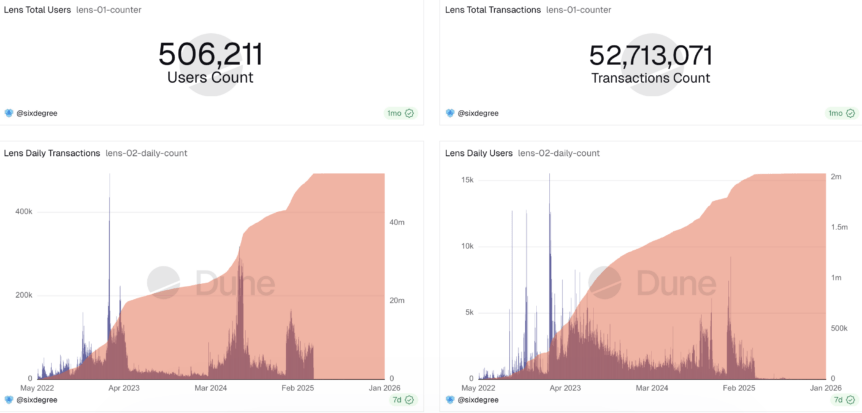
Farcaster features more than two million total registered users and hundreds of thousands of daily interactions, measured by posts and reactions. Lens has accumulated about 506,000 users, according to Dune Analytics data.

Source: Dune Analytics Ethereum, Vitalik Buterin, SocialFiSource: Dune Analytics
This article was originally published as Vitalik Buterin Says He’ll Return to Decentralized Social in 2026 on Crypto Breaking News – your trusted source for crypto news, Bitcoin news, and blockchain updates.

Market Opportunity
LightLink Logo
LightLink Price(LL)
$0.004418
$0.004418$0.004418
-0.06%
USD
LightLink (LL) Live Price Chart
Disclaimer: The articles reposted on this site are sourced from public platforms and are provided for informational purposes only. They do not necessarily reflect the views of MEXC. All rights remain with the original authors. If you believe any content infringes on third-party rights, please contact service@support.mexc.com for removal. MEXC makes no guarantees regarding the accuracy, completeness, or timeliness of the content and is not responsible for any actions taken based on the information provided. The content does not constitute financial, legal, or other professional advice, nor should it be considered a recommendation or endorsement by MEXC.

You May Also Like

U.S. Court Finds Pastor Found Guilty in $3M Crypto Scam

U.S. Court Finds Pastor Found Guilty in $3M Crypto Scam

The post U.S. Court Finds Pastor Found Guilty in $3M Crypto Scam appeared on BitcoinEthereumNews.com. Crime 18 September 2025 | 04:05 A Colorado judge has brought closure to one of the state’s most unusual cryptocurrency scandals, declaring INDXcoin to be a fraudulent operation and ordering its founders, Denver pastor Eli Regalado and his wife Kaitlyn, to repay $3.34 million. The ruling, issued by District Court Judge Heidi L. Kutcher, came nearly two years after the couple persuaded hundreds of people to invest in their token, promising safety and abundance through a Christian-branded platform called the Kingdom Wealth Exchange. The scheme ran between June 2022 and April 2023 and drew in more than 300 participants, many of them members of local church networks. Marketing materials portrayed INDXcoin as a low-risk gateway to prosperity, yet the project unraveled almost immediately. The exchange itself collapsed within 24 hours of launch, wiping out investors’ money. Despite this failure—and despite an auditor’s damning review that gave the system a “0 out of 10” for security—the Regalados kept presenting it as a solid opportunity. Colorado regulators argued that the couple’s faith-based appeal was central to the fraud. Securities Commissioner Tung Chan said the Regalados “dressed an old scam in new technology” and used their standing within the Christian community to convince people who had little knowledge of crypto. For him, the case illustrates how modern digital assets can be exploited to replicate classic Ponzi-style tactics under a different name. Court filings revealed where much of the money ended up: luxury goods, vacations, jewelry, a Range Rover, high-end clothing, and even dental procedures. In a video that drew worldwide attention earlier this year, Eli Regalado admitted the funds had been spent, explaining that a portion went to taxes while the remainder was used for a home renovation he claimed was divinely inspired. The judgment not only confirms that INDXcoin qualifies as a…
Share
BitcoinEthereumNews2025/09/18 09:14
What is the 80 20 rule for Airbnb? A practical guide for hosts
What is the 80 20 rule for Airbnb? A practical guide for hosts

This article explains the 80 20 idea as a practical heuristic for Airbnb hosts and shows how it links to realistic, low-cash ways people gain control of short-term
Share
Coinstats2026/01/31 08:42
Why ZKP Ranks Among the Best New Cryptos to Buy With Fair Design and Private Compute

Why ZKP Ranks Among the Best New Cryptos to Buy With Fair Design and Private Compute

While many investors focus on the latest trending tokens, ZKP has been steadily building a foundation with lasting value. By combining real hardware, verifiable
Share
Techbullion2026/01/31 09:00