

Bitmine Stakes Additional 250,912 Ethereum Worth $745M – 61% Is Now Staked
Ethereum has slipped below the $3,000 level, extending a period of fragile price action as the broader crypto market remains cautious. While spot prices continue to struggle with overhead resistance, on-chain data points to a notable divergence between market sentiment and long-term positioning. According to data from Arkham, Bitmine has staked an additional 250,912 ETH—worth roughly $745 million—over the past 18 hours, adding to an already substantial locked position.
This move brings renewed attention to the behavior of large, well-capitalized players during periods of price weakness. Staking activity of this magnitude suggests that some participants are prioritizing yield generation and long-term exposure over short-term price fluctuations. Rather than distributing holdings into market rallies, these entities are choosing to remove supply from circulation, tightening liquid availability while accepting reduced flexibility.
The contrast is notable. Ethereum’s price is trading below a key psychological threshold, yet capital continues to flow into staking contracts at scale. This dynamic highlights the growing structural role of Ethereum’s proof-of-stake model, where investment decisions are increasingly driven by network participation and cash-flow–like returns, not only price appreciation.
As Ethereum consolidates below $3,000, the key question is whether sustained staking demand can offset weak spot momentum, or if price will need to stabilize further before confidence returns across the broader market.
Large-Scale Staking Tightens Liquid Ethereum Supply
According to data from Arkham, Bitmine has now staked a total of 2,582,963 ETH, valued at approximately $7.67 billion. This represents about 61% of its total Ethereum holdings, a level that underscores how aggressively large holders are committing capital to long-term network participation rather than maintaining liquid exposure.

This behavior is particularly notable given the current market context. Ethereum remains below the $3,000 level, volatility is elevated, and leverage metrics suggest fragile positioning among short-term traders. Despite this, Bitmine’s decision to stake a majority of its ETH indicates a clear preference for yield generation and balance-sheet efficiency over tactical trading. Staking effectively removes ETH from active circulation, tightening the available supply and capping sell-side pressure from these large wallets.
At the same time, Ethereum balances held on exchanges have continued to trend lower, reinforcing the picture of constrained liquid supply. While declining exchange balances do not guarantee upward price movement, they do suggest that fewer coins are readily available to meet sudden sell demand. In this environment, price action becomes more sensitive to marginal flows, particularly during periods of stress or renewed demand.
The combination of large-scale staking and shrinking exchange reserves points to a market where long-term holders are locking in exposure. Even as short-term sentiment remains cautious. Whether this structural tightening of supply translates into price support will depend on broader risk conditions and the return of sustained spot demand.
ETH Consolidates Below Key Moving Averages
Ethereum’s price action reflects a market caught between weakening momentum and an attempt to stabilize after a prolonged correction. On the daily chart, ETH is trading near the $2,900–$3,000 zone, a level that has acted as both psychological support and a pivot area in recent weeks. The rejection from higher levels earlier in the quarter confirmed a clear sequence of lower highs, keeping the broader structure tilted to the downside.
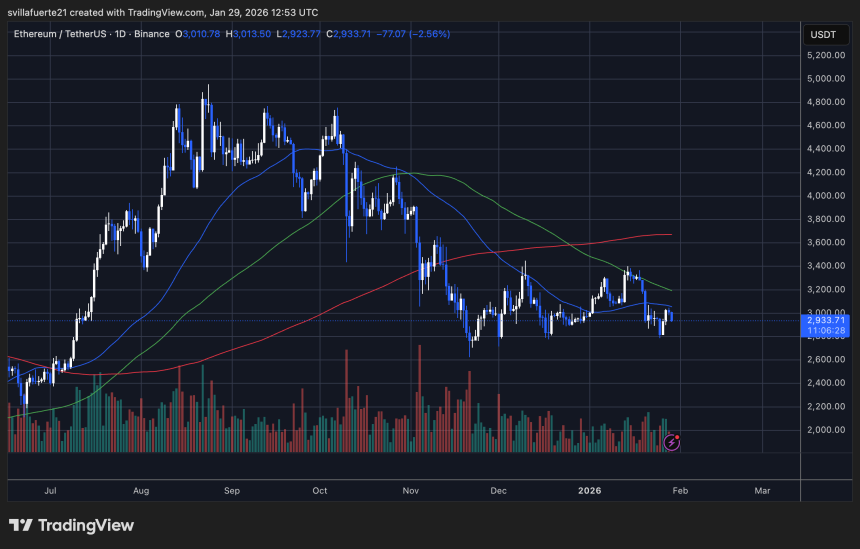
From a trend perspective, ETH remains below its key moving averages. The 50-day average has rolled over and sits above the price. Reinforcing short-term bearish pressure, while the 100-day average continues to slope downward. Acting as dynamic resistance near the $3,200–$3,300 area.
The 200-day moving average is still rising but flattening. Is positioned higher and signals that long-term trend support has not yet been reclaimed. Until ETH can close decisively above the 50- and 100-day averages, upside attempts are likely to remain corrective rather than impulsive.
Volume dynamics add context to this consolidation. Selling pressure during the latest pullback was notable but not extreme, suggesting distribution rather than panic. Since then, volume has contracted, consistent with a market entering a compression phase. This points to indecision rather than aggressive accumulation.
Overall, ETH is consolidating below major resistance while holding a fragile support band near $2,800–$2,900. A sustained loss of this zone would expose downside risk. While any recovery requires a reclaim of key moving averages to shift the structure toward stabilization.
Featured image from ChatGPT, chart from TradingView.com
You May Also Like

The Channel Factories We’ve Been Waiting For

Shanghai residents flock to sell gold as its price hit record highs
