On January 30, the XRP price crashed sharply, reflecting rising investor anxiety over the economic outlook. Market jitters fueled by postponed U.S. inflation reportsOn January 30, the XRP price crashed sharply, reflecting rising investor anxiety over the economic outlook. Market jitters fueled by postponed U.S. inflation reports

XRP price prediction ahead of US PCE inflation data and government shutdown risks

On January 30, the XRP price crashed sharply, reflecting rising investor anxiety over the economic outlook.

Table of Contents

  • Macroeconomic pressure builds

Market jitters fueled by postponed U.S. inflation reports and potential government shutdowns drove heavy selling in the cryptocurrency market.

Summary
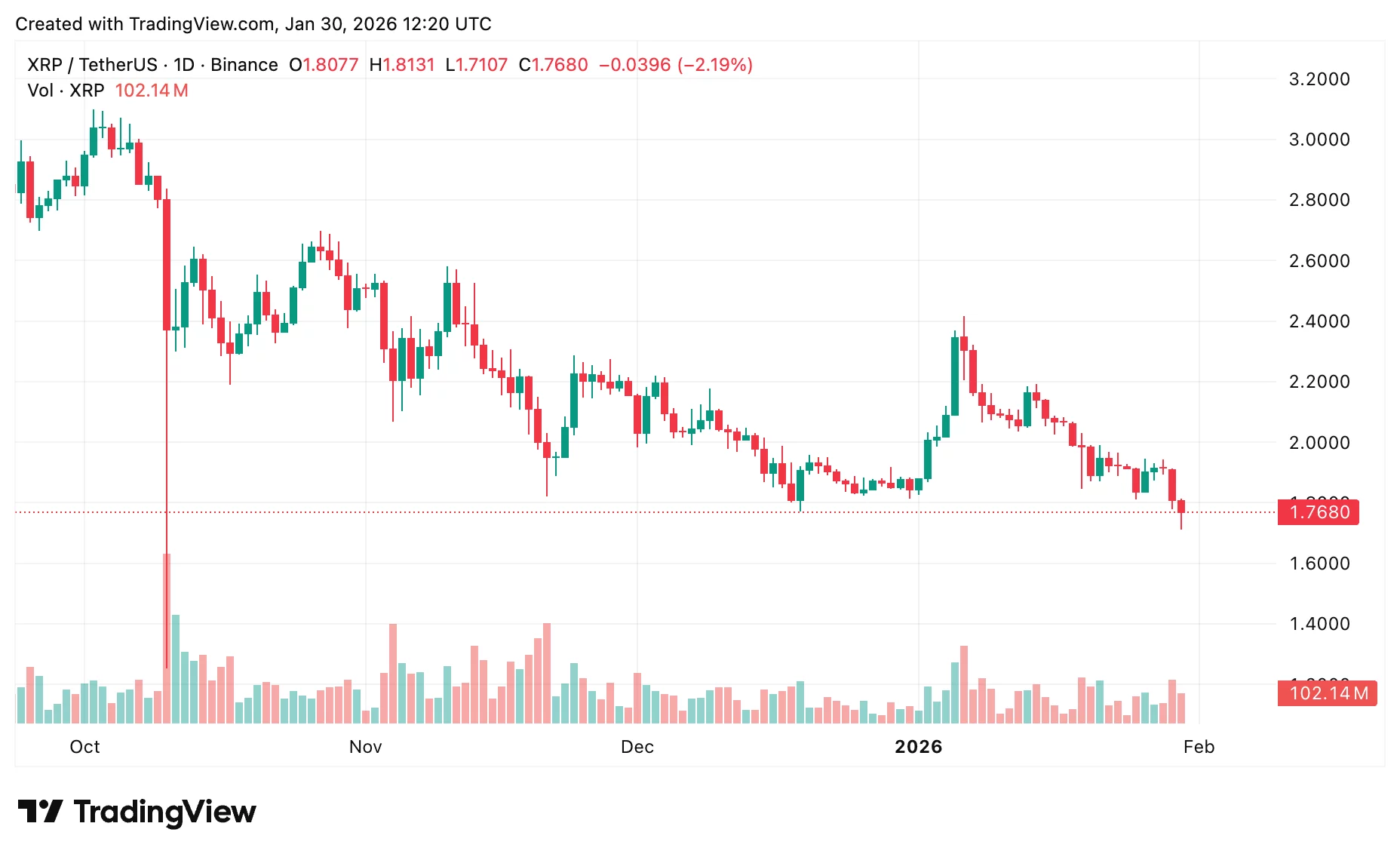
  • On January 30, the XRP price dropped sharply to around $1.75 at last check, reflecting rising investor anxiety over economic uncertainty.
  • Near-term XRP volatility is expected, with the price prediction largely dependent on political and macroeconomic developments.
  • Technically, a daily close below $1.80 could push XRP toward $1.60–$1.50, while a rebound requires a close above $1.83.

Macroeconomic pressure builds

After failing to hold the $1.86–$1.87 support area on January 29, selling pressure increased, sending the price down to $1.73 the next day. At the time of writing, Ripple (XRP) is down close to 5.4% in 24 hours.
XRP price prediction ahead of US PCE inflation data and government shutdown risks - 2

The drop came after the Federal Reserve decided to hold interest rates steady, keeping the federal funds rate between 3.5% and 3.75%. While this was largely anticipated, uncertainty about the Fed’s next moves continues to weigh on investor sentiment.

Complicating the outlook is the ongoing distortion of U.S. economic data caused by earlier government shutdowns. Several key reports remain delayed, including the Fed’s preferred inflation gauge, the Personal Consumption Expenditures (PCE) Index, which will stay a month behind until April. This lack of timely data makes it more difficult for policymakers to confidently adjust rates.

The Bureau of Economic Analysis recently released a combined PCE report for October and November, showing inflation rose 2.8% year over year (excluding food and energy) and 0.2% month over month, largely in line with expectations. However, uncertainty has resurfaced as the current funding resolution expires on January 30, raising the risk of another partial government shutdown.

Federal Reserve Chair Jerome Powell noted that the U.S. is only now moving past data distortions caused by the previous six-week shutdown. Another lapse in funding could disrupt inflation data collection again, potentially affecting the quality of February’s CPI report.

XRP price prediction based on current levels

The near-term XRP outlook looks pretty bearish right now. If the price closes below $1.80 on a daily chart, it could open the door for a drop toward $1.60, and if sellers keep pushing, $1.50 isn’t out of the question.

On the flip side, XRP would need to break $1.83 on a daily close to show any short-term signs of recovery. Without some positive news on the macro front, it’s hard to see much upside right now.

What comes next?

According to current XRP forecasts, the cryptocurrency could see a bumpy ride in the near term due to political uncertainty, delayed U.S. inflation reports, and other macroeconomic headwinds. While XRP remains fundamentally appealing over the long term, the immediate XRP price prediction will hinge on how these risks play out.

Disclaimer: The articles reposted on this site are sourced from public platforms and are provided for informational purposes only. They do not necessarily reflect the views of MEXC. All rights remain with the original authors. If you believe any content infringes on third-party rights, please contact service@support.mexc.com for removal. MEXC makes no guarantees regarding the accuracy, completeness, or timeliness of the content and is not responsible for any actions taken based on the information provided. The content does not constitute financial, legal, or other professional advice, nor should it be considered a recommendation or endorsement by MEXC.

You May Also Like

Saudi Awwal Bank Adopts Chainlink Tools, LINK Near $23

Saudi Awwal Bank Adopts Chainlink Tools, LINK Near $23

The post Saudi Awwal Bank Adopts Chainlink Tools, LINK Near $23 appeared on BitcoinEthereumNews.com. SAB adopts Chainlink’s CCIP and CRE to expand tokenization and cross-border finance tools. SAB and Wamid target $2.32T Saudi capital markets with blockchain-based tokenization plans. LINK price falls 2.43% to $22.99 despite higher trading volume and steady liquidity ratios. Saudi Awwal Bank has added Chainlink’s Cross-Chain Interoperability Protocol (CCIP) and the Chainlink Runtime Environment (CRE) to its digital strategy. CCIP links assets and data across multiple blockchains, while CRE provides banks with a controlled framework to test and deploy new financial applications. The lender, with more than $100 billion in assets, is applying the tools to tokenized assets, cross-border settlement, and automated credit platforms. The move signals that Chainlink’s infrastructure is being adopted at scale inside regulated finance. Related: Chainlink’s Deal with SBI Is a Major Win, But Chart Shows LINK’s Battle at $27 Resistance Wamid Partnership Aims at $2.32 Trillion Markets In parallel, SAB signed an agreement with Wamid, a subsidiary of the Saudi Tadawul Group, to pilot tokenization of the Saudi Exchange’s $2.32 trillion capital markets. The focus is on equities and debt products, opening the door for blockchain-based issuance and settlement. SAB has already executed the world’s first Islamic repo on distributed ledger technology, in collaboration with Oumla earlier this year. That transaction gave regulators a template for compliant on-chain contracts. The Wamid deal builds directly on that precedent, shifting from single-instrument pilots toward broader capital markets integration. Saudi Blockchain Buildout Gains Pace Saudi institutions are building multiple layers of digital infrastructure. Oumla is working with Avalanche to develop the Kingdom’s first domestically hosted Layer 1 blockchain. SAB’s Chainlink adoption adds an interoperability and execution layer on top. Together, these projects are shaping a domestic framework for tokenization, with global connectivity added only where liquidity requires it. LINK Price and Liquidity Snapshot While institutional adoption progresses, Chainlink’s…
Share
BitcoinEthereumNews2025/09/18 08:49
What is the 80 20 rule for Airbnb? A practical guide for hosts

What is the 80 20 rule for Airbnb? A practical guide for hosts

This article explains the 80 20 idea as a practical heuristic for Airbnb hosts and shows how it links to realistic, low-cash ways people gain control of short-term
Share
Coinstats2026/01/31 08:42
Why ZKP Ranks Among the Best New Cryptos to Buy With Fair Design and Private Compute

Why ZKP Ranks Among the Best New Cryptos to Buy With Fair Design and Private Compute

While many investors focus on the latest trending tokens, ZKP has been steadily building a foundation with lasting value. By combining real hardware, verifiable
Share
Techbullion2026/01/31 09:00