

CZ Responds After Bitcoin Briefly ‘Crashes’ To $24,000 On Binance
Changpeng “CZ” Zhao pushed back after a screenshot showing bitcoin at roughly $24,111 on Binance went viral on X, arguing the move was a microstructure glitch on a thin, newly listed BTC/USD1 pair rather than a broader market crash and that the exchange itself “is NOT involved in trades.”
Did Bitcoin Really Crash To $24,000?
The sharp wick appeared isolated to BTC/USD1, a market quoted in USD1, a stablecoin launched by Trump family-backed World Liberty Financial. Within seconds, the pair snapped back toward prevailing bitcoin prices above $87,000, according to exchange data cited by traders sharing the screenshot.
CZ’s explanation was straightforward: on an illiquid order book, a single aggressive order can print an extreme price before arbitrage closes the gap. “This actually shows the exchange is NOT involved in trades. Low liquidity on new pairs means one large market order can spike prices, but arbitrageurs quickly corrected it. No liquidations occurred, as this pair isn’t included in any index.”
The Binance founder shared a breakdown from Head of Business Development of Solv Protocol Catherine Chan who said the move was “a liquidity event,” not a bitcoin collapse. She tied the dislocation to a Binance-and-USD1 promotion offering a 20% fixed APY deposit deal that, she claimed, pushed users to swap USDT into USD1 and briefly drove USD1 to a premium.
“Many users swapped USDT → USD1, pushing USD1 to a 0.39% premium: huge for a stablecoin. Smart money borrowed USD1 on @lista_dao against SolvBTC or SolvBTC-BTCB smart lending markets (~0.5% APY). They either deposited USD1 directly or sold it slowly on spot to meet demand. Then someone thought: ‘Why not just sell via BTC/USD1?’ They used a market order. Problem: BTC/USD1 has very thin liquidity. That market order wiped out most buy orders, briefly causing a very low price,” Catherine explained.
“Arbitrage bots instantly bought it back,” she wrote. “No fundamentals changed. No mass liquidations.”
The episode also picked up a familiar edge of crypto paranoia. One user, Bera (@doomsdart), framed it as a coordinated signal: “Cz and Trump family are telling us what they’re gonna do to our coins. Get ready.” CZ’s reply, by contrast, suggested the opposite — that the speed of arbitrage, and the absence of cascading liquidations, is evidence the venue wasn’t “printing” a market-wide price at all.
For traders, the takeaway is less dramatic than the screenshot implied, but still relevant: new quote-asset pairs can be structurally fragile, and promotions that rapidly concentrate flow into a single stablecoin can leave unusually thin order books in their wake. In that kind of market, a single market order can create a headline before it creates a trend.
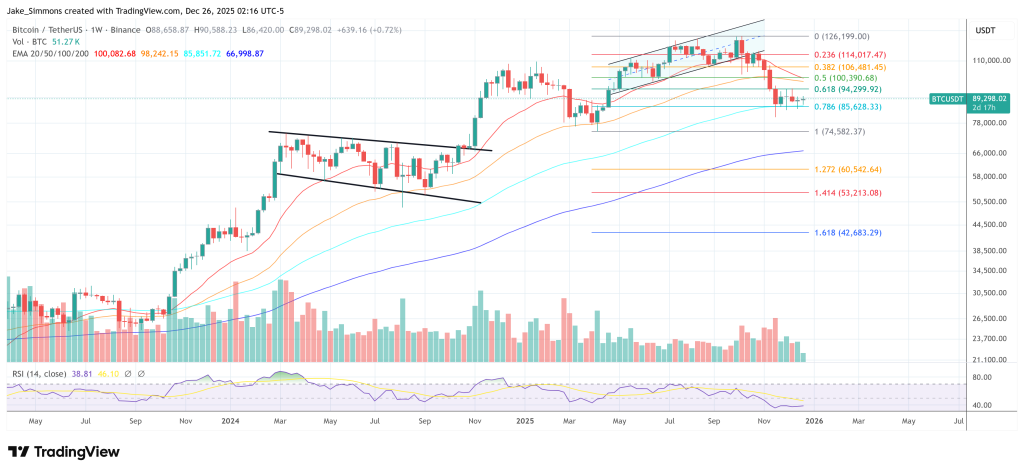
At press time, Bitcoin traded at $89,298.
You May Also Like

Markets await Fed’s first 2025 cut, experts bet “this bull market is not even close to over”

Vitalik Slams EU ‘No-Space’ Rules, Fuels Privacy Coin Debate
