A Saga is a sequence of local transactions.A Saga is a sequence of local transactions.

A Practical Guide to the Saga Pattern in Spring Boot Microservices

Modern microservices are small, autonomous, and independently deployable — but this also creates a huge problem.

Typical pharmacy prescription management - payments, banking, logistics, supply-chain, or booking systems perform operations across multiple microservices

  • Create Order
  • Reserve Inventory
  • Process Payment
  • Create Shipment
  • Update Loyalty Points

Each runs in its own database, service, and network boundary.

If one operation fails halfway, the entire business flow should not leave the system in an inconsistent state.

This is where the Saga Pattern becomes essential.

What is a Saga? Why Not Use ACID?

A Saga is a sequence of local transactions. \n Each local transaction updates data within one service and publishes an event to trigger the next step.

If a failure occurs:

  • The Saga triggers compensation actions to undo previously completed steps.

Why does ACID (2PC) not work in microservices?

| Problem | Explanation | |:---:|:---:| | 2PC is blocking | If the coordinator crashes, everything hangs. | | Microservices have independent DBs | No shared commit log across distributed DBs. | | Scales poorly | Locks span distributed systems. | | Cloud services do not support XA transactions | DynamoDB, S3, Mongo, Kafka, RDS, etc. |

A Saga avoids these issues with event-driven or orchestrated compensation logic.

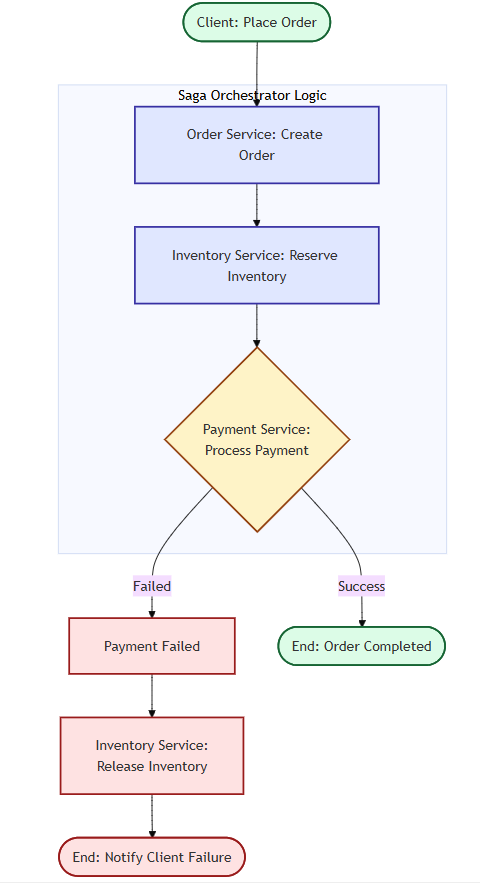
Saga Architecture Diagram:

\ Architecture
1. Use Case: Pharmacy Prescription Order Processing

Scenario

Imagine a Pharmacy Prescription Online platform where a customer places an order for a product.

The system involves three independent services:

  1. Order Service – Creates the order record.
  2. Inventory Service – Reserves the product in stock.
  3. Payment Service – Charges the customer.

Problem Without Saga

If one of these steps fails (e.g., payment fails), the previous steps might leave the system in an inconsistent state:

  • Order created
  • Inventory reserved
  • Payment failed
  • Result: Inventory stuck, order incomplete, manual intervention required.

This is unacceptable in enterprise systems, especially when multiple microservices interact.

Solution With Saga

Using a Saga Orchestration Pattern, each service executes its local transaction, and in case of failure, compensation actions roll back previous steps

  • Step 1: Order Service creates an order.
  • Step 2: Inventory Service reserves stock.
  • Step 3: The payment service charges the customer.
  • Failure Handling: If payment fails, the orchestrator calls the Inventory Service to release stock.

This ensures business-level consistency across services.

2. Why We Need the Saga Pattern

  1. Distributed Microservices: Traditional ACID transactions cannot span multiple microservices.
  2. Eventual Consistency: Ensures consistent outcomes without requiring global resource locking.
  3. Fault Tolerance: Automatically rolls back previous steps if a later step fails.
  4. Cloud-Native: Works seamlessly with scalable services in cloud environments.

Loose Coupling: Each service remains independent, communicating only through APIs.

3. Advantages of Using Saga

  • Reliability: Compensating transactions prevent data inconsistencies.
  • Scalability: Each service can scale independently; orchestration is centralized.
  • Resilience: Handles partial failures gracefully.
  • Business-Level Consistency: Focuses on correct business outcomes, not strict database consistency.
  • Monitoring and Debugging: The central orchestrator provides clear logs of each transaction step.

4. Step-by-Step Explanation of the Script

Below is a detailed walkthrough of the key script components from your Spring Boot Saga project.

4.1 Order Model (Order.java)

\

package com.example.orderservice; public class Order {     private Long id;     private String product;     private String status;     public Order() {         // default constructor (required for Jackson)     }     public Order(Long id, String product, String status) {         this.id = id;         this.product = product;         this.status = status;     }     public Long getId() {         return id;     }     public void setId(Long id) {         this.id = id;     }     public String getProduct() {         return product;     }     public void setProduct(String product) {         this.product = product;     }     public String getStatus() {         return status;     }     public void setStatus(String status) {         this.status = status;     } }

  • Purpose: Represents an order.

  • Business Logic: Stores the product name, order ID, and status (CREATED, CANCELLED, COMPLETED).

    4.2 Order Controller (OrderController.java)

    \

package com.example.orderservice; import org.springframework.web.bind.annotation.*; @RestController @RequestMapping("/orders") public class OrderController {     @PostMapping     public Order create(@RequestParam("product") String product) {         return new Order(1L, product, "CREATED");     }     @PostMapping("/cancel")     public String cancel() {         return "ORDER_CANCELLED";     }     @PostMapping("/complete")     public String complete() {         return "ORDER_COMPLETED";     } }

\

  • Endpoints

  • POST /orders → Creates an order.

  • POST /orders/cancel → Cancels an order (used for compensation).

  • POST /orders/complete → Marks order completed.

  • Why it works with Saga: Endpoints are simple, predictable, and return either the object or a status string for orchestration.

    4.3 Inventory Controller (InventoryController.java)

    \

package com.example.inventoryservice; import org.springframework.web.bind.annotation.*; @RestController @RequestMapping("/inventory") public class InventoryController {     @PostMapping("/reserve")     public boolean reserve(@RequestParam("product") String product) {         return !"FAIL".equals(product);     }     @PostMapping("/release")     public void release(@RequestParam("product") String product) {} }

\

  • Purpose: Reserves product in stock, releases it if payment fails.

  • Logic: Simulates success/failure. In enterprise systems, this would check actual stock in a database.

    \ 4.4. Payment Controller (PaymentController.java)

    \

package com.example.paymentservice; import org.springframework.web.bind.annotation.*; @RestController @RequestMapping("/payments") public class PaymentController {     @PostMapping("/pay")     public boolean pay(@RequestParam("amount") double amount) {         return amount <= 5000;     }     @PostMapping("/refund")     public void refund(@RequestParam double amount) {} }

\

  • Purpose: Processes payment and simulates failure for testing.

  • Why it works in Saga: Returns a Boolean indicating success/failure, allowing the orchestrator to trigger compensations.

    4.5. Saga Orchestrator (SagaController.java)

    \

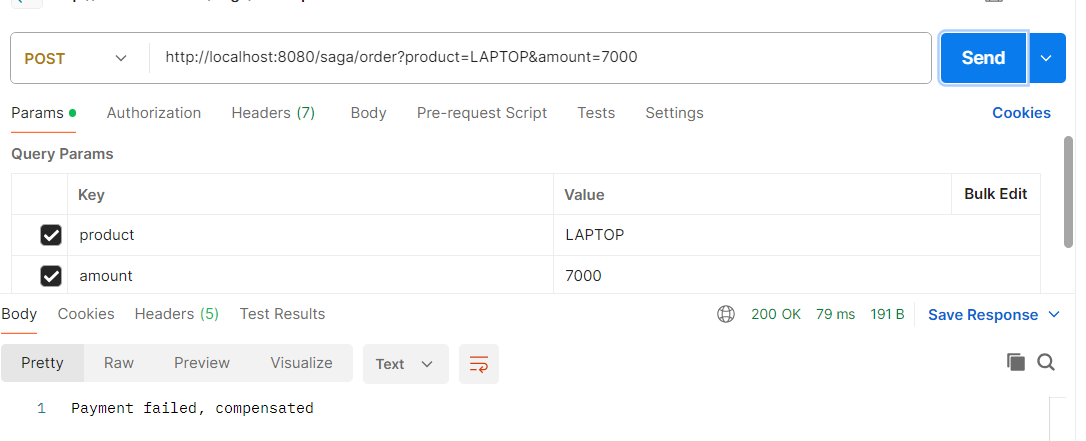
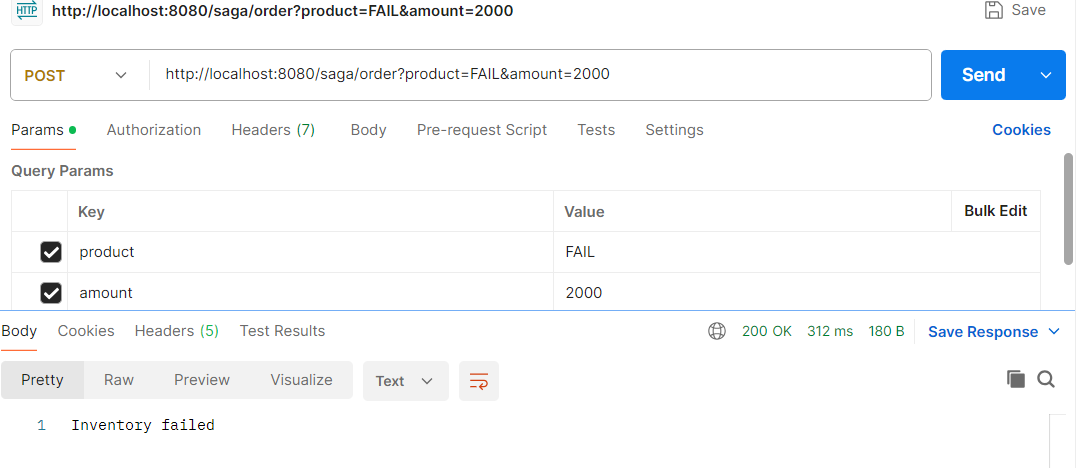
package com.example.sagaorchestrator; import org.springframework.web.bind.annotation.*; import org.springframework.web.client.RestTemplate; @RestController @RequestMapping("/saga") public class SagaController {     private final RestTemplate rest = new RestTemplate();     @PostMapping("/order")     public String place(@RequestParam("product") String product, @RequestParam("amount") double amount) {         Object order = rest.postForObject(                 "http://localhost:8081/orders?product=" + product,                 null,                 Object.class         );                  if (order == null) {             return "Order creation failed";         }         Boolean inventory = rest.postForObject(             "http://localhost:8082/inventory/reserve?product=" + product,             null,             Boolean.class         );         if (inventory == null || !inventory) {             return "Inventory failed";         }         Boolean payment = rest.postForObject(             "http://localhost:8083/payments/pay?amount=" + amount,             null,             Boolean.class         );         if (payment == null || !payment) {             rest.postForObject(                     "http://localhost:8082/inventory/release?product=" + product,                     null,                     Void.class             );             return "Payment failed, compensated";         }         return "Order completed successfully";     } }

\

  • Flow Explained
  1. Order creation → First step, must succeed to proceed.
  2. Inventory reservation → If it fails, the saga stops.
  3. Payment processing → If it fails, the orchestrator triggers inventory release (compensation).
  4. Success → Returns a success message.

Enterprise Ready: Demonstrates clear orchestration, compensation, and business-level consistency.

\ 4.6 Verification of Outputs

\

  1. Success Case

\

  1. Payment Failure Case

\ Postman

\

  1. Inventory Failure Case:

\ ** Postman

5. Advantages Highlighted

  • Fault-Tolerant: Automatically compensates failed transactions.
  • Business Consistency: Ensures the order state and inventory are always consistent.
  • Scalable: Each service runs independently.
  • Cloud-Native Ready: Can run on Kubernetes or any cloud environment.
  • Enterprise Applicable: Matches real-world systems in healthcare, banking, and data platforms.

6. Why Enterprises Need This Pattern

  • In distributed systems, manual rollback is error-prone.
  • Saga ensures automatic recovery, reducing downtime.
  • Prevents inconsistent data in multi-service workflows.
  • Supports asynchronous processing, improving performance and scalability.

\

Market Opportunity
SAGA Logo
SAGA Price(SAGA)
$0.06023
$0.06023$0.06023
+2.99%
USD
SAGA (SAGA) Live Price Chart
Disclaimer: The articles reposted on this site are sourced from public platforms and are provided for informational purposes only. They do not necessarily reflect the views of MEXC. All rights remain with the original authors. If you believe any content infringes on third-party rights, please contact service@support.mexc.com for removal. MEXC makes no guarantees regarding the accuracy, completeness, or timeliness of the content and is not responsible for any actions taken based on the information provided. The content does not constitute financial, legal, or other professional advice, nor should it be considered a recommendation or endorsement by MEXC.

You May Also Like

Will XRP Price Increase In September 2025?

Will XRP Price Increase In September 2025?

Ripple XRP is a cryptocurrency that primarily focuses on building a decentralised payments network to facilitate low-cost and cross-border transactions. It’s a native digital currency of the Ripple network, which works as a blockchain called the XRP Ledger (XRPL). It utilised a shared, distributed ledger to track account balances and transactions. What Do XRP Charts Reveal? […]
Share
Tronweekly2025/09/18 00:00
Ripple IPO Back in Spotlight as Valuation Hits $50B

Ripple IPO Back in Spotlight as Valuation Hits $50B

The post Ripple IPO Back in Spotlight as Valuation Hits $50B appeared first on Coinpedia Fintech News Ripple, the blockchain payments company behind XRP, is once
Share
CoinPedia2025/12/27 14:24
Lovable AI’s Astonishing Rise: Anton Osika Reveals Startup Secrets at Bitcoin World Disrupt 2025

Lovable AI’s Astonishing Rise: Anton Osika Reveals Startup Secrets at Bitcoin World Disrupt 2025

BitcoinWorld Lovable AI’s Astonishing Rise: Anton Osika Reveals Startup Secrets at Bitcoin World Disrupt 2025 Are you ready to witness a phenomenon? The world of technology is abuzz with the incredible rise of Lovable AI, a startup that’s not just breaking records but rewriting the rulebook for rapid growth. Imagine creating powerful apps and websites just by speaking to an AI – that’s the magic Lovable brings to the masses. This groundbreaking approach has propelled the company into the spotlight, making it one of the fastest-growing software firms in history. And now, the visionary behind this sensation, co-founder and CEO Anton Osika, is set to share his invaluable insights on the Disrupt Stage at the highly anticipated Bitcoin World Disrupt 2025. If you’re a founder, investor, or tech enthusiast eager to understand the future of innovation, this is an event you cannot afford to miss. Lovable AI’s Meteoric Ascent: Redefining Software Creation In an era where digital transformation is paramount, Lovable AI has emerged as a true game-changer. Its core premise is deceptively simple yet profoundly impactful: democratize software creation. By enabling anyone to build applications and websites through intuitive AI conversations, Lovable is empowering the vast majority of individuals who lack coding skills to transform their ideas into tangible digital products. This mission has resonated globally, leading to unprecedented momentum. The numbers speak for themselves: Achieved an astonishing $100 million Annual Recurring Revenue (ARR) in less than a year. Successfully raised a $200 million Series A funding round, valuing the company at $1.8 billion, led by industry giant Accel. Is currently fielding unsolicited investor offers, pushing its valuation towards an incredible $4 billion. As industry reports suggest, investors are unequivocally “loving Lovable,” and it’s clear why. This isn’t just about impressive financial metrics; it’s about a company that has tapped into a fundamental need, offering a solution that is both innovative and accessible. The rapid scaling of Lovable AI provides a compelling case study for any entrepreneur aiming for similar exponential growth. The Visionary Behind the Hype: Anton Osika’s Journey to Innovation Every groundbreaking company has a driving force, and for Lovable, that force is co-founder and CEO Anton Osika. His journey is as fascinating as his company’s success. A physicist by training, Osika previously contributed to the cutting-edge research at CERN, the European Organization for Nuclear Research. This deep technical background, combined with his entrepreneurial spirit, has been instrumental in Lovable’s rapid ascent. Before Lovable, he honed his skills as a co-founder of Depict.ai and a Founding Engineer at Sana. Based in Stockholm, Osika has masterfully steered Lovable from a nascent idea to a global phenomenon in record time. His leadership embodies a unique blend of profound technical understanding and a keen, consumer-first vision. At Bitcoin World Disrupt 2025, attendees will have the rare opportunity to hear directly from Osika about what it truly takes to build a brand that not only scales at an incredible pace in a fiercely competitive market but also adeptly manages the intense cultural conversations that inevitably accompany such swift and significant success. His insights will be crucial for anyone looking to understand the dynamics of high-growth tech leadership. Unpacking Consumer Tech Innovation at Bitcoin World Disrupt 2025 The 20th anniversary of Bitcoin World is set to be marked by a truly special event: Bitcoin World Disrupt 2025. From October 27–29, Moscone West in San Francisco will transform into the epicenter of innovation, gathering over 10,000 founders, investors, and tech leaders. It’s the ideal platform to explore the future of consumer tech innovation, and Anton Osika’s presence on the Disrupt Stage is a highlight. His session will delve into how Lovable is not just participating in but actively shaping the next wave of consumer-facing technologies. Why is this session particularly relevant for those interested in the future of consumer experiences? Osika’s discussion will go beyond the superficial, offering a deep dive into the strategies that have allowed Lovable to carve out a unique category in a market long thought to be saturated. Attendees will gain a front-row seat to understanding how to identify unmet consumer needs, leverage advanced AI to meet those needs, and build a product that captivates users globally. The event itself promises a rich tapestry of ideas and networking opportunities: For Founders: Sharpen your pitch and connect with potential investors. For Investors: Discover the next breakout startup poised for massive growth. For Innovators: Claim your spot at the forefront of technological advancements. The insights shared regarding consumer tech innovation at this event will be invaluable for anyone looking to navigate the complexities and capitalize on the opportunities within this dynamic sector. Mastering Startup Growth Strategies: A Blueprint for the Future Lovable’s journey isn’t just another startup success story; it’s a meticulously crafted blueprint for effective startup growth strategies in the modern era. Anton Osika’s experience offers a rare glimpse into the practicalities of scaling a business at breakneck speed while maintaining product integrity and managing external pressures. For entrepreneurs and aspiring tech leaders, his talk will serve as a masterclass in several critical areas: Strategy Focus Key Takeaways from Lovable’s Journey Rapid Scaling How to build infrastructure and teams that support exponential user and revenue growth without compromising quality. Product-Market Fit Identifying a significant, underserved market (the 99% who can’t code) and developing a truly innovative solution (AI-powered app creation). Investor Relations Balancing intense investor interest and pressure with a steadfast focus on product development and long-term vision. Category Creation Carving out an entirely new niche by democratizing complex technologies, rather than competing in existing crowded markets. Understanding these startup growth strategies is essential for anyone aiming to build a resilient and impactful consumer experience. Osika’s session will provide actionable insights into how to replicate elements of Lovable’s success, offering guidance on navigating challenges from product development to market penetration and investor management. Conclusion: Seize the Future of Tech The story of Lovable, under the astute leadership of Anton Osika, is a testament to the power of innovative ideas meeting flawless execution. Their remarkable journey from concept to a multi-billion-dollar valuation in record time is a compelling narrative for anyone interested in the future of technology. By democratizing software creation through Lovable AI, they are not just building a company; they are fostering a new generation of creators. His appearance at Bitcoin World Disrupt 2025 is an unmissable opportunity to gain direct insights from a leader who is truly shaping the landscape of consumer tech innovation. Don’t miss this chance to learn about cutting-edge startup growth strategies and secure your front-row seat to the future. Register now and save up to $668 before Regular Bird rates end on September 26. To learn more about the latest AI market trends, explore our article on key developments shaping AI features. This post Lovable AI’s Astonishing Rise: Anton Osika Reveals Startup Secrets at Bitcoin World Disrupt 2025 first appeared on BitcoinWorld.
Share
Coinstats2025/09/17 23:40