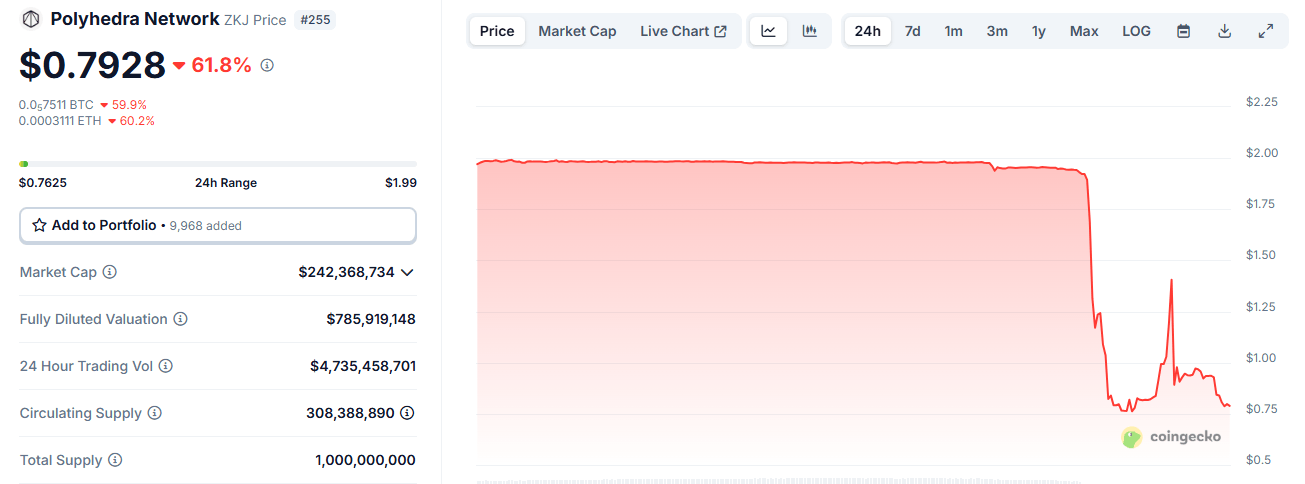
On June 15, ZKJ, the native token of Polyhedra Network, suffered a sudden and steep collapse, plunging more than 60% from $1.98 to a record low of $0.7625 in just under two hours. ZKJ Revival Short-Lived On June 15, ZKJ, the native token of Polyhedra Network, suffered a flash crash, plummeting by more than 60% […]On June 15, ZKJ, the native token of Polyhedra Network, suffered a sudden and steep collapse, plunging more than 60% from $1.98 to a record low of $0.7625 in just under two hours. ZKJ Revival Short-Lived On June 15, ZKJ, the native token of Polyhedra Network, suffered a flash crash, plummeting by more than 60% […]

ZKJ Token Plummets More Than 60% in Flash Crash Amid Rug-Pull Allegations

On June 15, ZKJ, the native token of Polyhedra Network, suffered a sudden and steep collapse, plunging more than 60% from $1.98 to a record low of $0.7625 in just under two hours.

ZKJ Revival Short-Lived

On June 15, ZKJ, the native token of Polyhedra Network, suffered a flash crash, plummeting by more than 60% in less than two hours. What began as a sudden drop from $1.98 cascaded to an all-time low of $0.7625, according to Coingecko data. While the token showed a fleeting sign of recovery, briefly surging to $1.41, this rally proved short-lived. At the time of writing ( June 15, 12:40 p.m. EST), the Polyhedra Network native token had retreated once more, languishing just below the $0.80 mark.
ZKJ Token Plummets More Than 60% in Flash Crash Amid Rug-Pull Allegations

Coinmarketcap data painted an even bleaker picture, indicating a staggering 80% freefall for Polyhedra Network’s token, which nosedived from approximately $1.94 to a jarring $0.33. This plunge decimated the token’s market capitalization, bringing it down to a meager $94.76 million at the time of writing.

The collapse was particularly striking given ZKJ’s prior stability. For more than 30 days, the token had traded within a narrow band of $2.05 and $1.98, establishing itself as one of the less volatile tokens in a notoriously unpredictable market.
ZKJ Token Plummets More Than 60% in Flash Crash Amid Rug-Pull Allegations

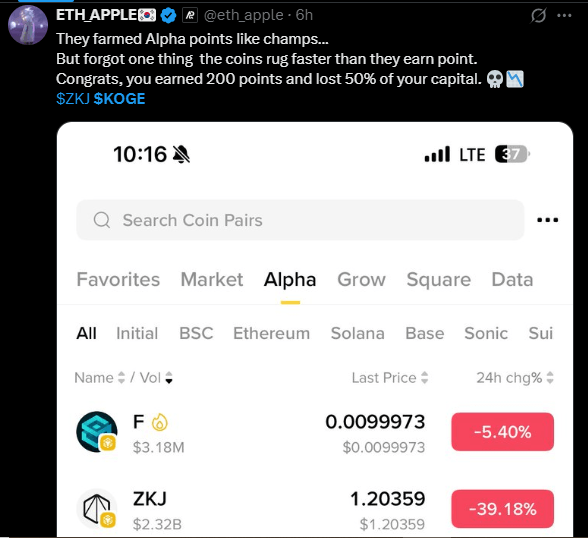
Meanwhile, the synchronized crash of ZKJ and KOGE sparked widespread speculation, with one prominent X user, ETH APPLE, pointing to a potentially “long-planned harvesting operation” as the cause. KOGE, mirroring Polyhedra Network’s native token, experienced its own plunge following the alleged draining of its liquidity pool.

“The issue began when the KOGE pool ran out of USDT, leaving LPs unable to exit positions,” stated ETH APPLE. “This led to a mass sell-off of KOGE into ZKJ, causing both tokens to crash. The situation worsened as it was revealed that the KOGE team hadn’t added any USDT to the pool.”

The alleged draining of liquidity has in turn fueled rug-pull accusations from the distressed community. Although ZKJ was reportedly “actively defending its USDT pool,” it ultimately found itself caught in the crossfire, its value dragged down by the unfolding chaos, as further detailed by ETH APPLE.

Market Opportunity
Moonveil Logo
Moonveil Price(MORE)
$0.003288
$0.003288$0.003288
-17.69%
USD
Moonveil (MORE) Live Price Chart
Disclaimer: The articles reposted on this site are sourced from public platforms and are provided for informational purposes only. They do not necessarily reflect the views of MEXC. All rights remain with the original authors. If you believe any content infringes on third-party rights, please contact service@support.mexc.com for removal. MEXC makes no guarantees regarding the accuracy, completeness, or timeliness of the content and is not responsible for any actions taken based on the information provided. The content does not constitute financial, legal, or other professional advice, nor should it be considered a recommendation or endorsement by MEXC.

You May Also Like

From random auctions to forward contracts, how does ETHGas transform block space into a priced resource?

From random auctions to forward contracts, how does ETHGas transform block space into a priced resource?

Key points: ETHGas redefines Ethereum block space as a priced resource, moving beyond transaction fees that fluctuate with demand. Through block space futures and
Share
PANews2025/12/26 14:00
Headwind Helps Best Wallet Token

Headwind Helps Best Wallet Token

The post Headwind Helps Best Wallet Token appeared on BitcoinEthereumNews.com. Google has announced the launch of a new open-source protocol called Agent Payments Protocol (AP2) in partnership with Coinbase, the Ethereum Foundation, and 60 other organizations. This allows AI agents to make payments on behalf of users using various methods such as real-time bank transfers, credit and debit cards, and, most importantly, stablecoins. Let’s explore in detail what this could mean for the broader cryptocurrency markets, and also highlight a presale crypto (Best Wallet Token) that could explode as a result of this development. Google’s Push for Stablecoins Agent Payments Protocol (AP2) uses digital contracts known as ‘Intent Mandates’ and ‘Verifiable Credentials’ to ensure that AI agents undertake only those payments authorized by the user. Mandates, by the way, are cryptographically signed, tamper-proof digital contracts that act as verifiable proof of a user’s instruction. For example, let’s say you instruct an AI agent to never spend more than $200 in a single transaction. This instruction is written into an Intent Mandate, which serves as a digital contract. Now, whenever the AI agent tries to make a payment, it must present this mandate as proof of authorization, which will then be verified via the AP2 protocol. Alongside this, Google has also launched the A2A x402 extension to accelerate support for the Web3 ecosystem. This production-ready solution enables agent-based crypto payments and will help reshape the growth of cryptocurrency integration within the AP2 protocol. Google’s inclusion of stablecoins in AP2 is a massive vote of confidence in dollar-pegged cryptocurrencies and a huge step toward making them a mainstream payment option. This widens stablecoin usage beyond trading and speculation, positioning them at the center of the consumption economy. The recent enactment of the GENIUS Act in the U.S. gives stablecoins more structure and legal support. Imagine paying for things like data crawls, per-task…
Share
BitcoinEthereumNews2025/09/18 01:27
zkPass Listing: Upbit’s Strategic Move to Boost Privacy-Focused Crypto Adoption

zkPass Listing: Upbit’s Strategic Move to Boost Privacy-Focused Crypto Adoption

BitcoinWorld zkPass Listing: Upbit’s Strategic Move to Boost Privacy-Focused Crypto Adoption In a significant move for the privacy-focused cryptocurrency sector
Share
bitcoinworld2025/12/26 14:45