South African businesses are entering a new era of tax compliance as the SA Revenue Service steadily modernises its tax ecosystem. They will be compelled to workSouth African businesses are entering a new era of tax compliance as the SA Revenue Service steadily modernises its tax ecosystem. They will be compelled to work

SARS Digitisation Is Coming: How Businesses Can Start Preparing

2026/03/18 15:51
3 min di lettura
Per feedback o dubbi su questo contenuto, contattateci all'indirizzo crypto.news@mexc.com.

South African businesses are entering a new era of tax compliance as the SA Revenue Service steadily modernises its tax ecosystem. They will be compelled to work on upgraded eFiling and e@syFile platforms, use e-invoicing and e-reporting as their standard, and align with SARS’ modernisation of the VAT system.

These changes are not yet mandatory, and draft legislation points to a phased rollout to be completed around 2028. This may seem distant, but preparation today can prevent operational headaches tomorrow. Renaldo Muregess, Head of Software Pre-Sales at Itec South Africa, says that the sooner businesses understand the changes and align their systems, the smoother the transition will be: “Companies that act early will gain clarity, reduce risk, and avoid last-minute crises.”

Early preparation is about structuring invoice data, validating systems, and giving finance teams real-time visibility across all transactions. “The benefits go beyond compliance,” says Muregess. “Streamlining and digitising internal processes now will work to reduce errors, save time and free teams up to do more, and strengthen governance leading up to the implementation deadline.”

Seeing where SARS is heading

SARS’ digital transformation aims to make reporting more standardised and transparent by moving companies onto a Peppol-style interoperability model that enables them to exchange structured, machine-readable invoices through certified access points or service providers. In doing so, the authority is encouraging businesses to think beyond spreadsheets and manual processes, and to focus instead on automated workflows that integrate seamlessly with ERP and accounting systems.

By starting to adapt now, organisations can address technical requirements, test systems, and ensure that their teams are prepared well ahead of mandatory deadlines.

Understanding the SARS digitisation process
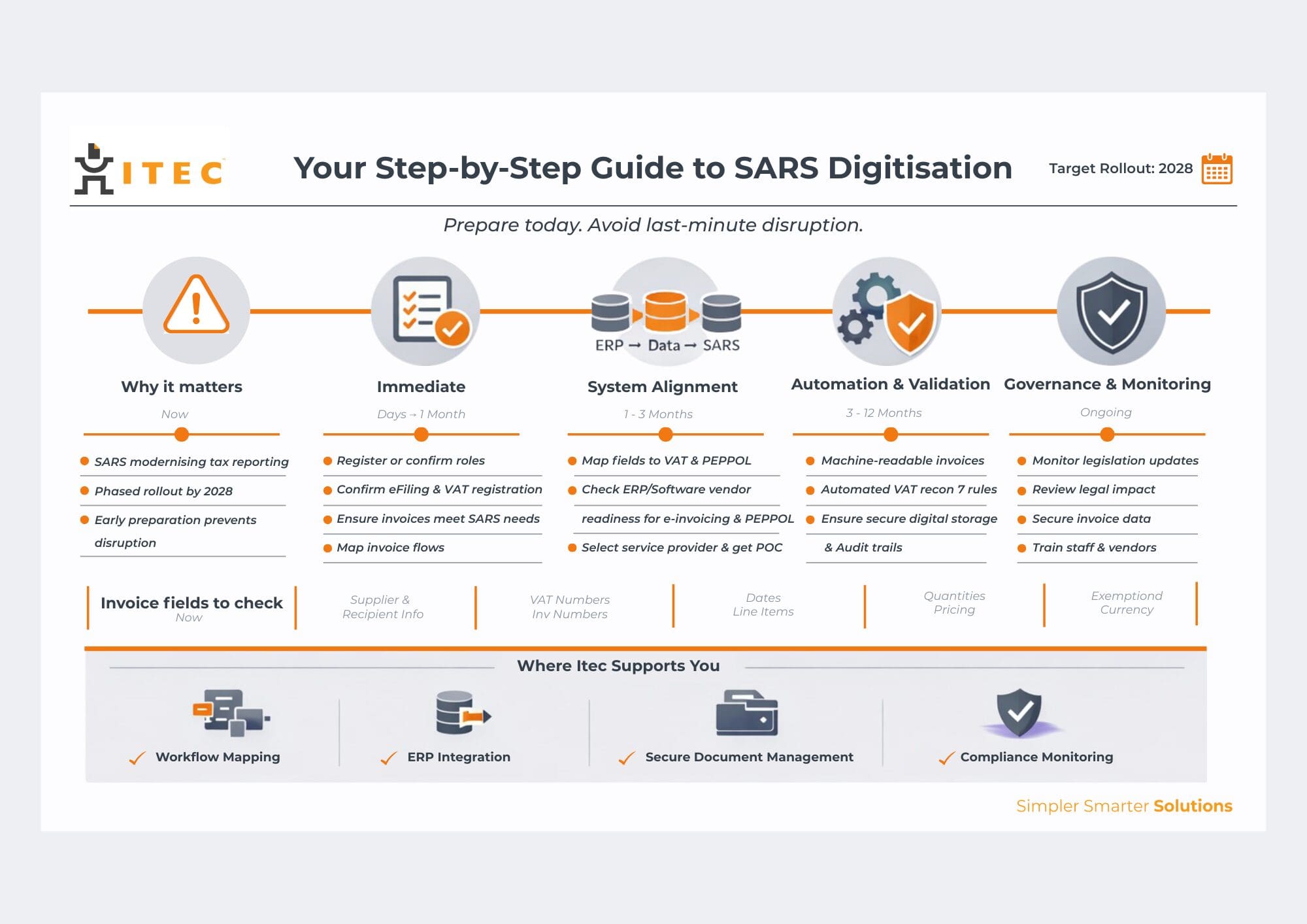
Infographic_Step-by-Step Guide to SARS DigitisationInfographic_Step-by-Step Guide to SARS Digitisation

Knowing the risks

Muregess says that, instead of creating new risks, digitisation exposes weaknesses that have always existed – and helps to eliminate them. “Dispersed spreadsheets, paper-based records, and siloed departmental data can increase errors and make audits stressful. Businesses that confront these vulnerabilities early can strengthen compliance and improve operational efficiency simultaneously. This approach turns a potentially daunting change into an opportunity for improvement and resilience.”

Leveraging the benefits

For finance, compliance, and IT teams alike, the shift is about more than reporting. The new, structured processes will reduce the time spent reconciling invoices and tracking missing information manually, and the resulting centralised, validated data will make errors visible before they reach SARS.

But choosing the right implementation partner is crucial. Experts can guide companies through technical setup, ensure that workflows are standardised, and train employees, creating a smoother, less stressful transition. This, in turn, allows tax compliance to become a routine part of operations rather than a crisis-driven task.

“When your data is structured and visible, compliance becomes a by-product, not a burden. Companies that partner with experts early will be in a stronger position to embrace SARS’ digital future with confidence, while also gaining efficiency, transparency, and greater control over their financial reporting,” says Muregess.

Opportunità di mercato
Logo Notcoin
Valore Notcoin (NOT)
$0.0003921
$0.0003921$0.0003921
+0.05%
USD
Grafico dei prezzi in tempo reale di Notcoin (NOT)
Disclaimer: gli articoli ripubblicati su questo sito provengono da piattaforme pubbliche e sono forniti esclusivamente a scopo informativo. Non riflettono necessariamente le opinioni di MEXC. Tutti i diritti rimangono agli autori originali. Se ritieni che un contenuto violi i diritti di terze parti, contatta crypto.news@mexc.com per la rimozione. MEXC non fornisce alcuna garanzia in merito all'accuratezza, completezza o tempestività del contenuto e non è responsabile per eventuali azioni intraprese sulla base delle informazioni fornite. Il contenuto non costituisce consulenza finanziaria, legale o professionale di altro tipo, né deve essere considerato una raccomandazione o un'approvazione da parte di MEXC.

Potrebbe anche piacerti

Lombard (BARD) Plunges 37.6% in 24 Hours: On-Chain Data Reveals Deeper Issues

Lombard (BARD) Plunges 37.6% in 24 Hours: On-Chain Data Reveals Deeper Issues

Lombard Protocol's native token BARD experienced a sharp 37.6% decline to $0.67, erasing $91 million in market capitalization within 24 hours. Our analysis of on
Condividi
Blockchainmagazine2026/03/19 07:04
Polygon Tops RWA Rankings With $1.1B in Tokenized Assets

Polygon Tops RWA Rankings With $1.1B in Tokenized Assets

The post Polygon Tops RWA Rankings With $1.1B in Tokenized Assets appeared on BitcoinEthereumNews.com. Key Notes A new report from Dune and RWA.xyz highlights Polygon’s role in the growing RWA sector. Polygon PoS currently holds $1.13 billion in RWA Total Value Locked (TVL) across 269 assets. The network holds a 62% market share of tokenized global bonds, driven by European money market funds. The Polygon POL $0.25 24h volatility: 1.4% Market cap: $2.64 B Vol. 24h: $106.17 M network is securing a significant position in the rapidly growing tokenization space, now holding over $1.13 billion in total value locked (TVL) from Real World Assets (RWAs). This development comes as the network continues to evolve, recently deploying its major “Rio” upgrade on the Amoy testnet to enhance future scaling capabilities. This information comes from a new joint report on the state of the RWA market published on Sept. 17 by blockchain analytics firm Dune and data platform RWA.xyz. The focus on RWAs is intensifying across the industry, coinciding with events like the ongoing Real-World Asset Summit in New York. Sandeep Nailwal, CEO of the Polygon Foundation, highlighted the findings via a post on X, noting that the TVL is spread across 269 assets and 2,900 holders on the Polygon PoS chain. The Dune and https://t.co/W6WSFlHoQF report on RWA is out and it shows that RWA is happening on Polygon. Here are a few highlights: – Leading in Global Bonds: Polygon holds 62% share of tokenized global bonds (driven by Spiko’s euro MMF and Cashlink euro issues) – Spiko U.S.… — Sandeep | CEO, Polygon Foundation (※,※) (@sandeepnailwal) September 17, 2025 Key Trends From the 2025 RWA Report The joint publication, titled “RWA REPORT 2025,” offers a comprehensive look into the tokenized asset landscape, which it states has grown 224% since the start of 2024. The report identifies several key trends driving this expansion. According to…
Condividi
BitcoinEthereumNews2025/09/18 00:40
Slumps as Yen gains on risk aversion

Slumps as Yen gains on risk aversion

The post Slumps as Yen gains on risk aversion appeared on BitcoinEthereumNews.com. The GBP/JPY register losses of 0.20& on Wednesday as investors wait for the Bank
Condividi
BitcoinEthereumNews2026/03/19 07:37
