The AI startup frenzy and FOMO are inflating round sizes and valuations. Yes, the potential is huge. But too much capital too early often leads to mediocre outcomes. Remake of 2020–22?The AI startup frenzy and FOMO are inflating round sizes and valuations. Yes, the potential is huge. But too much capital too early often leads to mediocre outcomes. Remake of 2020–22?

AI Startup Surge Risks Repeating Tech’s Last Funding Mania

Silicon Valley has a notoriously short memory. In 2023, we were recovering from the 2020-2022 zero-interest-rate policy (ZIRP), a period during which startup fundraising and valuations were irrational. (Remember when Fast raised at 1B+ valuation, hired 500 people but only generated $600K in revenue?)

Then, the correction hit hard. A record number of startups shut down in 2023–2024 after running out of money, failing to find product-market fit, or growing too slowly to raise again. Even soft landings were off the table as M&A stalled due to economic uncertainty and focus on AI.

In the public markets, many of the 2020–2023 tech IPOs and SPACs now trade at a fraction of what they raised, with uncertain paths to growth or profitability (e.g., BuzzFeed, OpenDoor, Rivian).

Crypto also experienced its speculative run during that same period. This led to the funding of many “zombie” Web3 companies that still lack customers and viable use cases.

What is happening now

Artificial intelligence is hot. It’s still early, but the potential is massive and the implications are profound. AI is already changing industries today and will transform even more tomorrow.

AI is moving at light speed with new technologies, models, papers, and startups emerging daily. 80%+ of YCombinator's batches are AI startups.

AI will reshuffle the deck the same way other breakthrough technologies did; some businesses will become stronger with AI, others will be disrupted, and new giants will emerge.

Remake of the 2020-2022 fundraising frenzy?

Once again, FOMO and herd mentality are driving investors to aggressively back AI startups and lead "monster" rounds to avoid being left behind, often at very optimistic (which then becomes delusional in a couple of years) valuations, disconnected from actual traction or stage. There is a running joke on Twitter that if you put LLM, GenAI, or Agent on a pitch deck, someone will knock at your door with a term sheet.

Startups raising too much or pivoting too fast: many Series A+ rounds closed with offerings still behind a waitlist, pre-product-market fit, questionable moats, or little to no revenue. Others are abandoning years of product, research, and customer insights to pivot into something completely different just to wear the “AI-powered X” label.

Some startups are using AI as a "get out of jail free" card: I know of a SaaS company that raised a large seed in 2020. Fast-forward to last year, they had little traction, limited runway, and couldn't raise the next round. Then, they added a thin AI layer to their product and rebranded as an AI company. They were still solving the same problem. Their metrics didn’t improve, but the new positioning got them two Series A term sheets within weeks. You could call it smart or opportunistic, but the reality will catch them later.

My advice to founders

No matter the hype, round size, and press coverage, all startups will eventually be measured using the same scorecard: activation, retention, monetization, and growth. Startups might raise once based on a narrative and grandiose vision, but their next round will be grounded on fundamentals reflecting the reality of their business.

Do not build a company or seek validation from VCs or the tech press. Build for customers. Talk to them, understand their problem, and offer an exceptional product that solves that problem. Great companies take decades to build, so ignore the noise and play the long-term game. Sooner or later, the AI novelty will fade, and only companies with products loved by customers and with durable, profitable, and defensible business models will survive.

AI won’t magically 2x your retention, monetization, or get you to product-market fit overnight. But it can help in two powerful ways. Internally, it can boost your team’s productivity, speeding up experiments and shipping features to market faster. Externally, it can help customers get to your product’s value faster through better automation, streamlined workflows, or capabilities that weren’t feasible before. The goal isn’t to sprinkle AI for the sake of it but to use it where it can help you solve real problems.

If you're being offered more money than you planned to raise, pause, and think before taking it. Can you realistically grow and "deserve" a multiple of that valuation with actual traction and revenue? Is scaling prematurely your headcount and burn going to set up your company and team for long-term success? Will you be happy with your equity after all the possible dilution? Resource constraints (time, money, team size, etc.) can be your greatest advantage, forcing focus, creativity, and discipline. Otherwise, if you prefer to take as much capital now, throw money and headcount at your problems, and figure things out later, you are in for the ride of your life, and I wish you the best.
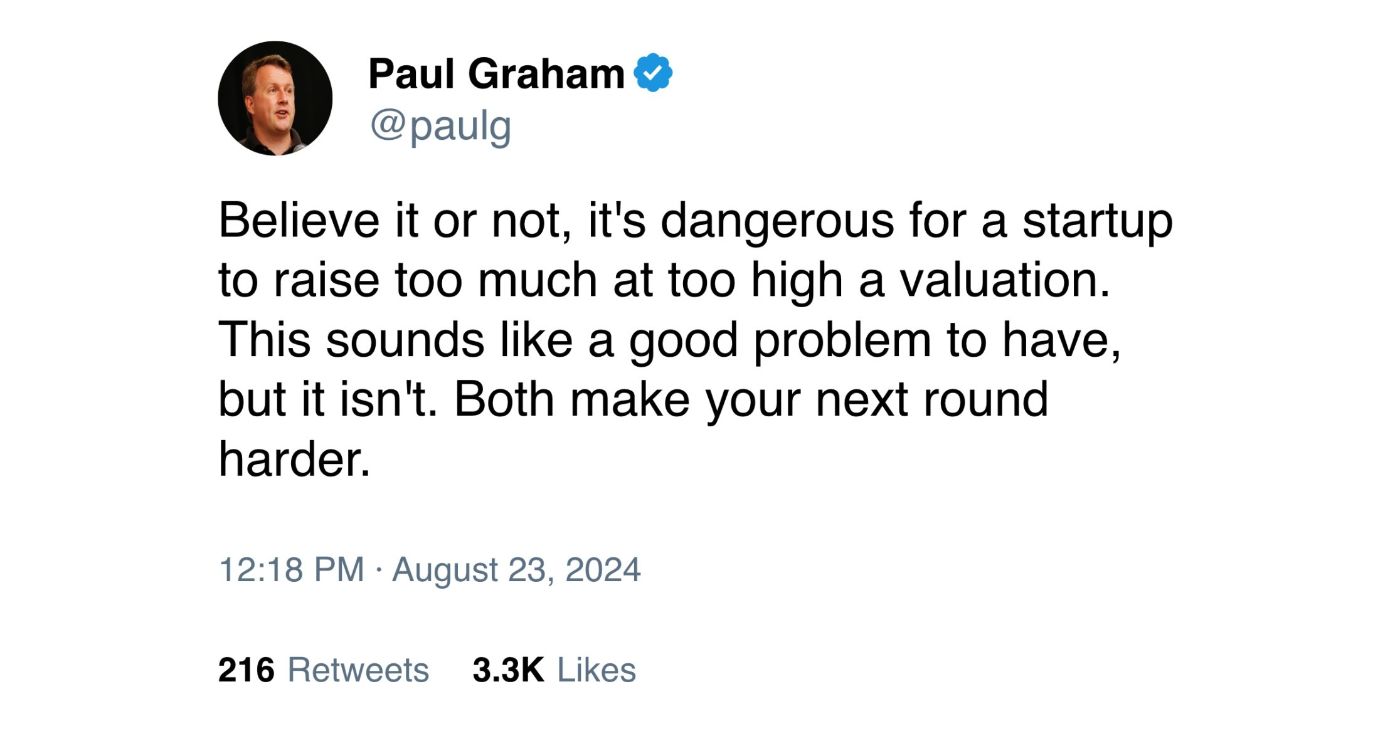
https://x.com/paulg/status/1827062907936678081


I host weekly office hours to help startups with product, growth, and company strategy. I occasionally open a few slots to founders outside my portfolio. DM me!

Market Opportunity
null Logo
null Price(null)
--
----
USD
null (null) Live Price Chart
Disclaimer: The articles reposted on this site are sourced from public platforms and are provided for informational purposes only. They do not necessarily reflect the views of MEXC. All rights remain with the original authors. If you believe any content infringes on third-party rights, please contact service@support.mexc.com for removal. MEXC makes no guarantees regarding the accuracy, completeness, or timeliness of the content and is not responsible for any actions taken based on the information provided. The content does not constitute financial, legal, or other professional advice, nor should it be considered a recommendation or endorsement by MEXC.

You May Also Like

Fed forecasts only one rate cut in 2026, a more conservative outlook than expected

Fed forecasts only one rate cut in 2026, a more conservative outlook than expected

The post Fed forecasts only one rate cut in 2026, a more conservative outlook than expected appeared on BitcoinEthereumNews.com. Federal Reserve Chairman Jerome Powell talks to reporters following the regular Federal Open Market Committee meetings at the Fed on July 30, 2025 in Washington, DC. Chip Somodevilla | Getty Images The Federal Reserve is projecting only one rate cut in 2026, fewer than expected, according to its median projection. The central bank’s so-called dot plot, which shows 19 individual members’ expectations anonymously, indicated a median estimate of 3.4% for the federal funds rate at the end of 2026. That compares to a median estimate of 3.6% for the end of this year following two expected cuts on top of Wednesday’s reduction. A single quarter-point reduction next year is significantly more conservative than current market pricing. Traders are currently pricing in at two to three more rate cuts next year, according to the CME Group’s FedWatch tool, updated shortly after the decision. The gauge uses prices on 30-day fed funds futures contracts to determine market-implied odds for rate moves. Here are the Fed’s latest targets from 19 FOMC members, both voters and nonvoters: Zoom In IconArrows pointing outwards The forecasts, however, showed a large difference of opinion with two voting members seeing as many as four cuts. Three officials penciled in three rate reductions next year. “Next year’s dot plot is a mosaic of different perspectives and is an accurate reflection of a confusing economic outlook, muddied by labor supply shifts, data measurement concerns, and government policy upheaval and uncertainty,” said Seema Shah, chief global strategist at Principal Asset Management. The central bank has two policy meetings left for the year, one in October and one in December. Economic projections from the Fed saw slightly faster economic growth in 2026 than was projected in June, while the outlook for inflation was updated modestly higher for next year. There’s a lot of uncertainty…
Share
BitcoinEthereumNews2025/09/18 02:59
We’re not being as forward-looking as normal

We’re not being as forward-looking as normal

The post We’re not being as forward-looking as normal appeared on BitcoinEthereumNews.com. Bank of Canada (BoC) Governor Tiff Macklem addressed reporters’ questions, offering insights into the central bank’s monetary policy outlook. His remarks came after the BoC lowered its interest rate by 25 basis points to 2.50%, a move that markets had broadly anticipated. BoC press conference key highlights Wage growth continued to ease. The preferred core inflation measures have been around 3.0%. Underlying inflation is running around 2.5%. Consensus to cut rates was clear. Attention now shifts to how exports perform. There are still some mixed signals on inflation. The Inflation picture hasn’t changed much since January. We’re not being as forward-looking as normal. The Bank of Canada considered holding the overnight rate steady. I have more comfort looking at the upward pressure on CPI. We will be assessing the impact of government announcements on targeted support and support for big projects. Inflationary pressures look somewhat more contained. If risks tilt further we are prepared to take more action. Will take it one meeting at a time. This section below was published at 13:45 GMT to cover the Bank of Canada’s policy announcements and the initial market reaction. In line with market analysts’ expectations, the Bank of Canada (BoC) trimmed its policy rate by 25 basis points, taking it to 2.50% on Wednesday. Investors’ attention will now shift to the usual press conference by Governor Tiff Macklem at 14:30 GMT. BoC policy statement key highlights Rate cut was appropriate given the weaker economy and less upside risk to inflation. On a monthly basis, upward momentum in core inflation seen earlier this year has dissipated. Disruption linked to trade shifts will continue to add costs even as they weigh on economic uncertainties. BoC says it will continue to support economic growth while ensuring inflation remains well controlled. Ottawa’s decision to scrap tariffs…
Share
BitcoinEthereumNews2025/09/18 05:17
Jim Cramer Sounds Alarm On Bitcoin’s Unreliability As A Short-Term Currency After Brutal Weekend Drop To $74,000 ⋆ ZyCrypto

Jim Cramer Sounds Alarm On Bitcoin’s Unreliability As A Short-Term Currency After Brutal Weekend Drop To $74,000 ⋆ ZyCrypto

The post Jim Cramer Sounds Alarm On Bitcoin’s Unreliability As A Short-Term Currency After Brutal Weekend Drop To $74,000 ⋆ ZyCrypto appeared on BitcoinEthereumNews
Share
BitcoinEthereumNews2026/02/03 16:40