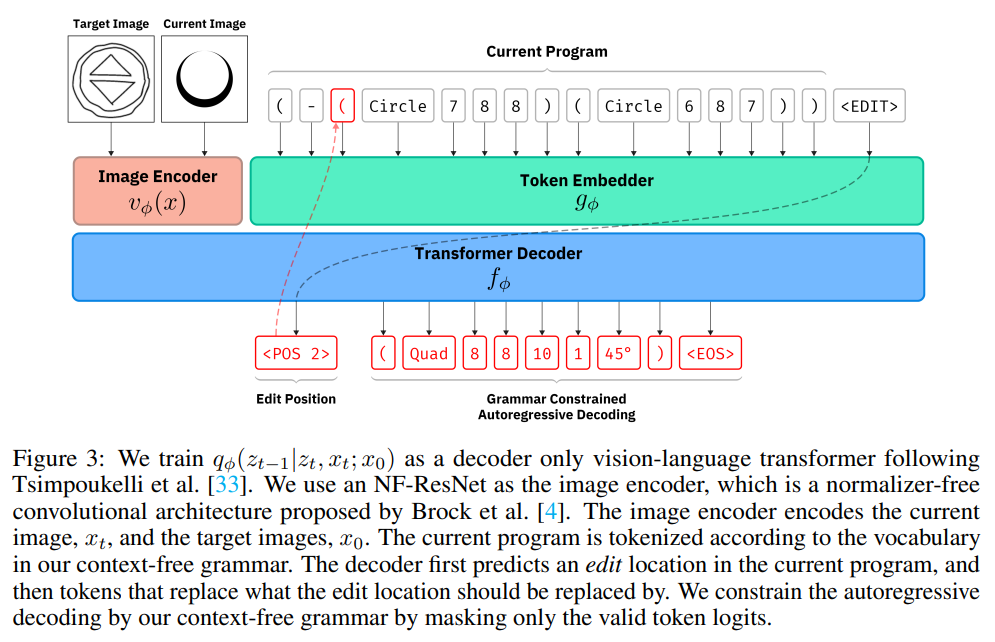
This method is designed to overcome challenges in a standard autoregressive approach, allowing the model to make targeted, grammatically correct changesThis method is designed to overcome challenges in a standard autoregressive approach, allowing the model to make targeted, grammatically correct changes

Syntactically Valid Code Editing: A Training Methodology for Neural Program Synthesis

Abstract and 1. Introduction

  1. Background & Related Work

  2. Method

    3.1 Sampling Small Mutations

    3.2 Policy

    3.3 Value Network & Search

    3.4 Architecture

  3. Experiments

    4.1 Environments

    4.2 Baselines

    4.3 Ablations

  4. Conclusion, Acknowledgments and Disclosure of Funding, and References

    \

Appendix

A. Mutation Algorithm

B. Context-Free Grammars

C. Sketch Simulation

D. Complexity Filtering

E. Tree Path Algorithm

F. Implementation Details

3.4 Architecture

\ We add two additional types of tokens: an token, which serves as a start-of-sentence token for the model; and tokens, which allow the model to reference positions within its context. Given a current image, a target image, and a current tokenized program, we train this transformer model to predict the edit position and the replacement text autoregressively. While making predictions, the decoding is constrained under the grammar. We mask out the prediction logits to only include edit positions that represent nodes in the syntax tree, and only produce replacements that are syntactically valid for the selected edit position.

\ We set σsmall = 2, which means the network is only allowed to produce edits with fewer than two primitives. For training data, we sample an infinite stream of random expressions from the CFG. We choose a random number of noise steps, s ∈ [1, 5], to produce a mutated expression. For some percentage of the examples, ρ, we instead sample a completely random new expression as our mutated expression. We trained for 3 days for the environments we tested on a single Nvidia A6000 GPU.

\
\

:::info Authors:

(1) Shreyas Kapur, University of California, Berkeley (srkp@cs.berkeley.edu);

(2) Erik Jenner, University of California, Berkeley (jenner@cs.berkeley.edu);

(3) Stuart Russell, University of California, Berkeley (russell@cs.berkeley.edu).

:::


:::info This paper is available on arxiv under CC BY-SA 4.0 DEED license.

:::

\

Disclaimer: The articles reposted on this site are sourced from public platforms and are provided for informational purposes only. They do not necessarily reflect the views of MEXC. All rights remain with the original authors. If you believe any content infringes on third-party rights, please contact service@support.mexc.com for removal. MEXC makes no guarantees regarding the accuracy, completeness, or timeliness of the content and is not responsible for any actions taken based on the information provided. The content does not constitute financial, legal, or other professional advice, nor should it be considered a recommendation or endorsement by MEXC.

You May Also Like

Fed forecasts only one rate cut in 2026, a more conservative outlook than expected

Fed forecasts only one rate cut in 2026, a more conservative outlook than expected

The post Fed forecasts only one rate cut in 2026, a more conservative outlook than expected appeared on BitcoinEthereumNews.com. Federal Reserve Chairman Jerome Powell talks to reporters following the regular Federal Open Market Committee meetings at the Fed on July 30, 2025 in Washington, DC. Chip Somodevilla | Getty Images The Federal Reserve is projecting only one rate cut in 2026, fewer than expected, according to its median projection. The central bank’s so-called dot plot, which shows 19 individual members’ expectations anonymously, indicated a median estimate of 3.4% for the federal funds rate at the end of 2026. That compares to a median estimate of 3.6% for the end of this year following two expected cuts on top of Wednesday’s reduction. A single quarter-point reduction next year is significantly more conservative than current market pricing. Traders are currently pricing in at two to three more rate cuts next year, according to the CME Group’s FedWatch tool, updated shortly after the decision. The gauge uses prices on 30-day fed funds futures contracts to determine market-implied odds for rate moves. Here are the Fed’s latest targets from 19 FOMC members, both voters and nonvoters: Zoom In IconArrows pointing outwards The forecasts, however, showed a large difference of opinion with two voting members seeing as many as four cuts. Three officials penciled in three rate reductions next year. “Next year’s dot plot is a mosaic of different perspectives and is an accurate reflection of a confusing economic outlook, muddied by labor supply shifts, data measurement concerns, and government policy upheaval and uncertainty,” said Seema Shah, chief global strategist at Principal Asset Management. The central bank has two policy meetings left for the year, one in October and one in December. Economic projections from the Fed saw slightly faster economic growth in 2026 than was projected in June, while the outlook for inflation was updated modestly higher for next year. There’s a lot of uncertainty…
Share
BitcoinEthereumNews2025/09/18 02:59
We’re not being as forward-looking as normal

We’re not being as forward-looking as normal

The post We’re not being as forward-looking as normal appeared on BitcoinEthereumNews.com. Bank of Canada (BoC) Governor Tiff Macklem addressed reporters’ questions, offering insights into the central bank’s monetary policy outlook. His remarks came after the BoC lowered its interest rate by 25 basis points to 2.50%, a move that markets had broadly anticipated. BoC press conference key highlights Wage growth continued to ease. The preferred core inflation measures have been around 3.0%. Underlying inflation is running around 2.5%. Consensus to cut rates was clear. Attention now shifts to how exports perform. There are still some mixed signals on inflation. The Inflation picture hasn’t changed much since January. We’re not being as forward-looking as normal. The Bank of Canada considered holding the overnight rate steady. I have more comfort looking at the upward pressure on CPI. We will be assessing the impact of government announcements on targeted support and support for big projects. Inflationary pressures look somewhat more contained. If risks tilt further we are prepared to take more action. Will take it one meeting at a time. This section below was published at 13:45 GMT to cover the Bank of Canada’s policy announcements and the initial market reaction. In line with market analysts’ expectations, the Bank of Canada (BoC) trimmed its policy rate by 25 basis points, taking it to 2.50% on Wednesday. Investors’ attention will now shift to the usual press conference by Governor Tiff Macklem at 14:30 GMT. BoC policy statement key highlights Rate cut was appropriate given the weaker economy and less upside risk to inflation. On a monthly basis, upward momentum in core inflation seen earlier this year has dissipated. Disruption linked to trade shifts will continue to add costs even as they weigh on economic uncertainties. BoC says it will continue to support economic growth while ensuring inflation remains well controlled. Ottawa’s decision to scrap tariffs…
Share
BitcoinEthereumNews2025/09/18 05:17
Jim Cramer Sounds Alarm On Bitcoin’s Unreliability As A Short-Term Currency After Brutal Weekend Drop To $74,000 ⋆ ZyCrypto

Jim Cramer Sounds Alarm On Bitcoin’s Unreliability As A Short-Term Currency After Brutal Weekend Drop To $74,000 ⋆ ZyCrypto

The post Jim Cramer Sounds Alarm On Bitcoin’s Unreliability As A Short-Term Currency After Brutal Weekend Drop To $74,000 ⋆ ZyCrypto appeared on BitcoinEthereumNews
Share
BitcoinEthereumNews2026/02/03 16:40