Total crypto VC funding hit $8 billion in Q3 2025, powered not by hype but by policy stability. The Trump administration’s pro-crypto stance and tokenization’s rise turned regulation from a headwind into alpha. For investors, the shift signals predictable frameworks, institutional exits, and a market no longer ruled by speculation — a structural reset that makes compliance a source of performance. Why Policy Became the Catalyst Why ImportantCryptoRank data show US-based funds drove one-third of crypto VC activity in Q3. Federal clarity on stablecoins, taxation, and compliance drew institutions back, producing the strongest quarter since 2021. The figures confirm that US regulation—rather than liquidity—now shapes venture momentum. Source: CryptoRank Crypto VC Confidence Returns Latest UpdateThe Silicon Valley Venture Capitalist Confidence Index posted one of its steepest drops in two decades, before rebounding in Q2 as tariff anxiety eased. Capital rotated into tokenization, compliance, and AI–crypto convergence — seen as resilient amid uncertainty. The rebound suggests investors are recalibrating, not retreating, trading hype for fundamentals as policy replaces sentiment as the main compass for risk. State Street found that 60% of institutions plan to double their digital-asset exposure within three years, with over half expecting 10–24% of portfolios to be tokenized by 2030. Tokenized private equity and debt are becoming the “first stop” for liquidity-seeking allocators, though LP-token models remain legally gray. Tokenization institutionalizes the venture itself, turning private markets into programmable, tradable capital. Behind the ScenesLlobet noted that funds like a16z, Paradigm, and Pantera now use tokenized side vehicles, letting LPs trade fund shares on compliant platforms. DAO treasuries and decentralized pools are emerging as rivals to traditional VC funding, showing how crypto now finances itself through its own rails. BackgroundRegulatory opacity once kept allocators away. “Legal uncertainty and illiquidity constrained blockchain finance,” as noted by Llobet’s 2025 study. That changed when Washington approved a national stablecoin framework and tax incentives for compliant entities, legitimizing crypto for pensions and sovereign funds. Global Repercussions Wider ImpactCryptoRank’s Q3 data show 275 deals, two-thirds under $10M — clear evidence of discipline over speculation. Source: CryptoRank CeFi and infrastructure absorbed 60% of capital, while GameFi and NFTs fell below 10%. Investors are re-rating risk through cash flow rather than hype — a hallmark of market maturity. MetricQ3 2025SourceTotal VC Funding$8BCryptoRankAvg Deal Size$3–10MCryptoRankInstitutional Allocation+60% planned increaseState StreetConfidence Index3.26 / 5SSRN / SVVCCI State Street expects tokenized funds to be standard by 2030, while CryptoRank projects $18–25B in 2025 inflows — a sustainable, compliance-driven cycle. Regulation now functions less as a constraint than as a competitive edge. Crypto VC Faces Its First Real Stress Test Risks & ChallengesRay Dalio warned that US debt, now about 116% of GDP, mirrors pre–World War II dynamics and could erode risk appetite if fiscal repair stalls. Dalio’s “deficit bomb” and SVVCCI data suggest trade volatility could delay IPOs. Ackerman of DataTribe warned AI euphoria may form a “bubble” that resets valuations and diverts capital from Web3. Policy may anchor sentiment, but macro debt and AI speculation will test whether the sector’s new discipline can hold. “Institutional investors are moving beyond experimentation; digital assets are now a strategic lever for growth,” said Joerg Ambrosius, State Street. “Trade volatility will limit exits short term, but AI and blockchain remain the twin pillars of new value creation,” noted Howard Lee, Founders Equity Partners. “Crypto VC has institutionalized. Tokenized funds are the new standard for liquidity,” said Marçal Llobet, University of Barcelona. Crypto VC has entered a disciplined, institutional phase. Regulatory clarity and tokenization are expanding access while reducing volatility. Yet continued growth depends on macro stability and measured risk-taking. If predictability holds, 2025 may be remembered as the year compliance became alpha.Total crypto VC funding hit $8 billion in Q3 2025, powered not by hype but by policy stability. The Trump administration’s pro-crypto stance and tokenization’s rise turned regulation from a headwind into alpha. For investors, the shift signals predictable frameworks, institutional exits, and a market no longer ruled by speculation — a structural reset that makes compliance a source of performance. Why Policy Became the Catalyst Why ImportantCryptoRank data show US-based funds drove one-third of crypto VC activity in Q3. Federal clarity on stablecoins, taxation, and compliance drew institutions back, producing the strongest quarter since 2021. The figures confirm that US regulation—rather than liquidity—now shapes venture momentum. Source: CryptoRank Crypto VC Confidence Returns Latest UpdateThe Silicon Valley Venture Capitalist Confidence Index posted one of its steepest drops in two decades, before rebounding in Q2 as tariff anxiety eased. Capital rotated into tokenization, compliance, and AI–crypto convergence — seen as resilient amid uncertainty. The rebound suggests investors are recalibrating, not retreating, trading hype for fundamentals as policy replaces sentiment as the main compass for risk. State Street found that 60% of institutions plan to double their digital-asset exposure within three years, with over half expecting 10–24% of portfolios to be tokenized by 2030. Tokenized private equity and debt are becoming the “first stop” for liquidity-seeking allocators, though LP-token models remain legally gray. Tokenization institutionalizes the venture itself, turning private markets into programmable, tradable capital. Behind the ScenesLlobet noted that funds like a16z, Paradigm, and Pantera now use tokenized side vehicles, letting LPs trade fund shares on compliant platforms. DAO treasuries and decentralized pools are emerging as rivals to traditional VC funding, showing how crypto now finances itself through its own rails. BackgroundRegulatory opacity once kept allocators away. “Legal uncertainty and illiquidity constrained blockchain finance,” as noted by Llobet’s 2025 study. That changed when Washington approved a national stablecoin framework and tax incentives for compliant entities, legitimizing crypto for pensions and sovereign funds. Global Repercussions Wider ImpactCryptoRank’s Q3 data show 275 deals, two-thirds under $10M — clear evidence of discipline over speculation. Source: CryptoRank CeFi and infrastructure absorbed 60% of capital, while GameFi and NFTs fell below 10%. Investors are re-rating risk through cash flow rather than hype — a hallmark of market maturity. MetricQ3 2025SourceTotal VC Funding$8BCryptoRankAvg Deal Size$3–10MCryptoRankInstitutional Allocation+60% planned increaseState StreetConfidence Index3.26 / 5SSRN / SVVCCI State Street expects tokenized funds to be standard by 2030, while CryptoRank projects $18–25B in 2025 inflows — a sustainable, compliance-driven cycle. Regulation now functions less as a constraint than as a competitive edge. Crypto VC Faces Its First Real Stress Test Risks & ChallengesRay Dalio warned that US debt, now about 116% of GDP, mirrors pre–World War II dynamics and could erode risk appetite if fiscal repair stalls. Dalio’s “deficit bomb” and SVVCCI data suggest trade volatility could delay IPOs. Ackerman of DataTribe warned AI euphoria may form a “bubble” that resets valuations and diverts capital from Web3. Policy may anchor sentiment, but macro debt and AI speculation will test whether the sector’s new discipline can hold. “Institutional investors are moving beyond experimentation; digital assets are now a strategic lever for growth,” said Joerg Ambrosius, State Street. “Trade volatility will limit exits short term, but AI and blockchain remain the twin pillars of new value creation,” noted Howard Lee, Founders Equity Partners. “Crypto VC has institutionalized. Tokenized funds are the new standard for liquidity,” said Marçal Llobet, University of Barcelona. Crypto VC has entered a disciplined, institutional phase. Regulatory clarity and tokenization are expanding access while reducing volatility. Yet continued growth depends on macro stability and measured risk-taking. If predictability holds, 2025 may be remembered as the year compliance became alpha.

Regulation Becomes Alpha: US Policy Fuels Crypto VC

3 min read

Total crypto VC funding hit $8 billion in Q3 2025, powered not by hype but by policy stability. The Trump administration’s pro-crypto stance and tokenization’s rise turned regulation from a headwind into alpha.

For investors, the shift signals predictable frameworks, institutional exits, and a market no longer ruled by speculation — a structural reset that makes compliance a source of performance.

Why Policy Became the Catalyst

Why ImportantCryptoRank data show US-based funds drove one-third of crypto VC activity in Q3. Federal clarity on stablecoins, taxation, and compliance drew institutions back, producing the strongest quarter since 2021. The figures confirm that US regulation—rather than liquidity—now shapes venture momentum.
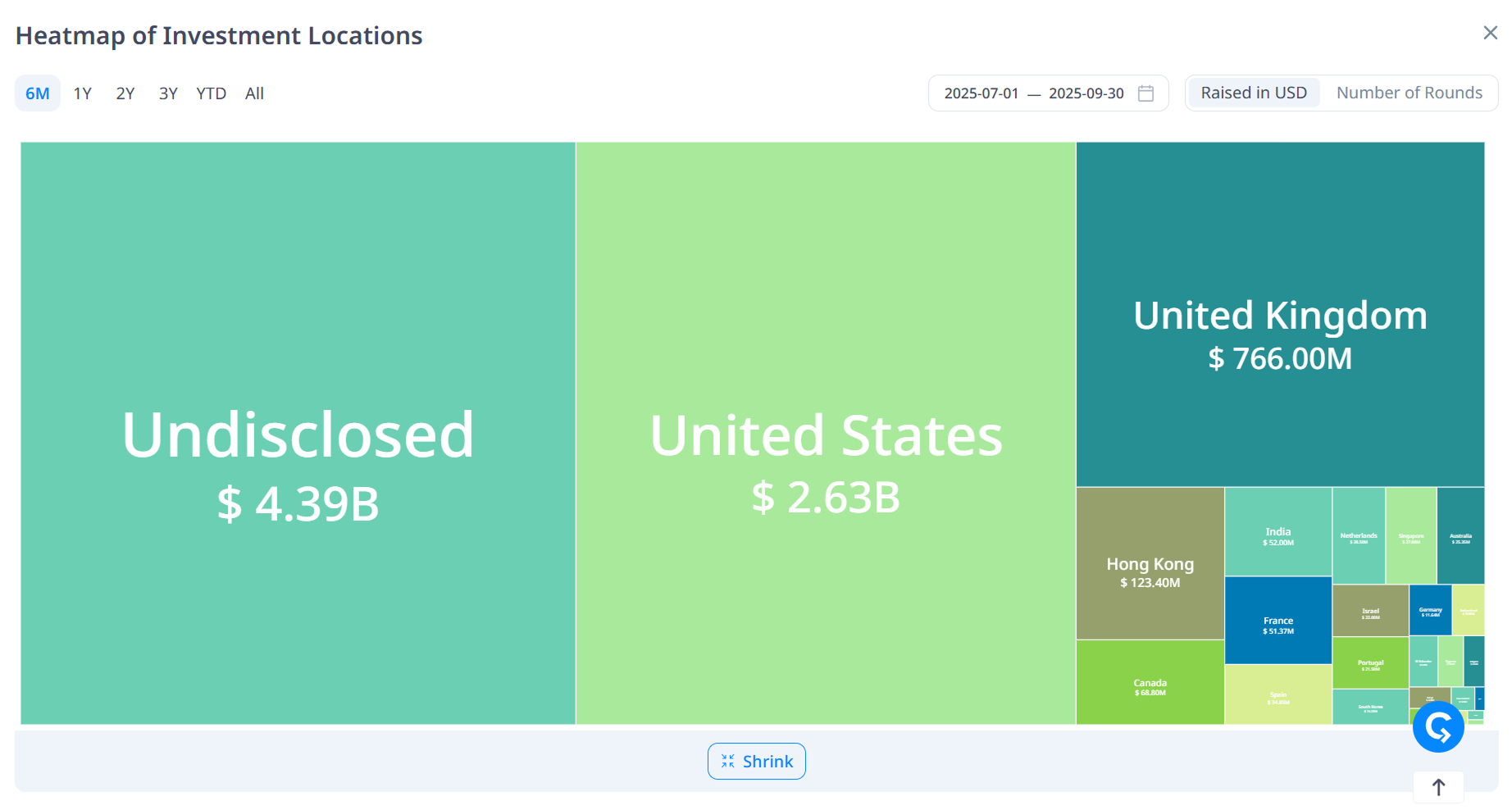
Source: CryptoRank

Crypto VC Confidence Returns

Latest UpdateThe Silicon Valley Venture Capitalist Confidence Index posted one of its steepest drops in two decades, before rebounding in Q2 as tariff anxiety eased. Capital rotated into tokenization, compliance, and AI–crypto convergence — seen as resilient amid uncertainty. The rebound suggests investors are recalibrating, not retreating, trading hype for fundamentals as policy replaces sentiment as the main compass for risk.

State Street found that 60% of institutions plan to double their digital-asset exposure within three years, with over half expecting 10–24% of portfolios to be tokenized by 2030. Tokenized private equity and debt are becoming the “first stop” for liquidity-seeking allocators, though LP-token models remain legally gray. Tokenization institutionalizes the venture itself, turning private markets into programmable, tradable capital.

Behind the ScenesLlobet noted that funds like a16z, Paradigm, and Pantera now use tokenized side vehicles, letting LPs trade fund shares on compliant platforms. DAO treasuries and decentralized pools are emerging as rivals to traditional VC funding, showing how crypto now finances itself through its own rails.

BackgroundRegulatory opacity once kept allocators away. “Legal uncertainty and illiquidity constrained blockchain finance,” as noted by Llobet’s 2025 study. That changed when Washington approved a national stablecoin framework and tax incentives for compliant entities, legitimizing crypto for pensions and sovereign funds.

Global Repercussions

Wider ImpactCryptoRank’s Q3 data show 275 deals, two-thirds under $10M — clear evidence of discipline over speculation.
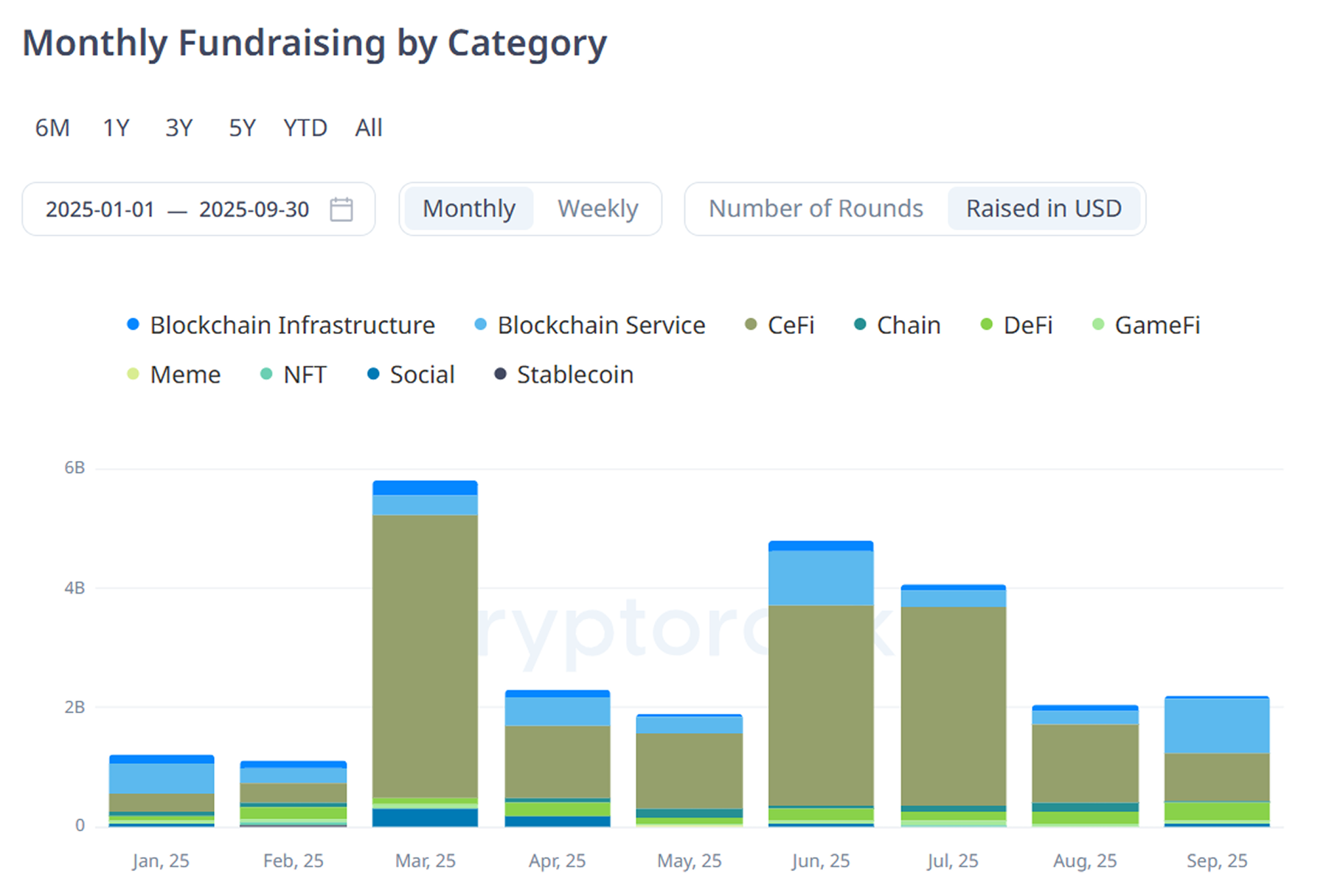
Source: CryptoRank

CeFi and infrastructure absorbed 60% of capital, while GameFi and NFTs fell below 10%. Investors are re-rating risk through cash flow rather than hype — a hallmark of market maturity.

MetricQ3 2025Source
Total VC Funding$8BCryptoRank
Avg Deal Size$3–10MCryptoRank
Institutional Allocation+60% planned increaseState Street
Confidence Index3.26 / 5SSRN / SVVCCI

State Street expects tokenized funds to be standard by 2030, while CryptoRank projects $18–25B in 2025 inflows — a sustainable, compliance-driven cycle. Regulation now functions less as a constraint than as a competitive edge.

Crypto VC Faces Its First Real Stress Test

Risks & ChallengesRay Dalio warned that US debt, now about 116% of GDP, mirrors pre–World War II dynamics and could erode risk appetite if fiscal repair stalls.

Dalio’s “deficit bomb” and SVVCCI data suggest trade volatility could delay IPOs. Ackerman of DataTribe warned AI euphoria may form a “bubble” that resets valuations and diverts capital from Web3. Policy may anchor sentiment, but macro debt and AI speculation will test whether the sector’s new discipline can hold.

Crypto VC has entered a disciplined, institutional phase. Regulatory clarity and tokenization are expanding access while reducing volatility. Yet continued growth depends on macro stability and measured risk-taking. If predictability holds, 2025 may be remembered as the year compliance became alpha.

Disclaimer: The articles reposted on this site are sourced from public platforms and are provided for informational purposes only. They do not necessarily reflect the views of MEXC. All rights remain with the original authors. If you believe any content infringes on third-party rights, please contact service@support.mexc.com for removal. MEXC makes no guarantees regarding the accuracy, completeness, or timeliness of the content and is not responsible for any actions taken based on the information provided. The content does not constitute financial, legal, or other professional advice, nor should it be considered a recommendation or endorsement by MEXC.

You May Also Like

Wormhole launches reserve tying protocol revenue to token

Wormhole launches reserve tying protocol revenue to token

The post Wormhole launches reserve tying protocol revenue to token appeared on BitcoinEthereumNews.com. Wormhole is changing how its W token works by creating a new reserve designed to hold value for the long term. Announced on Wednesday, the Wormhole Reserve will collect onchain and offchain revenues and other value generated across the protocol and its applications (including Portal) and accumulate them into W, locking the tokens within the reserve. The reserve is part of a broader update called W 2.0. Other changes include a 4% targeted base yield for tokenholders who stake and take part in governance. While staking rewards will vary, Wormhole said active users of ecosystem apps can earn boosted yields through features like Portal Earn. The team stressed that no new tokens are being minted; rewards come from existing supply and protocol revenues, keeping the cap fixed at 10 billion. Wormhole is also overhauling its token release schedule. Instead of releasing large amounts of W at once under the old “cliff” model, the network will shift to steady, bi-weekly unlocks starting October 3, 2025. The aim is to avoid sharp periods of selling pressure and create a more predictable environment for investors. Lockups for some groups, including validators and investors, will extend an additional six months, until October 2028. Core contributor tokens remain under longer contractual time locks. Wormhole launched in 2020 as a cross-chain bridge and now connects more than 40 blockchains. The W token powers governance and staking, with a capped supply of 10 billion. By redirecting fees and revenues into the new reserve, Wormhole is betting that its token can maintain value as demand for moving assets and data between chains grows. This is a developing story. This article was generated with the assistance of AI and reviewed by editor Jeffrey Albus before publication. Get the news in your inbox. Explore Blockworks newsletters: Source: https://blockworks.co/news/wormhole-launches-reserve
Share
BitcoinEthereumNews2025/09/18 01:55
Kalshi debuts ecosystem hub with Solana and Base

Kalshi debuts ecosystem hub with Solana and Base

The post Kalshi debuts ecosystem hub with Solana and Base appeared on BitcoinEthereumNews.com. Kalshi, the US-regulated prediction market exchange, rolled out a new program on Wednesday called KalshiEco Hub. The initiative, developed in partnership with Solana and Coinbase-backed Base, is designed to attract builders, traders, and content creators to a growing ecosystem around prediction markets. By combining its regulatory footing with crypto-native infrastructure, Kalshi said it is aiming to become a bridge between traditional finance and onchain innovation. The hub offers grants, technical assistance, and marketing support to selected projects. Kalshi also announced that it will support native deposits of Solana’s SOL token and USDC stablecoin, making it easier for users already active in crypto to participate directly. Early collaborators include Kalshinomics, a dashboard for market analytics, and Verso, which is building professional-grade tools for market discovery and execution. Other partners, such as Caddy, are exploring ways to expand retail-facing trading experiences. Kalshi’s move to embrace blockchain partnerships comes at a time when prediction markets are drawing fresh attention for their ability to capture sentiment around elections, economic policy, and cultural events. Competitor Polymarket recently acquired QCEX — a derivatives exchange with a CFTC license — to pave its way back into US operations under regulatory compliance. At the same time, platforms like PredictIt continue to push for a clearer regulatory footing. The legal terrain remains complex, with some states issuing cease-and-desist orders over whether these event contracts count as gambling, not finance. This is a developing story. This article was generated with the assistance of AI and reviewed by editor Jeffrey Albus before publication. Get the news in your inbox. Explore Blockworks newsletters: Source: https://blockworks.co/news/kalshi-ecosystem-hub-solana-base
Share
BitcoinEthereumNews2025/09/18 04:40
Optimizely Named a Leader in the 2026 Gartner® Magic Quadrant™ for Personalization Engines

Optimizely Named a Leader in the 2026 Gartner® Magic Quadrant™ for Personalization Engines

Company recognized as a Leader for the second consecutive year NEW YORK, Feb. 5, 2026 /PRNewswire/ — Optimizely, the leading digital experience platform (DXP) provider
Share
AI Journal2026/02/06 00:47