What to Know: Saylor’s ‘I Won’t Back Down’ message comes as Bitcoin slides toward $80K–$85K, pressuring leveraged players and reigniting crash warnings. Strategy’s 649K+ BTC stack remains profitable on paper, but the stock premium has nearly vanished, testing investor patience with the treasury bet. U.Today+1 Bitcoin Hyper aims to solve Bitcoin’s throughput, fees, and programmability issues with an SVM-based Layer-2 that keeps Bitcoin as the settlement layer. The $HYPER presale has raised over $28M, offers around 41% staking rewards, and targets multi-X upside if its Layer-2 roadmap and ecosystem delivery succeed. Bitcoin just pulled off one of the nastiest rug-pull-looking dips of the entire cycle. In a matter of hours, the price fell from above $120K to sub-$90K and even wicked into the $80,600 zone, wiping out billions in longs and reigniting the classic “it’s over, lads” chorus across Crypto X. And right in the middle of the chaos, Michael Saylor dropped four words that could basically be printed on his business card: “I won’t back down.” This time, the line carried extra weight. His company, Strategy, is now sitting on roughly 649,870 BTC at an average price near $74,430, still in profit despite the crash, even as the stock gets punished and critics wonder how long a leveraged Bitcoin maxi can stare down this kind of volatility. Strategy even ran a poll that showed nearly 78% of respondents were simply HODLing through the sell-off. Hardcore Bitcoiners still see turbulence, not terminal failure, but not everyone’s built for that degree of mark-to-market pain. Retail, smaller funds, and DeFi traders are increasingly searching for ways to keep Bitcoin exposure without just holding spot and praying. That’s where the new rotation narrative comes in. If Bitcoin stays the monetary backbone of crypto, the best altcoins this cycle may be the ones solving what Bitcoin can’t: throughput, fees, and programmability. Bitcoin Hyper ($HYPER) fits that thesis almost too well, positioning itself as a Bitcoin Layer-2 designed to make BTC behave like a fast, flexible, programmable asset, all without compromising the base layer. Bitcoin Hyper Turns Bitcoin Volatility Into Layer-2 Utility Behind the branding, Bitcoin Hyper is targeting a very real structural gap in the Bitcoin ecosystem. BTC still handles only a handful of transactions per second, and fees spike whenever activity increases, which is why most of today’s DeFi, NFTs, and on-chain experimentation have migrated to faster environments, such as Solana. Bitcoin Hyper’s solution is a rollup-style Layer-2 anchored to Bitcoin but powered by an SVM (Solana Virtual Machine) execution layer. Users send BTC to a monitored main-chain address, a canonical bridge verifies the deposit, and the network mints an equivalent amount of wrapped BTC on Hyper. From there, transactions run on a high-throughput chain with near-instant finality and low fees, while zero-knowledge proofs periodically settle back to Bitcoin L1. The architecture aims to preserve Bitcoin’s security while moving actual activity, payments, DEX trades, lending, NFT markets, even meme-coin chaos, onto a chain that feels Solana-fast. Because it uses SVM, existing Rust developers can port their apps with minimal friction, giving Hyper a realistic shot at building an ecosystem instead of becoming another pretty but empty L2. Of course, there are risks. $HYPER is still in presale, and the roadmap is ambitious: audits and presale throughout 2025, mainnet and SVM+dApp integration between late 2025 and early 2026, then token listings, SDKs, and a DAO rollout in 2026. Execution needs to hit those milestones for the L2 thesis to play out. Security is at least trending positively. The contracts have already cleared audits from Coinsult and SpyWolf, with no hidden mint functions or obvious backdoors flagged, a good start, even if it doesn’t eliminate the typical smart-contract and market risks associated with new chains. For anyone who wants to stay structurally long Bitcoin while also capturing upside from where the next wave of blockspace demand might land, $HYPER offers a clean play. If Bitcoin activity increases and DeFi migrates toward BTC-secured infrastructure, a functioning Bitcoin-anchored Layer-2 could absorb a disproportionate share of that value. Inside the Bitcoin Hyper Presale and $HYPER Token Economics While Bitcoin has been violently whipsawing, the Bitcoin Hyper presale has been doing the opposite, grinding steadily upward. It has now crossed $28.3M raised, with the current stage pricing $HYPER around $0.013325. That still puts it in micro-cap range, but the raise is now large enough that this is no longer a small degen side-quest. Real capital is flowing in. Presale buyers can also stake $HYPER at 41% rewards, with more than a billion tokens already locked. Those yields will naturally taper off as more wallets join in, but the intent is clear: early participants are encouraged to behave like long-term network partners, not short-term flippers. It aligns neatly with the idea of $HYPER acting as a “beta on Bitcoin’s evolution” rather than just another momentum meme. On the valuation side, upside scenarios being circulated are bold but at least mathematically grounded. One widely shared fundamental review puts a potential 2025 high near $0.02595 once mainnet is live and liquidity deepens, roughly a 2x from the current presale range if the thesis holds. More aggressive models project further out, mapping a possible 2026 high around $0.08625 and a 2030 target near $0.253, assuming the roadmap lands, the ecosystem fills in, and major exchanges eventually list the token. Relative to today’s pricing, that implies roughly 6–7x to the 2026 level and close to 19x by 2030. Nothing is guaranteed, but it explains why $HYPER keeps showing up in alt-rotation threads whenever traders discuss asymmetric setups tied to Bitcoin infrastructure instead of random meme noise. Crucially, $HYPER isn’t pitched as a hedge against Bitcoin; it’s pitched as a way to amplify it. If Saylor’s “I Won’t Back Down” stance represents the diamond-hands end of the spectrum, Bitcoin Hyper is where the more risk-tolerant crowd is rotating: still ideologically long BTC, but looking to high-beta Layer-2 infrastructure for bigger potential multiples as the cycle churns through volatility. This article is informational only; crypto, especially presales, is highly volatile. Always do your own research and never risk rent money. Authored by Aaron Walker, NewsBTC – https://www.newsbtc.com/news/best-altcoins-saylor-wont-back-down-bitcoin-hyper-presaleWhat to Know: Saylor’s ‘I Won’t Back Down’ message comes as Bitcoin slides toward $80K–$85K, pressuring leveraged players and reigniting crash warnings. Strategy’s 649K+ BTC stack remains profitable on paper, but the stock premium has nearly vanished, testing investor patience with the treasury bet. U.Today+1 Bitcoin Hyper aims to solve Bitcoin’s throughput, fees, and programmability issues with an SVM-based Layer-2 that keeps Bitcoin as the settlement layer. The $HYPER presale has raised over $28M, offers around 41% staking rewards, and targets multi-X upside if its Layer-2 roadmap and ecosystem delivery succeed. Bitcoin just pulled off one of the nastiest rug-pull-looking dips of the entire cycle. In a matter of hours, the price fell from above $120K to sub-$90K and even wicked into the $80,600 zone, wiping out billions in longs and reigniting the classic “it’s over, lads” chorus across Crypto X. And right in the middle of the chaos, Michael Saylor dropped four words that could basically be printed on his business card: “I won’t back down.” This time, the line carried extra weight. His company, Strategy, is now sitting on roughly 649,870 BTC at an average price near $74,430, still in profit despite the crash, even as the stock gets punished and critics wonder how long a leveraged Bitcoin maxi can stare down this kind of volatility. Strategy even ran a poll that showed nearly 78% of respondents were simply HODLing through the sell-off. Hardcore Bitcoiners still see turbulence, not terminal failure, but not everyone’s built for that degree of mark-to-market pain. Retail, smaller funds, and DeFi traders are increasingly searching for ways to keep Bitcoin exposure without just holding spot and praying. That’s where the new rotation narrative comes in. If Bitcoin stays the monetary backbone of crypto, the best altcoins this cycle may be the ones solving what Bitcoin can’t: throughput, fees, and programmability. Bitcoin Hyper ($HYPER) fits that thesis almost too well, positioning itself as a Bitcoin Layer-2 designed to make BTC behave like a fast, flexible, programmable asset, all without compromising the base layer. Bitcoin Hyper Turns Bitcoin Volatility Into Layer-2 Utility Behind the branding, Bitcoin Hyper is targeting a very real structural gap in the Bitcoin ecosystem. BTC still handles only a handful of transactions per second, and fees spike whenever activity increases, which is why most of today’s DeFi, NFTs, and on-chain experimentation have migrated to faster environments, such as Solana. Bitcoin Hyper’s solution is a rollup-style Layer-2 anchored to Bitcoin but powered by an SVM (Solana Virtual Machine) execution layer. Users send BTC to a monitored main-chain address, a canonical bridge verifies the deposit, and the network mints an equivalent amount of wrapped BTC on Hyper. From there, transactions run on a high-throughput chain with near-instant finality and low fees, while zero-knowledge proofs periodically settle back to Bitcoin L1. The architecture aims to preserve Bitcoin’s security while moving actual activity, payments, DEX trades, lending, NFT markets, even meme-coin chaos, onto a chain that feels Solana-fast. Because it uses SVM, existing Rust developers can port their apps with minimal friction, giving Hyper a realistic shot at building an ecosystem instead of becoming another pretty but empty L2. Of course, there are risks. $HYPER is still in presale, and the roadmap is ambitious: audits and presale throughout 2025, mainnet and SVM+dApp integration between late 2025 and early 2026, then token listings, SDKs, and a DAO rollout in 2026. Execution needs to hit those milestones for the L2 thesis to play out. Security is at least trending positively. The contracts have already cleared audits from Coinsult and SpyWolf, with no hidden mint functions or obvious backdoors flagged, a good start, even if it doesn’t eliminate the typical smart-contract and market risks associated with new chains. For anyone who wants to stay structurally long Bitcoin while also capturing upside from where the next wave of blockspace demand might land, $HYPER offers a clean play. If Bitcoin activity increases and DeFi migrates toward BTC-secured infrastructure, a functioning Bitcoin-anchored Layer-2 could absorb a disproportionate share of that value. Inside the Bitcoin Hyper Presale and $HYPER Token Economics While Bitcoin has been violently whipsawing, the Bitcoin Hyper presale has been doing the opposite, grinding steadily upward. It has now crossed $28.3M raised, with the current stage pricing $HYPER around $0.013325. That still puts it in micro-cap range, but the raise is now large enough that this is no longer a small degen side-quest. Real capital is flowing in. Presale buyers can also stake $HYPER at 41% rewards, with more than a billion tokens already locked. Those yields will naturally taper off as more wallets join in, but the intent is clear: early participants are encouraged to behave like long-term network partners, not short-term flippers. It aligns neatly with the idea of $HYPER acting as a “beta on Bitcoin’s evolution” rather than just another momentum meme. On the valuation side, upside scenarios being circulated are bold but at least mathematically grounded. One widely shared fundamental review puts a potential 2025 high near $0.02595 once mainnet is live and liquidity deepens, roughly a 2x from the current presale range if the thesis holds. More aggressive models project further out, mapping a possible 2026 high around $0.08625 and a 2030 target near $0.253, assuming the roadmap lands, the ecosystem fills in, and major exchanges eventually list the token. Relative to today’s pricing, that implies roughly 6–7x to the 2026 level and close to 19x by 2030. Nothing is guaranteed, but it explains why $HYPER keeps showing up in alt-rotation threads whenever traders discuss asymmetric setups tied to Bitcoin infrastructure instead of random meme noise. Crucially, $HYPER isn’t pitched as a hedge against Bitcoin; it’s pitched as a way to amplify it. If Saylor’s “I Won’t Back Down” stance represents the diamond-hands end of the spectrum, Bitcoin Hyper is where the more risk-tolerant crowd is rotating: still ideologically long BTC, but looking to high-beta Layer-2 infrastructure for bigger potential multiples as the cycle churns through volatility. This article is informational only; crypto, especially presales, is highly volatile. Always do your own research and never risk rent money. Authored by Aaron Walker, NewsBTC – https://www.newsbtc.com/news/best-altcoins-saylor-wont-back-down-bitcoin-hyper-presale

Saylor Says ‘I Won’t Back Down’ As Traders Eye Best Altcoins Like Bitcoin Hyper

2025/11/24 20:43
6 min read

What to Know:

  • Saylor’s ‘I Won’t Back Down’ message comes as Bitcoin slides toward $80K–$85K, pressuring leveraged players and reigniting crash warnings.
  • Strategy’s 649K+ BTC stack remains profitable on paper, but the stock premium has nearly vanished, testing investor patience with the treasury bet. U.Today+1
  • Bitcoin Hyper aims to solve Bitcoin’s throughput, fees, and programmability issues with an SVM-based Layer-2 that keeps Bitcoin as the settlement layer.
  • The $HYPER presale has raised over $28M, offers around 41% staking rewards, and targets multi-X upside if its Layer-2 roadmap and ecosystem delivery succeed.

Bitcoin just pulled off one of the nastiest rug-pull-looking dips of the entire cycle. In a matter of hours, the price fell from above $120K to sub-$90K and even wicked into the $80,600 zone, wiping out billions in longs and reigniting the classic “it’s over, lads” chorus across Crypto X.

And right in the middle of the chaos, Michael Saylor dropped four words that could basically be printed on his business card: “I won’t back down.” This time, the line carried extra weight.

His company, Strategy, is now sitting on roughly 649,870 BTC at an average price near $74,430, still in profit despite the crash, even as the stock gets punished and critics wonder how long a leveraged Bitcoin maxi can stare down this kind of volatility.
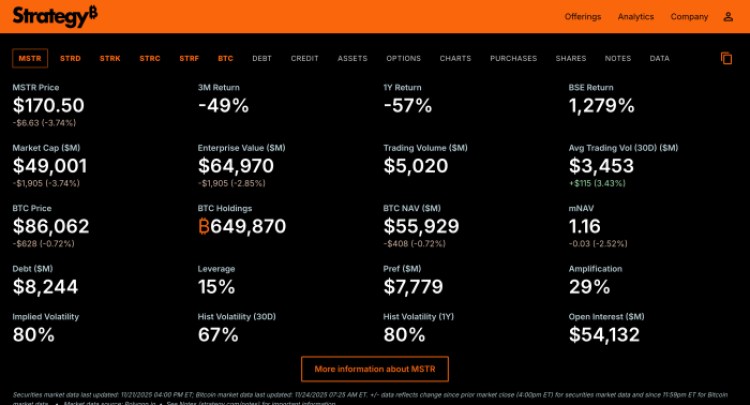
Strategy Bitcoin Holdings

Strategy even ran a poll that showed nearly 78% of respondents were simply HODLing through the sell-off. Hardcore Bitcoiners still see turbulence, not terminal failure, but not everyone’s built for that degree of mark-to-market pain.

Retail, smaller funds, and DeFi traders are increasingly searching for ways to keep Bitcoin exposure without just holding spot and praying.

That’s where the new rotation narrative comes in. If Bitcoin stays the monetary backbone of crypto, the best altcoins this cycle may be the ones solving what Bitcoin can’t: throughput, fees, and programmability.

Bitcoin Hyper ($HYPER) fits that thesis almost too well, positioning itself as a Bitcoin Layer-2 designed to make BTC behave like a fast, flexible, programmable asset, all without compromising the base layer.

Bitcoin Hyper Turns Bitcoin Volatility Into Layer-2 Utility

Behind the branding, Bitcoin Hyper is targeting a very real structural gap in the Bitcoin ecosystem. BTC still handles only a handful of transactions per second, and fees spike whenever activity increases, which is why most of today’s DeFi, NFTs, and on-chain experimentation have migrated to faster environments, such as Solana.

Bitcoin Hyper’s solution is a rollup-style Layer-2 anchored to Bitcoin but powered by an SVM (Solana Virtual Machine) execution layer. Users send BTC to a monitored main-chain address, a canonical bridge verifies the deposit, and the network mints an equivalent amount of wrapped BTC on Hyper.

From there, transactions run on a high-throughput chain with near-instant finality and low fees, while zero-knowledge proofs periodically settle back to Bitcoin L1.

The architecture aims to preserve Bitcoin’s security while moving actual activity, payments, DEX trades, lending, NFT markets, even meme-coin chaos, onto a chain that feels Solana-fast.

Because it uses SVM, existing Rust developers can port their apps with minimal friction, giving Hyper a realistic shot at building an ecosystem instead of becoming another pretty but empty L2.

Of course, there are risks. $HYPER is still in presale, and the roadmap is ambitious: audits and presale throughout 2025, mainnet and SVM+dApp integration between late 2025 and early 2026, then token listings, SDKs, and a DAO rollout in 2026. Execution needs to hit those milestones for the L2 thesis to play out.

Security is at least trending positively. The contracts have already cleared audits from Coinsult and SpyWolf, with no hidden mint functions or obvious backdoors flagged, a good start, even if it doesn’t eliminate the typical smart-contract and market risks associated with new chains.

For anyone who wants to stay structurally long Bitcoin while also capturing upside from where the next wave of blockspace demand might land, $HYPER offers a clean play.

If Bitcoin activity increases and DeFi migrates toward BTC-secured infrastructure, a functioning Bitcoin-anchored Layer-2 could absorb a disproportionate share of that value.

Inside the Bitcoin Hyper Presale and $HYPER Token Economics

While Bitcoin has been violently whipsawing, the Bitcoin Hyper presale has been doing the opposite, grinding steadily upward. It has now crossed $28.3M raised, with the current stage pricing $HYPER around $0.013325.

That still puts it in micro-cap range, but the raise is now large enough that this is no longer a small degen side-quest. Real capital is flowing in.

Presale buyers can also stake $HYPER at 41% rewards, with more than a billion tokens already locked. Those yields will naturally taper off as more wallets join in, but the intent is clear: early participants are encouraged to behave like long-term network partners, not short-term flippers.

It aligns neatly with the idea of $HYPER acting as a “beta on Bitcoin’s evolution” rather than just another momentum meme.

On the valuation side, upside scenarios being circulated are bold but at least mathematically grounded. One widely shared fundamental review puts a potential 2025 high near $0.02595 once mainnet is live and liquidity deepens, roughly a 2x from the current presale range if the thesis holds.

More aggressive models project further out, mapping a possible 2026 high around $0.08625 and a 2030 target near $0.253, assuming the roadmap lands, the ecosystem fills in, and major exchanges eventually list the token.

Relative to today’s pricing, that implies roughly 6–7x to the 2026 level and close to 19x by 2030. Nothing is guaranteed, but it explains why $HYPER keeps showing up in alt-rotation threads whenever traders discuss asymmetric setups tied to Bitcoin infrastructure instead of random meme noise.

Crucially, $HYPER isn’t pitched as a hedge against Bitcoin; it’s pitched as a way to amplify it.

If Saylor’s “I Won’t Back Down” stance represents the diamond-hands end of the spectrum, Bitcoin Hyper is where the more risk-tolerant crowd is rotating: still ideologically long BTC, but looking to high-beta Layer-2 infrastructure for bigger potential multiples as the cycle churns through volatility.

This article is informational only; crypto, especially presales, is highly volatile. Always do your own research and never risk rent money.

Authored by Aaron Walker, NewsBTC – https://www.newsbtc.com/news/best-altcoins-saylor-wont-back-down-bitcoin-hyper-presale

Market Opportunity
Threshold Logo
Threshold Price(T)
$0.007152
$0.007152$0.007152
+1.11%
USD
Threshold (T) Live Price Chart
Disclaimer: The articles reposted on this site are sourced from public platforms and are provided for informational purposes only. They do not necessarily reflect the views of MEXC. All rights remain with the original authors. If you believe any content infringes on third-party rights, please contact service@support.mexc.com for removal. MEXC makes no guarantees regarding the accuracy, completeness, or timeliness of the content and is not responsible for any actions taken based on the information provided. The content does not constitute financial, legal, or other professional advice, nor should it be considered a recommendation or endorsement by MEXC.

You May Also Like

Galaxy Digital Authorizes $200M Share Buyback as Stock Rebounds

Galaxy Digital Authorizes $200M Share Buyback as Stock Rebounds

Galaxy Digital Holdings Ltd. announced this week that its board has authorized a $200 million share repurchase program for the company’s Class A common stock. Galaxy
Share
Coinstats2026/02/08 07:30
Kalshi debuts ecosystem hub with Solana and Base

Kalshi debuts ecosystem hub with Solana and Base

The post Kalshi debuts ecosystem hub with Solana and Base appeared on BitcoinEthereumNews.com. Kalshi, the US-regulated prediction market exchange, rolled out a new program on Wednesday called KalshiEco Hub. The initiative, developed in partnership with Solana and Coinbase-backed Base, is designed to attract builders, traders, and content creators to a growing ecosystem around prediction markets. By combining its regulatory footing with crypto-native infrastructure, Kalshi said it is aiming to become a bridge between traditional finance and onchain innovation. The hub offers grants, technical assistance, and marketing support to selected projects. Kalshi also announced that it will support native deposits of Solana’s SOL token and USDC stablecoin, making it easier for users already active in crypto to participate directly. Early collaborators include Kalshinomics, a dashboard for market analytics, and Verso, which is building professional-grade tools for market discovery and execution. Other partners, such as Caddy, are exploring ways to expand retail-facing trading experiences. Kalshi’s move to embrace blockchain partnerships comes at a time when prediction markets are drawing fresh attention for their ability to capture sentiment around elections, economic policy, and cultural events. Competitor Polymarket recently acquired QCEX — a derivatives exchange with a CFTC license — to pave its way back into US operations under regulatory compliance. At the same time, platforms like PredictIt continue to push for a clearer regulatory footing. The legal terrain remains complex, with some states issuing cease-and-desist orders over whether these event contracts count as gambling, not finance. This is a developing story. This article was generated with the assistance of AI and reviewed by editor Jeffrey Albus before publication. Get the news in your inbox. Explore Blockworks newsletters: Source: https://blockworks.co/news/kalshi-ecosystem-hub-solana-base
Share
BitcoinEthereumNews2025/09/18 04:40
First family moves on from Wall Street as Eric Trump backs crypto

First family moves on from Wall Street as Eric Trump backs crypto

Eric Trump says crypto could actually save the U.S. dollar. Not kill it. Not weaken it. On Tuesday, just hours after ringing the Nasdaq opening bell for American Bitcoin’s public debut, a company where he’s got over $500 million stashed, Eric told the Financial Times that crypto is “arguably” the reason the dollar might stay alive. “Mining bitcoin here, and being financially independent and running a kind of financial revolution out of the United States of America…I think it arguably saves the US dollar,” he said. The timing wasn’t random. Eric’s comments came while the dollar was getting dragged. This year, it’s been tanking… fast. The cause? President Donald Trump’s trade war and his endless public jabs at the Federal Reserve, which just slashed interest rates again. The Fed cut rates yesterday, for the first time this year, right after Donald’s latest round of pressure. It’s not helping. Investors are losing confidence in what’s supposed to be the safest currency on Earth. Eric says crypto is fun, family is done with Wall Street Eric isn’t just pushing crypto from the sidelines. His family has gone full throttle into the space. We’re talking a Truth Social Bitcoin ETF, a Bitcoin treasury tied to Trump Media, and two meme coins; $MELANIA and $TRUMP. Eric defended both coins, saying they were meant to be “fun,” and explained why people are buying in: “They want to bet on a coin, or they want to bet on a player. They want to bet on a celebrity, or they want to bet on a famous brand. Or they just love somebody to death, and they want to buy, you know, a kind of small piece of them, via digital currency.” And Eric doesn’t give Wall Street any credit. At all. He made it clear that everything they’ve built was done without the help of big-name banks. “It’s almost like the ultimate revenge against the big banks and modern finance,” he said. That jab came after the Trump Organization filed a lawsuit against Capital One, accusing the bank of closing their accounts in 2021 for political reasons — something the bank denies. But Eric wasn’t done. “You realise you just don’t need them. And frankly, you don’t miss them.” He added that he wasn’t just referring to Capital One, but “all” of Wall Street’s major lenders and their “top people.” Stablecoins, trillions, and the White House betting on crypto Stablecoins have traditional banks spooked. They think cash might flow out of the banking system if coins like Tether or Circle offer better returns. And that fear isn’t fake. It’s growing, especially after Congress passed the first major crypto law in July. Now the White House wants stablecoin issuers to buy up a fat slice of the Treasury’s debt. Why? Because these crypto firms make money on the interest from the bonds they hold. Last year, Eric co-founded World Liberty Financial Inc. (WLFI), a crypto company that runs a stablecoin called USD1, pegged to the U.S. dollar. That project has serious family backing. Donald held 15.75 billion WLFI tokens at the end of 2024, based on official filings. At Wednesday’s trading price, that holding was worth over $3 billion. When asked about the family’s financial gain from crypto, Eric downplayed it. “If my father cared about monetising his life, the last thing he would have done is run for president, where all we’ve done is un-monetise our life.” Your crypto news deserves attention - KEY Difference Wire puts you on 250+ top sites
Share
Coinstats2025/09/18 20:41