

Ethereum (ETH) Price Dips After $2,985 Rejection; Can $2,800 Support Hold?
The post Ethereum (ETH) Price Dips After $2,985 Rejection; Can $2,800 Support Hold? appeared first on Coinpedia Fintech News
The Ethereum price is slipping back after facing a firm rejection from the $2,950–$3,000 resistance zone, a level that has repeatedly capped upside momentum this month. The pullback has now opened the door for a potential retest of the $2,800 support area, a region that previously triggered strong buyer interest. While the short-term structure leans bearish, sentiment could quickly shift if the U.S. stock market regains momentum, which often spills over into crypto.
The next reaction from $2,800 will likely determine whether the ETH price rebounds—or extends its correction.
The price remained under pressure over the past 24 hours, as broader market sentiment stayed fragile. Despite the slowdown, on-chain data shows aggressive whale accumulation, with large holders adding over 300,000+ ETH during the dip—signalling growing confidence at lower levels. At the same time, institutional players facing sizeable unrealised losses are intensifying scrutiny on ETH’s price path. With retail activity weakening, Ethereum’s short-term trend now hinges on whether buyers can defend the $2,800 support.
ETH Price Analysis: Will it Rise Above $3000?
Ethereum’s price action remains fragile after another rejection near the $2,950–$3,000 zone, a level that continues to act as a firm barrier against bullish momentum. The latest pullback has pushed ETH back toward the mid-$2,800 range, where traders are watching for signs of stability. With broader market sentiment still mixed and liquidity thinning into month-end, Ethereum now sits at a critical juncture. The next reaction around support will determine whether this move becomes a deeper correction or a launchpad for recovery.
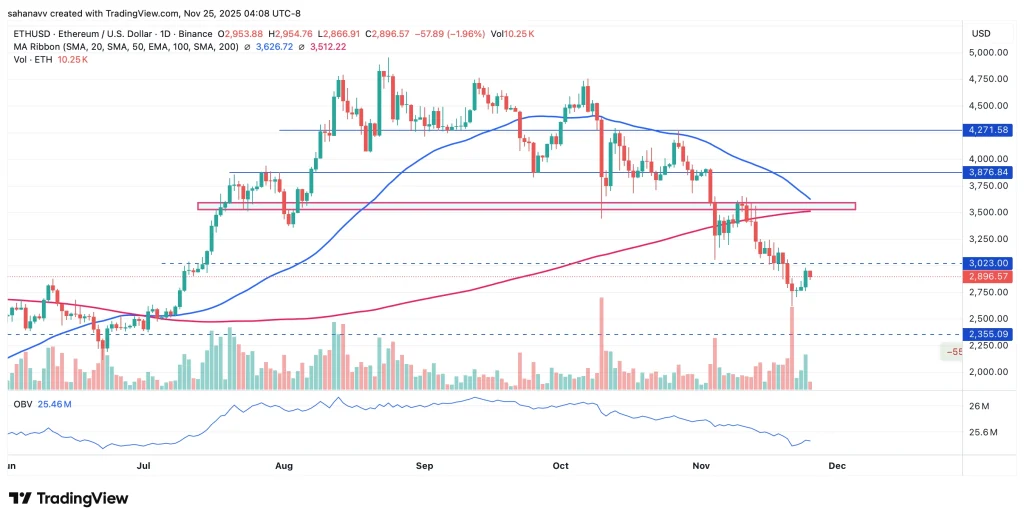
The chart highlights ETH’s sharp rejection from the $2,950–$3,000 ceiling, sending the price back toward the $2,800 support. A potential death cross, with the 50-day MA nearing a drop below the 200-day MA, signals weakening medium-term momentum. At the same time, OBV is steadily depleting, showing that real buying pressure is fading. Together, these indicators increase the probability of a deeper pullback, unless bulls defend $2,800 and force a recovery toward $3,023.
Conclusion
Ethereum’s near-term outlook hinges on how it behaves around the critical $2,800 support. The mounting risk of a death cross and a steadily weakening OBV suggest that bullish momentum is fading faster than expected. However, this zone has historically attracted strong demand, meaning a decisive bounce could quickly reopen the path toward $2,950–$3,023. If buyers fail to step in, ETH may enter a deeper corrective phase before any bullish recovery attempt can regain traction.
You May Also Like

XRP Enters ‘Washout Zone,’ Then Targets $30, Crypto Analyst Says
Republicans are 'very concerned about Texas' turning blue: GOP senator

Wormhole token soars following tokenomics overhaul, W reserve launch
Wormhole’s native token has had a tough time since launch, debuting at $1.66 before dropping significantly despite the general crypto market’s bull cycle. Wormhole, an interoperability protocol facilitating asset transfers between blockchains, announced updated tokenomics to its native Wormhole (W) token, including a token reserve and more yield for stakers. The changes could affect the protocol’s governance, as staked Wormhole tokens allocate voting power to delegates.According to a Wednesday announcement, three main changes are coming to the Wormhole token: a W reserve funded with protocol fees and revenue, a 4% base yield for staking with higher rewards for active ecosystem participants, and a change from bulk unlocks to biweekly unlocks.“The goal of Wormhole Contributors is to significantly expand the asset transfer and messaging volume that Wormhole facilitates over the next 1-2 years,” the protocol said. According to Wormhole, more tokens will be locked as adoption takes place and revenue filters back to the company.Read more