Sen. Adam Schiff from the Democratic Party introduced a new bill, the COIN Act, aimed at blocking U.S. Presidents and their families from promoting or launching cryptocurrency ventures. Why did Democrats come up with a new bill, and what is…Sen. Adam Schiff from the Democratic Party introduced a new bill, the COIN Act, aimed at blocking U.S. Presidents and their families from promoting or launching cryptocurrency ventures. Why did Democrats come up with a new bill, and what is…

COIN Act: a new turn in the Democrats battle v Trump’s cryptocurrency business?

4 min read

Sen. Adam Schiff from the Democratic Party introduced a new bill, the COIN Act, aimed at blocking U.S. Presidents and their families from promoting or launching cryptocurrency ventures. Why did Democrats come up with a new bill, and what is at stake for Donald Trump? 

Table of Contents

  • The new act
  • Burgeoning crypto empire of the Trumps
  • Future of the COIN Act

The new act

The full name of the bill introduced by Adam Schiff is Curbing Officials’ Income and Nondisclosure Act. The new act is not explicitly aimed at ruining Trump’s cryptocurrency business. Rather, it bans all the sitting presidents, vice presidents, and their immediate family members (siblings, spouses, and children) from using their privileged position in the crypto space and other financial spaces. On top of cryptocurrencies, the act regulates (bans) endorsements and issuance of securities, commodities, and futures.

The act bars top officials and their families from endorsing crypto projects and other assets and using the likeness of their names or images for the promotion of crypto ventures. The legislation is also blocking the issuance and sponsorship of assets. The COIN Act does not prohibit presidents and their families from purchasing, holding, and sending cryptocurrencies. Crypto assets held by senior officials are subject to disclosures just like other financial assets.

Violators are penalized and are subjected to disgorgement of their illegal profit to the Treasury of the U.S. If the violation led to an aggregate loss of $1,000,000 or more to a citizen or several citizens of the U.S. or if the assets were used for bribery, violators can be subjected to criminal prosecution. Understandably, insider trading and fraud are also banned.

Democrats have tried to push similar regulations before. In the spring of 2025, they tried to add clauses that would ban Trump from the crypto business to the Genius Act, regulating stablecoins. However, Democrats didn’t succeed in amending the bill. Seemingly, that was the reason for creating a new one, fully dedicated to the ties of the top officials with the business.

Burgeoning crypto empire of the Trumps

As Trump and his family are closely tied to several cryptocurrency projects, the COIN Act threatens their well-being. Adam Schiff makes it clear in a video he posted on X.

In the video, Schiff says that from Trump’s recent financial disclosure, we learned that the POTUS has gained substantial amounts of money from selling branded goods with this image or name on them (including the Trump-labeled Bible). 

However, Schiff continues, the most lucrative source of income for Trump and his family is the “cryptocurrency scheme.” One of the elements of this scheme is the Official Trump memecoin (the proceeds from this venture are not subjected to disclosures, as Trump launched the token before the inauguration). 

Another element of the scheme mentioned by Schiff is the stablecoin USD1 launched by World Liberty Finance, a company closely tied to Donald Trump and his sons, Donald and Eric. Through his involvement in World Liberty Finance, Donald Trump alone made $57 million in the first quarter of 2025.

The COIN Act threatens these ventures, as its ban on involvement in the crypto business stretches from 180 days pre-term to two years following the end of the term. It would make proceedings from memecoins Official Trump and Melania illegal, as well as the Trump family’s involvement in World Liberty Finance.

In January 2025, Trump Media and Technology Group, the parent company behind Truth Social, announced it would allocate $250 million in cryptocurrencies through a new platform Truth.Fi. Eric Trump is the chief strategic officer of the new mining venture American Bitcoin. In May, the company announced it was going public. 98% of the company belongs to Eric Trump and Donald Trump Jr. 

Future of the COIN Act

Schiff supported the GENIUS Act despite the fact that the restrictions for crypto businesses for senior officials were omitted from the bill. Generally, it shows that Schiff is not going to serve as a hurdle for crypto innovation in the U.S., while he is still concerned about eye-popping Trump’s conflict of interest. 

As of the press time, the COIN Act has the support of nine Senate Democrats. It is too early to judge if the proposal will see success. Previously, Republicans showed no interest in limiting Trump’s involvement in the crypto business, so the COIN Act may be rejected just like the amendments to the GENIUS Act that were denied before. However, time will show if this defining bill will become the rule.

Market Opportunity
Sentio Protocol Logo
Sentio Protocol Price(SEN)
$0.002639
$0.002639$0.002639
+0.95%
USD
Sentio Protocol (SEN) Live Price Chart
Disclaimer: The articles reposted on this site are sourced from public platforms and are provided for informational purposes only. They do not necessarily reflect the views of MEXC. All rights remain with the original authors. If you believe any content infringes on third-party rights, please contact service@support.mexc.com for removal. MEXC makes no guarantees regarding the accuracy, completeness, or timeliness of the content and is not responsible for any actions taken based on the information provided. The content does not constitute financial, legal, or other professional advice, nor should it be considered a recommendation or endorsement by MEXC.

You May Also Like

Three dormant wallets, suspected to belong to the same entity, purchased 5,970 ETH eight hours ago.
Three dormant wallets, suspected to belong to the same entity, purchased 5,970 ETH eight hours ago.

PANews reported on February 4 that, according to Lookonchain monitoring, three wallets that had been dormant for four years (likely controlled by the same entity
Share
PANews2026/02/04 11:36
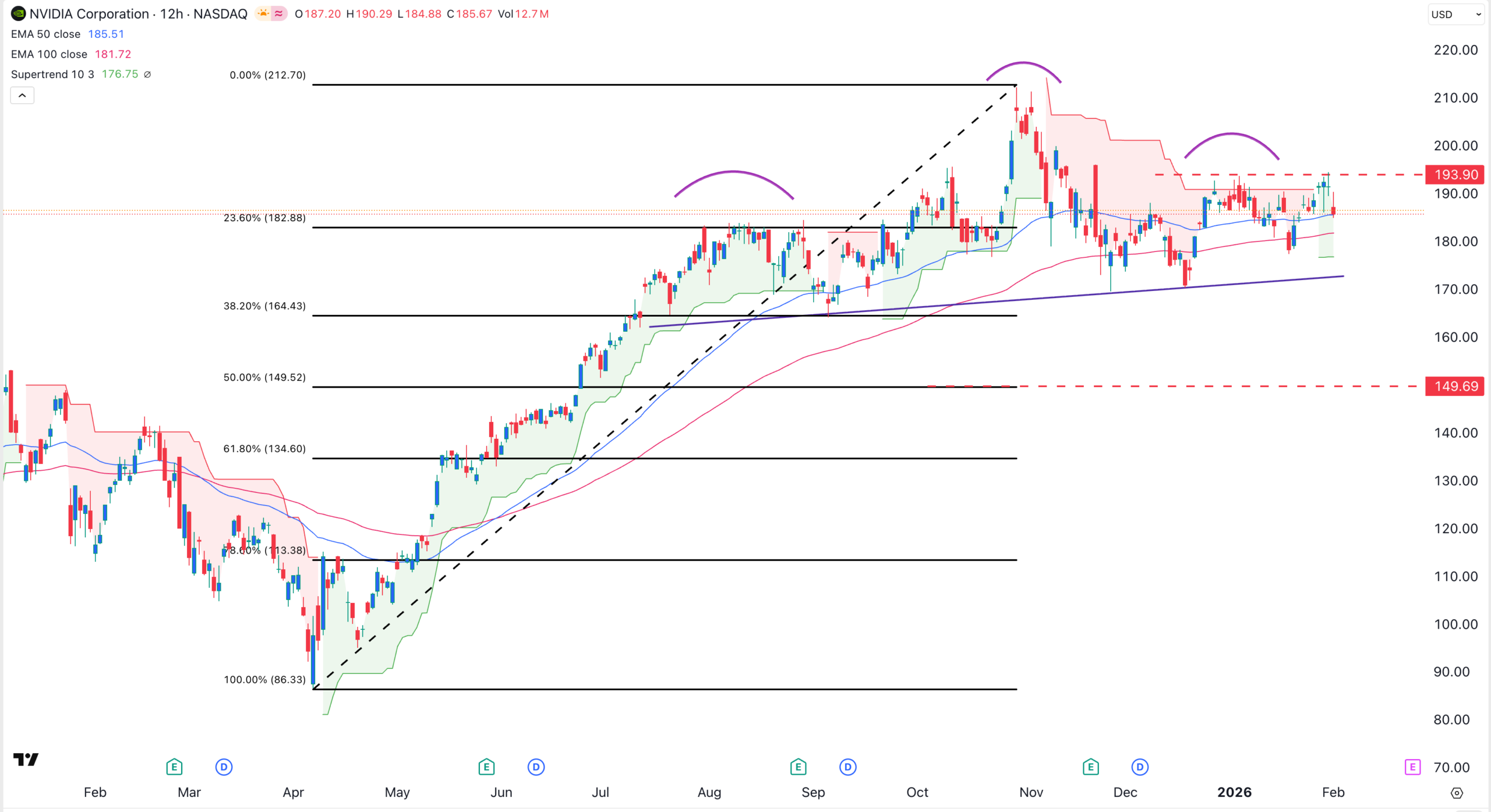
NVIDIA Stock Price Analysis as OpenAI Issues Concerns About its Chips

NVIDIA Stock Price Analysis as OpenAI Issues Concerns About its Chips

Key Insights NVIDIA stock started the week in the red. It crashed by over 2%. Meanwhile, the S&P 500, Dow Jones, and Nasdaq 100 moved close to their all-time highs
Share
Themarketperiodical2026/02/04 11:27
Ondo Finance Launches USDY Yieldcoin on Stellar, Bringing Tokenized U.S. Treasuries to Users

Ondo Finance Launches USDY Yieldcoin on Stellar, Bringing Tokenized U.S. Treasuries to Users

Ondo Finance, a U.S.-based digital asset firm specializing in bringing traditional financial products on-chain through tokenization, is expanding its yieldcoin USDY to the Stellar network. This lates update marks a step forward in merging tokenized real-world assets with a global payments infrastructure, unlocking new opportunities for users worldwide. The announcement was made at the Stellar Meridian event in Copacabana, Rio de Janeiro, on September 17. USDY Joins the Stellar Ecosystem Ondo Finance, a recognized leader in tokenized real-world assets, announced the deployment of United States Dollar Yield (USDY) on Stellar, the payments-focused blockchain known for speed and low transaction costs. USDY is the most widely available “yieldcoin,” offering investors access to onchain assets backed by U.S. Treasuries. This launch allows Stellar’s global user base to tap into permissionless, yield-bearing assets tied to one of the safest financial instruments in the world. It also aligns with Stellar’s mission of driving fast, affordable cross-border payments. Combining Yield with Payments Infrastructure “Stablecoins unlocked global access to the U.S. dollar. With USDY, we’re taking the next step by bringing U.S. Treasuries onchain in a form that combines stability, liquidity, and yield,” said Ian De Bode, Chief Strategy Officer at Ondo Finance. “Fast, affordable cross-border payments are at the center of what Stellar was designed to do. The global reach of the Stellar ecosystem combined with a yield-bearing asset like USDY levels up what is possible onchain, allowing wallets and businesses to offer yield opportunities to their users,” said Denelle Dixon, CEO of the Stellar Development Foundation. Ondo claims by pairing USDY with Stellar’s infrastructure, new possibilities open up in treasury management, collateralization, and everyday financial applications. Unlocking Institutional and Retail Use Cases USDY currently manages over $650 million in total value locked (TVL) across nine blockchains and offers a 5.3% APY. By launching on Stellar, Ondo Finance extends these benefits to global retail and institutional users. The firm explains balances on Stellar can now become productive, supporting use cases such as onchain savings, institutional treasury strategies, cost-efficient collateral for DeFi protocols, and remittance flows that carry yield rather than remaining static. A Milestone for Tokenized Treasuries With the integration of USDY, Stellar users gain more than just access to stable-value assets—they gain access to institutional-grade yield. For investors outside the U.S., the launch represents a new way to combine the safety of Treasuries with the accessibility of blockchain technology. As tokenization accelerates globally, Ondo Finance’s decision to deploy USDY on Stellar reinforces the narrative that blockchain is not just about speculation, but about reimagining the global financial system through secure, yield-bearing digital assets
Share
CryptoNews2025/09/18 00:46
