The post LUNC Price Flashes Early Signs of a Macro Bottom—Is a 288% Technical Reversal Possible? appeared first on Coinpedia Fintech News LUNC price has quietlyThe post LUNC Price Flashes Early Signs of a Macro Bottom—Is a 288% Technical Reversal Possible? appeared first on Coinpedia Fintech News LUNC price has quietly

LUNC Price Flashes Early Signs of a Macro Bottom—Is a 288% Technical Reversal Possible?

2025/12/11 21:58
3 min read
For feedback or concerns regarding this content, please contact us at crypto.news@mexc.com
Why Terra Luna Price Is Up Today

The post LUNC Price Flashes Early Signs of a Macro Bottom—Is a 288% Technical Reversal Possible? appeared first on Coinpedia Fintech News

LUNC price has quietly put together an unexpected bounce over the past week, climbing from around $0.000026 to above $0.00008 — roughly a 150% move that stands out after months of heavy selling. The shift comes as downside pressure finally appears to be easing, with LUNA and USTC also seeing speculative inflows that have revived interest across the Terra ecosystem. 

The fundamentals remain shaky, but the recent price behaviour suggests the market may be stabilising after a long period of exhaustion—and this sets the stage for a deeper look at whether a true higher-timeframe reversal is forming.

Early Bullish Intent and Conditions for MSS Confirmation

LUNC is showing its first signs of bullish displacement, hinting at a possible shift in order flow. However, these signals remain preliminary and require validation. The key trigger is a monthly close above the Market Structure Shift (MSS) level at $0.00007300. A confirmed MSS would establish a higher-timeframe trend reversal, unlock bullish Points of Interest (POIs), and open continuation setups through Breaker Blocks, Order Blocks, or Fair Value Gaps. 

Only after this confirmation can price realistically pull toward buyside liquidity at $0.00017980 and the larger draw at $0.00028000 — a potential 288% expansion.

Technical Analysis: Structure, Levels, and Liquidity Zone

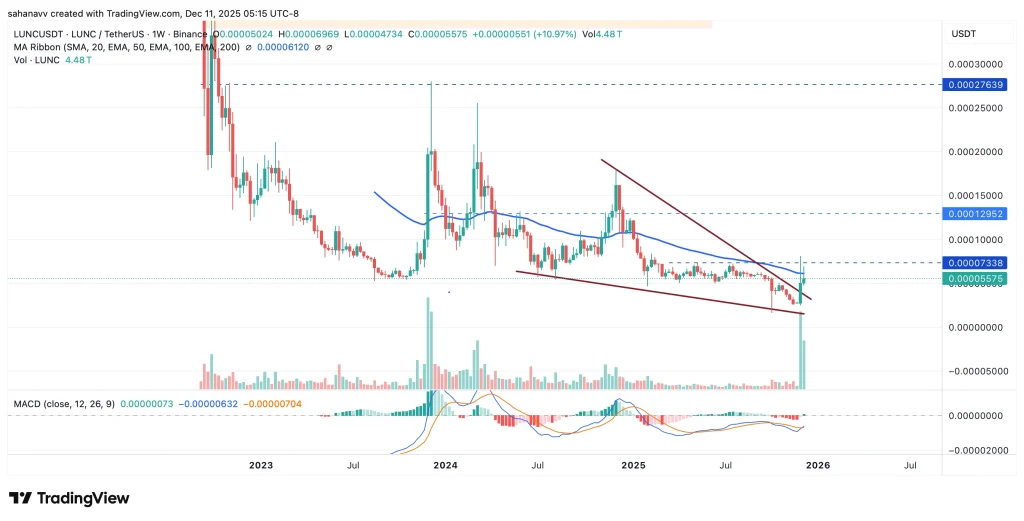
LUNC has broken out of a long-standing falling wedge on the weekly timeframe — its first meaningful structural break in months. The breakout was supported by a sharp surge in volume, indicating genuine market participation rather than a thin liquidity spike. Price has also reclaimed the 50-week moving average, a level it consistently struggled with throughout mid-2024 and 2025, which now acts as short-term support.
lunc price

The next major hurdle sits at $0.00007338, a key HTF level that price has tapped but not closed above. Clearing this zone would shift the weekly market structure and validate the broader reversal narrative. Above that, the next liquidity magnet is the $0.00012952 level, followed by the larger liquidity draw at $0.00027639.

Momentum indicators are improving as well: the MACD is crossing upward from deeply negative territory, suggesting the downtrend may finally be losing strength. While these signals are constructive, the lack of strong fundamentals means any upside continuation relies heavily on sustained volume and confirmation through higher closes.

Conclusion-What’s Next for LUNC Price?

LUNC is displaying its strongest macro-reversal signals in years, but technicals alone cannot override weak fundamentals and inconsistent demand. A monthly close above $0.00007300 is essential to confirm a legitimate Market Structure Shift; without it, any bounce remains vulnerable to rejection and renewed downside. If MSS validates, a controlled move toward liquidity zones at $0.00017980 and $0.00028000 becomes feasible. 

However, failure to reclaim MSS places LUNC at risk of prolonged sideways accumulation or deeper retests of lower support. Traders should view this as a technically promising setup, not a guaranteed reversal.

Market Opportunity
Terra Classic Logo
Terra Classic Price(LUNC)
$0.00003646
$0.00003646$0.00003646
-0.38%
USD
Terra Classic (LUNC) Live Price Chart
Disclaimer: The articles reposted on this site are sourced from public platforms and are provided for informational purposes only. They do not necessarily reflect the views of MEXC. All rights remain with the original authors. If you believe any content infringes on third-party rights, please contact crypto.news@mexc.com for removal. MEXC makes no guarantees regarding the accuracy, completeness, or timeliness of the content and is not responsible for any actions taken based on the information provided. The content does not constitute financial, legal, or other professional advice, nor should it be considered a recommendation or endorsement by MEXC.

You May Also Like

USDH Power Struggle Ignites Stablecoin “Bidding Wars” Across DeFi: Bloomberg

USDH Power Struggle Ignites Stablecoin “Bidding Wars” Across DeFi: Bloomberg

A heated contest for control over a new dollar-pegged token has set the stage for what analysts say could define the next phase of the stablecoin industry. According to Bloomberg, a bidding war unfolded on Hyperliquid, one of crypto’s fastest-growing trading platforms, with the prize being the right to issue USDH, its native stablecoin. The competition drew some of the sector’s most prominent names, including Paxos, Sky, and Ethena, who later withdrew their bid, alongside the lesser-known Native Markets, a startup backed by Stripe stablecoin subsidiary Bridge. Hyperliquid Stablecoin Race Shows Branding and Partnerships Matter as Much as Tech Over the weekend, Hyperliquid’s validators, the contributors who secure the network and vote on key decisions, awarded the USDH contract to Native Markets over the weekend. Despite its relatively new status, the firm’s connection with Stripe helped it outpace more established rivals. Stablecoins underpin decentralized finance by providing a dollar-backed medium for collateral, settlement, and payments across applications. What began as a grassroots, community-led sector has evolved into a battleground for institutions and payment companies seeking revenue from interest on reserves. Circle, for example, shares proceeds from its USDC with Coinbase under a partnership designed to stabilize earnings during market swings. The Hyperliquid contest offered a rare glimpse into just how intense competition has become. Paxos pledged to take no revenue until USDH surpassed $1 billion in circulation. Agora offered to share 100% of net revenue with Hyperliquid, while Ethena put forward 95%. All were outbid by Native Markets, whose ties to Stripe’s $1.1 billion acquisition of Bridge and subsequent rollout of the Tempo blockchain positioned it as a strong contender. “Every stablecoin issuer is extremely desperate for supply,” said Zaheer Ebtikar, co-founder of Split Capital. “They are willing to publicly announce how much they are willing to offer. It just shows it’s a very tough business for stablecoin issuers.” While USDC remains dominant on Hyperliquid with more than $5.6 billion in deposits, the arrival of USDH could shift flows and revenue dynamics. Paxos co-founder Bhau Kotecha said the firm sees the exchange’s growth as an important opportunity, while Agora’s co-founder Nick van Eck warned that awarding the contract to a vertically integrated issuer risked undermining decentralization. Regulatory positioning also factored into the debate. Paxos operates under a New York trust charter and is seeking a federal license, while Bridge holds money transmitter approvals in 30 states. Native Markets, in a blog post, cited regulatory flexibility and deployment speed as reasons for its selection. Hyperliquid said the strong engagement from its community validated the process. Circle CEO Jeremy Allaire dismissed concerns over USDC’s status, noting on X that competition benefits the ecosystem. Analysts suggested that fears of centralization may be exaggerated, noting that Hyperliquid is likely to remain neutral and support multiple stablecoins. Still, the contest over USDH highlighted a new reality for stablecoins: branding, partnerships, and business strategy are becoming as decisive as technology. Native Markets Secures USDH Stablecoin Mandate on Hyperliquid Hyperliquid has concluded its governance vote for the USDH stablecoin, awarding the mandate to Native Markets after a closely watched process that drew weeks of community debate and rival proposals. USDH, described by Hyperliquid as a “Hyperliquid-first, compliant, and natively minted” dollar-backed token, is intended to reduce the platform’s dependence on USDC and strengthen its spot markets. Validators on the decentralized exchange voted in favor of Native Markets, a relatively new player backed by Stripe’s Bridge subsidiary, over established contenders including Paxos and Ethena. The outcome followed a string of proposals offering aggressive revenue-sharing terms to win validator support, underscoring the scale of incentives attached to controlling USDH. Hyperliquid’s exchange has become a critical hub for stablecoin liquidity, with $5.7 billion in USDC, around 8% of its total supply, currently held on the network. At prevailing treasury yields, that translates to an estimated $200 million to $220 million in annual revenue for Circle, underlining why a native alternative could be transformative. Hyperliquid’s validators, who secure the network and vote on key decisions, selected Native Markets following an on-chain governance process that concluded September 15. Native Markets has laid out a phased rollout for USDH, beginning with capped minting and redemption trials before expanding into spot markets. Its reserves will be managed in cash and treasuries by BlackRock, with on-chain tokenization through Superstate and Bridge. Yield from those reserves will be split between Hyperliquid’s Assistance Fund and ecosystem development. The launch of USDH comes as Hyperliquid records record profits from perpetual futures trading, with $106 million in revenue in August alone, and prepares to slash spot trading fees by 80% to bolster liquidity. Analysts say the move positions Hyperliquid to capture more of the stablecoin economics internally, marking a significant step in its bid to rival the largest players in decentralized finance
Share
CryptoNews2025/09/18 00:48
Bitcoin Market Faces Renewed Pressure: What Lies Ahead?

Bitcoin Market Faces Renewed Pressure: What Lies Ahead?

The post Bitcoin Market Faces Renewed Pressure: What Lies Ahead? appeared on BitcoinEthereumNews.com. Recent data reveals heightened instability in the cryptocurrency

Share
BitcoinEthereumNews2026/03/31 01:21
BTC fell below $67,000, down 0.94% on the day.

BTC fell below $67,000, down 0.94% on the day.

PANews reported on March 31 that, according to OKX market data, BTC has just fallen below $67,000 and is currently trading at $66,989.20 per coin, down 0.94% on
Share
PANews2026/03/31 01:22