Bitcoin Magazine Michael Saylor’s Bitcoin Treasury Strategy Now Accounts for 3.2% of BTC Supply Strategy owns 3.2% of all Bitcoin, spending nearly $2 billion inBitcoin Magazine Michael Saylor’s Bitcoin Treasury Strategy Now Accounts for 3.2% of BTC Supply Strategy owns 3.2% of all Bitcoin, spending nearly $2 billion in

Michael Saylor’s Bitcoin Treasury Strategy Now Accounts for 3.2% of BTC Supply

Bitcoin Magazine

Michael Saylor’s Bitcoin Treasury Strategy Now Accounts for 3.2% of BTC Supply

Over the last two months, the broader bitcoin market has bled to semi-surprising lows and it seems like fear has crept into the forefront of market sentiment. But Strategy’s Michael Saylor, in true Saylor fashion, just put his head down and bought more bitcoin. 

Over the past two weeks, Strategy has spent nearly $2 billion just on Bitcoin.

Strategy has steadily expanded their Bitcoin treasury over the years, now holding 671,268 BTC — equivalent to 3.2% of all Bitcoin ever expected to exist, the company says.

The firm’s average purchase price for its holdings sits at roughly $75,000 per BTC, with a total acquisition cost of $50 billion and a current Bitcoin net asset value of $60 billion. 

Strategy has added Bitcoin in every quarter since Q3 2020, totaling 90 separate acquisitions.

Per Bitcointreasuries.net, Strategy’s Bitcoin holdings tower over every other publicly traded treasury, owning 12 times the next largest holder, MARA Holdings. 

While most companies in the top 10 hold between 13,000 and 53,000 BTC, Strategy’s accumulation dwarfs them, underscoring its unprecedented scale of BTC holdings. 

Earlier this month, Strategy created a $1.44 billion cash reserve to safeguard future dividends and interest payments, in an effort to reassure investors it would not need to sell any of its roughly $56 billion in Bitcoin amid broader Bitcoin market weakness.

Funded by recent Class A stock sales, the reserve initially covered 21 months of obligations, with plans to extend to 24 months. CEO Phong Le said the move sharply reduced the likelihood of BTC liquidation, addressing fears from prior comments. 

Strategy wants more bitcoin: ‘We are going to buy all of it’

At the Bitcoin MENA conference, Saylor discussed his bitcoin beliefs more, saying that Bitcoin was the foundation of a new digital capital and credit era. Addressing sovereign wealth funds, banks, and investors, Saylor framed Bitcoin as “digital capital,” contrasting it with traditional assets like gold, real estate, and equities, and emphasizing its potential as a core store of value in the digital economy. 

Saylor emphasized the growing institutional adoption of Bitcoin, with major U.S. banks—including Bank of America, Wells Fargo, JP Morgan, and Citi—now offering custody solutions and credit against Bitcoin. 

He also cited bipartisan government support from agencies like the Treasury, SEC, and CFTC.

Central to Strategy’s vision is converting volatile Bitcoin into predictable, yield-generating credit. Through over-collateralized instruments like STRK (8% dividend) and STRF (10% perpetual bond), Strategy delivers steady cash flows while enhancing long-term Bitcoin exposure.

Saylor claimed these mechanisms allow the company to double Bitcoin per share every seven years, creating liquidity and aligning corporate growth with investor returns. He likened Bitcoin-backed credit to gold-backed financial systems, envisioning a global shift toward digital gold-supported credit integrated into traditional banking.

Earlier this week, news came out that Strategy will retain its spot in the Nasdaq 100 index despite an annual reshuffle that removed six companies and added three.
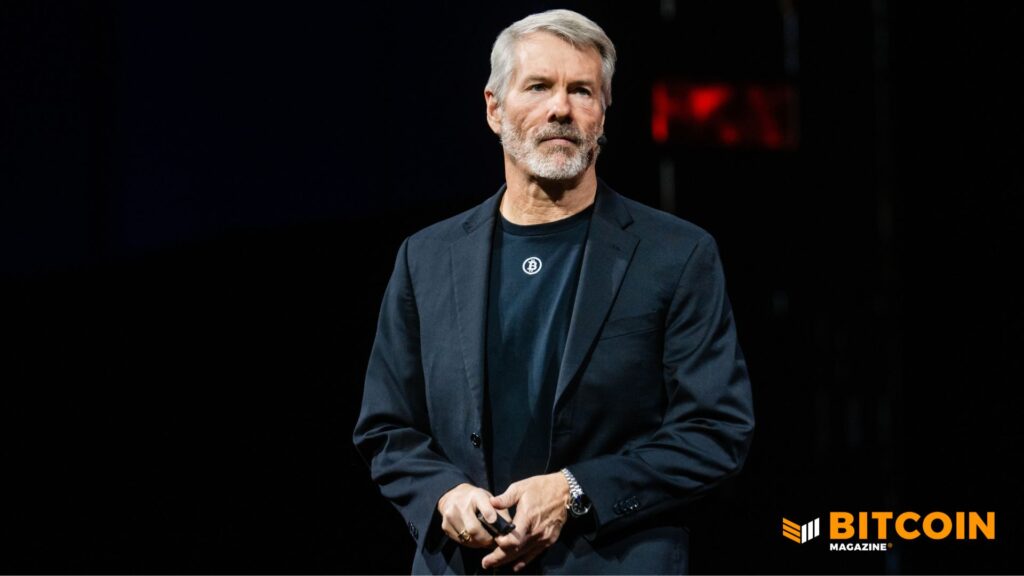
StrategyStrategy’s Michael Saylor speaking at Bitcoin Amsterdam

This post Michael Saylor’s Bitcoin Treasury Strategy Now Accounts for 3.2% of BTC Supply first appeared on Bitcoin Magazine and is written by Micah Zimmerman.

Market Opportunity
Nowchain Logo
Nowchain Price(NOW)
$0.00251
$0.00251$0.00251
-2.71%
USD
Nowchain (NOW) Live Price Chart
Disclaimer: The articles reposted on this site are sourced from public platforms and are provided for informational purposes only. They do not necessarily reflect the views of MEXC. All rights remain with the original authors. If you believe any content infringes on third-party rights, please contact service@support.mexc.com for removal. MEXC makes no guarantees regarding the accuracy, completeness, or timeliness of the content and is not responsible for any actions taken based on the information provided. The content does not constitute financial, legal, or other professional advice, nor should it be considered a recommendation or endorsement by MEXC.

You May Also Like

The Channel Factories We’ve Been Waiting For

The Channel Factories We’ve Been Waiting For

The post The Channel Factories We’ve Been Waiting For appeared on BitcoinEthereumNews.com. Visions of future technology are often prescient about the broad strokes while flubbing the details. The tablets in “2001: A Space Odyssey” do indeed look like iPads, but you never see the astronauts paying for subscriptions or wasting hours on Candy Crush.  Channel factories are one vision that arose early in the history of the Lightning Network to address some challenges that Lightning has faced from the beginning. Despite having grown to become Bitcoin’s most successful layer-2 scaling solution, with instant and low-fee payments, Lightning’s scale is limited by its reliance on payment channels. Although Lightning shifts most transactions off-chain, each payment channel still requires an on-chain transaction to open and (usually) another to close. As adoption grows, pressure on the blockchain grows with it. The need for a more scalable approach to managing channels is clear. Channel factories were supposed to meet this need, but where are they? In 2025, subnetworks are emerging that revive the impetus of channel factories with some new details that vastly increase their potential. They are natively interoperable with Lightning and achieve greater scale by allowing a group of participants to open a shared multisig UTXO and create multiple bilateral channels, which reduces the number of on-chain transactions and improves capital efficiency. Achieving greater scale by reducing complexity, Ark and Spark perform the same function as traditional channel factories with new designs and additional capabilities based on shared UTXOs.  Channel Factories 101 Channel factories have been around since the inception of Lightning. A factory is a multiparty contract where multiple users (not just two, as in a Dryja-Poon channel) cooperatively lock funds in a single multisig UTXO. They can open, close and update channels off-chain without updating the blockchain for each operation. Only when participants leave or the factory dissolves is an on-chain transaction…
Share
BitcoinEthereumNews2025/09/18 00:09
BFX Presale Raises $7.5M as Solana Holds $243 and Avalanche Eyes $1B Treasury — Best Cryptos to Buy in 2025

BFX Presale Raises $7.5M as Solana Holds $243 and Avalanche Eyes $1B Treasury — Best Cryptos to Buy in 2025

BFX presale hits $7.5M with tokens at $0.024 and 30% bonus code BLOCK30, while Solana holds $243 and Avalanche builds a $1B treasury to attract institutions.
Share
Blockchainreporter2025/09/18 01:07
Singapore Entrepreneur Loses Entire Crypto Portfolio After Downloading Fake Game

Singapore Entrepreneur Loses Entire Crypto Portfolio After Downloading Fake Game

The post Singapore Entrepreneur Loses Entire Crypto Portfolio After Downloading Fake Game appeared on BitcoinEthereumNews.com. In brief A Singapore-based man has
Share
BitcoinEthereumNews2025/12/18 05:17