

Who Really Sold The Dip? On-Chain Data Exposes Bitcoin’s True Sellers
Bitcoin has retraced to the $85,000 level, a critical support zone that bulls must defend to prevent a deeper breakdown. After failing to reclaim higher levels, price action has slowed and volatility has compressed, reinforcing a market environment dominated by apathy and fear.
Sentiment across the crypto space has deteriorated sharply, with a growing number of analysts openly discussing the possibility of a prolonged bear market extending into next year. In this context, understanding who is actually selling becomes far more important than the price move itself.
According to a recent CryptoQuant report, Bitcoin’s pullback from the ~$88.2K region toward ~$85K provides a clean on-chain read of market behavior beneath the surface. Exchange inflow data segmented by Short-Term Holders (STH) and Long-Term Holders (LTH) shows that the decline was not driven by structural distribution from long-term investors.
Historically, bear markets accelerate when long-term holders begin distributing supply. The absence of that behavior suggests the current drawdown reflects positioning adjustments and risk reduction rather than a collapse in long-term conviction. As Bitcoin tests $85K, the market is not only evaluating price support levels.
Short-Term Profit-Taking, Not Structural Distribution
The CryptoQuant report by Crazzyblockk provides a precise breakdown of who actually drove Bitcoin’s recent pullback. On December 15, when BTC traded near the $88.2K level, Short-Term Holders sent approximately 24.7K BTC to exchanges.
Crucially, 86.8% of this supply was realized in profit, while only 13.2% was sold at a loss. In dollar terms, profitable STH inflows exceeded $1.89 billion, vastly outweighing loss-driven selling. This profile clearly indicates that sellers were primarily near-term buyers exiting from strength, rather than panicked participants capitulating under stress.

As the price moved lower on December 16 toward the $86K area, total STH inflows dropped sharply to just 3.9K BTC. Although this smaller flow was realized at a loss, its limited size signals exhaustion rather than an acceleration of selling pressure. While the percentage of loss realization increased, the absolute volume did not—an important nuance often overlooked in surface-level market analysis.
Long-Term Holder behavior reinforces this constructive interpretation. Across both days, LTH inflows remained muted, falling from roughly 326 BTC to just 50 BTC. There is no sign of capitulation or meaningful distribution from this cohort. Overall, the data shows a market cooling through short-term profit-taking, not breaking through structural sell pressure.
Bitcoin Weekly Price Structure and Key Support Dynamics
Bitcoin has retraced sharply from its cycle highs and is now consolidating around the $85K–$88K zone. This area is technically significant. Price is currently interacting with the rising 100-week moving average, which has acted as dynamic support throughout the broader uptrend since 2023. So far, buyers are attempting to defend this level, preventing a deeper weekly close below it.
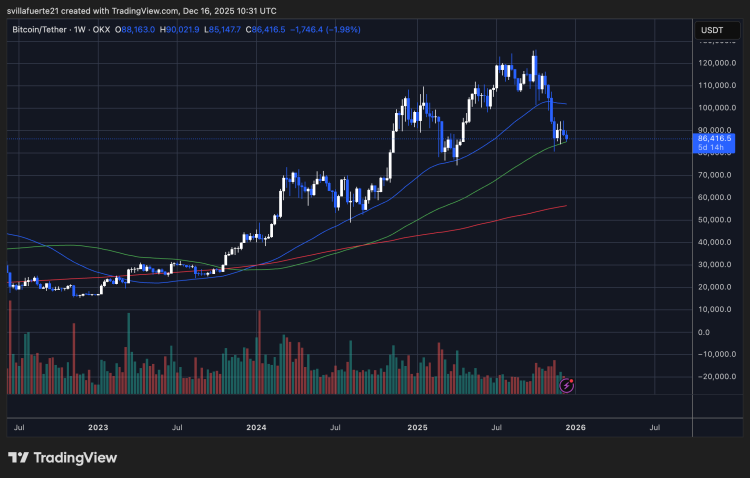
Structurally, the market has shifted from strong impulsive expansion into a corrective phase. The loss of the 50-week moving average earlier in the pullback signaled a transition from momentum-driven price discovery to consolidation and mean reversion. However, the longer-term trend remains intact as long as Bitcoin holds above the 200-week moving average, currently well below the price.
Volume has declined during the retracement, suggesting that selling pressure is not accelerating aggressively. This supports the view that the move is corrective rather than distributive. From a risk perspective, failure to hold the $85K region would open the door to a deeper retrace toward the low-$70K range.
Conversely, reclaiming the $90K–$92K zone would be required to restore bullish structure and momentum on the weekly timeframe.
Featured image from ChatGPT, chart from TradingView.com
You May Also Like

Visa Expands USDC Stablecoin Settlement For US Banks

Nasdaq Company Adds 7,500 BTC in Bold Treasury Move
