IA2 uses the TD3-TD-SWAR model and DRL to optimize index selection, reducing TPC-H workload runtime by 40% via adaptive action masking.IA2 uses the TD3-TD-SWAR model and DRL to optimize index selection, reducing TPC-H workload runtime by 40% via adaptive action masking.

Reducing TPC-H Workload Runtime by 40% with IA2 Deep Reinforcement Learning

Abstract and 1. Introduction

  1. Related Works

    2.1 Traditional Index Selection Approaches

    2.2 RL-based Index Selection Approaches

  2. Index Selection Problem

  3. Methodology

    4.1 Formulation of the DRL Problem

    4.2 Instance-Aware Deep Reinforcement Learning for Efficient Index Selection

  4. System Framework of IA2

    5.1 Preprocessing Phase

    5.2 RL Training and Application Phase

  5. Experiments

    6.1 Experimental Setting

    6.2 Experimental Results

    6.3 End-to-End Performance Comparison

    6.4 Key Insights

  6. Conclusion and Future Work, and References

Abstract

This study introduces the Instance-Aware Index Advisor (IA2), a novel deep reinforcement learning (DRL)-based approach for optimizing index selection in databases facing large action spaces of potential candidates. IA2 introduces the Twin Delayed Deep Deterministic Policy Gradient - Temporal Difference State-Wise Action Refinery (TD3-TD-SWAR) model, enabling efficient index selection by understanding workload-index dependencies and employing adaptive action masking. This method includes a comprehensive workload model, enhancing its ability to adapt to unseen workloads and ensuring robust performance across diverse database environments. Evaluation on benchmarks such as TPCH reveals IA2’s suggested indexes’ performance in enhancing runtime, securing a 40% reduction in runtime for complex TPC-H workloads compared to scenarios without indexes, and delivering a 20% improvement over existing state-of-theart DRL-based index advisors.

1 Introduction

For more than five decades, the pursuit of optimal index selection has been a key focus in database research, leading to significant advancements in index selection methodologies [8]. However, despite these developments, current strategies frequently struggle to provide both high-quality solutions and efficient selection processes [5].

\ The Index Selection Problem (ISP), detailed in Section 3, involves choosing the best subset of index candidates, considering multi-attribute indexes, from a specific workload, dataset, and under given constraints, such as storage capacity or a maximum number of indexes. This task, aimed at enhancing workload performance, is recognized as NP-hard, highlighting the complexities, especially when dealing with multi-attribute indexes, in achieving optimal index configurations [7].

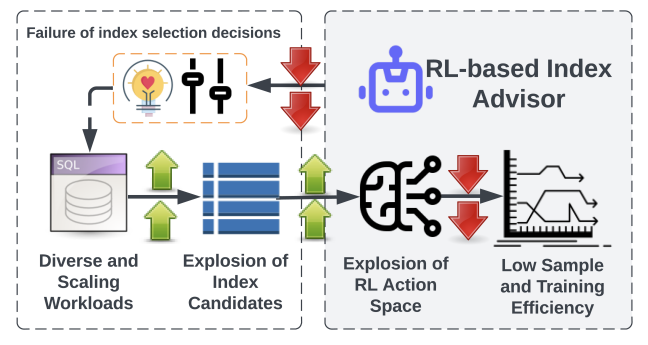
\ Reinforcement Learning (RL) offers a promising solution for navigating the complex decision spaces involved in index selection [6, 7, 10]. Yet, the broad spectrum of index options and the complexity of workload structures complicate the process, leading to prolonged training periods and challenges in achieving optimal configurations. This situation highlights the critical need for advanced solutions adept at efficiently managing the complexities of multi-attribute index selection [6]. Figure 1 illustrates the difficulties encountered with RL in index selection, stemming from the combinatorial complexity and vast action spaces. Our approach improves DRL agent efficiency via adaptive action selection, significantly refining the learning process. This enables rapid identification of advantageous indexes across varied database schemas and workloads, thereby addressing the intricate challenges of database optimization more effectively.

\ Our contributions are threefold: (i) modeling index selection as a reinforcement learning problem, characterized by a thorough system designed to support comprehensive workload representation and implement state-wise action pruning methods, distinguishing our approach from existing literature. (ii) employing TD3-TD-SWAR for efficient training and adaptive action space navigation; (iii) outperforming stateof-the-art methods in selecting optimal index configurations for diverse and even unseen workloads. Evaluated on the TPC-H Benchmark, IA2 demonstrates significant training efficiency, runtime improvements, and adaptability, marking a significant advancement in database optimization for diverse workloads.

\ Figure 1. Unique challenges to RL-based Index Advisors due to diverse and complex workloads
\

:::info This paper is available on arxiv under CC BY-NC-SA 4.0 Deed (Attribution-Noncommercial-Sharelike 4.0 International) license.

:::

\

Market Opportunity
Humanity Logo
Humanity Price(H)
$0.15629
$0.15629$0.15629
-11.77%
USD
Humanity (H) Live Price Chart
Disclaimer: The articles reposted on this site are sourced from public platforms and are provided for informational purposes only. They do not necessarily reflect the views of MEXC. All rights remain with the original authors. If you believe any content infringes on third-party rights, please contact service@support.mexc.com for removal. MEXC makes no guarantees regarding the accuracy, completeness, or timeliness of the content and is not responsible for any actions taken based on the information provided. The content does not constitute financial, legal, or other professional advice, nor should it be considered a recommendation or endorsement by MEXC.

You May Also Like

Unleashing A New Era Of Seller Empowerment

Unleashing A New Era Of Seller Empowerment

The post Unleashing A New Era Of Seller Empowerment appeared on BitcoinEthereumNews.com. Amazon AI Agent: Unleashing A New Era Of Seller Empowerment Skip to content Home AI News Amazon AI Agent: Unleashing a New Era of Seller Empowerment Source: https://bitcoinworld.co.in/amazon-ai-seller-tools/
Share
BitcoinEthereumNews2025/09/18 00:10
Coinbase On-Chain Lending: Unleash Impressive USDC Yields Up to 10.8%

Coinbase On-Chain Lending: Unleash Impressive USDC Yields Up to 10.8%

BitcoinWorld Coinbase On-Chain Lending: Unleash Impressive USDC Yields Up to 10.8% Are you looking for smarter ways to make your digital assets work for you? The world of cryptocurrency is constantly evolving, and a significant development has just arrived. Coinbase has launched an innovative Coinbase on-chain lending service for USDC, promising attractive yields. This exciting new offering allows users to earn up to 10.8% on their stablecoin holdings, opening up fresh opportunities for crypto enthusiasts and investors alike. What is Coinbase On-Chain Lending and How Does it Work? Coinbase’s new on-chain lending service is a groundbreaking step, bringing decentralized finance (DeFi) opportunities directly to its user base. This feature, as reported by The Block, is built on the robust Base network and powered by leading DeFi protocols Morpho and Steakhouse Financial. In essence, it bridges the gap between traditional crypto exchanges and the dynamic world of on-chain yield generation. Seamless Deposit Process: When you deposit USDC, Coinbase simplifies the process by creating a dedicated smart contract wallet for your funds. Optimized Yield: This smart contract then intelligently connects your USDC to multiple lending pools across the Base network. The goal is to optimize returns, ensuring you get the best possible yield. Immediate Earnings: You start earning yield right away, without any complex setup. Flexible Withdrawals: Importantly, you maintain control. Users can withdraw their funds at any time, offering crucial liquidity. This initiative makes high-yield opportunities, traditionally complex for many, incredibly accessible through the familiar Coinbase interface. It’s a powerful blend of security, simplicity, and earning potential. Maximizing Your Returns: The Power of Morpho and Base Network The impressive yields, reaching up to 10.8%, are not magic; they are the result of sophisticated underlying technology. Morpho and Steakhouse Financial, operating on the Base network, are key players in making this possible. Morpho, for instance, is known for its optimized lending protocols that aim to offer better rates by matching lenders and borrowers more efficiently. The Base network, developed by Coinbase itself, provides a secure, low-cost, and developer-friendly environment for decentralized applications. Its integration means that the Coinbase on-chain lending service benefits from: Enhanced Security: Leveraging the robust security of the underlying Ethereum network. Lower Transaction Costs: Making participation more economical for users. Scalability: Ensuring the service can handle a growing number of users and transactions efficiently. Moreover, the use of a smart contract wallet means your funds are managed transparently on the blockchain. This transparency is a cornerstone of DeFi, allowing users to verify transactions and the operational logic of the lending pools. Why Choose Coinbase for On-Chain Lending? For many, the world of decentralized finance can seem daunting due to its technical complexity and the perceived risks. Coinbase’s entry into on-chain lending significantly lowers this barrier. Here’s why this platform stands out: Trust and Reliability: Coinbase is a regulated and publicly traded company, bringing a layer of trust that is often missing in the broader DeFi landscape. User-Friendly Experience: The service is integrated directly into the Coinbase platform, making it incredibly easy for existing users to participate without navigating external DeFi protocols. Simplified Access: It abstracts away the complexities of interacting directly with smart contracts, setting up MetaMask, or managing gas fees for multiple protocols. Optimized Performance: By connecting to multiple lending pools, Coinbase aims to provide consistently competitive yields, taking the guesswork out of finding the best rates. Ultimately, this offering aims to democratize access to high-yield opportunities, making them available to a wider audience who might otherwise shy away from the intricacies of DeFi. Navigating the On-Chain Lending Landscape: Risks and Rewards While the prospect of earning up to 10.8% on your USDC is undeniably attractive, it is crucial to understand that all financial endeavors carry some level of risk. Coinbase on-chain lending, while designed for security and ease of use, is no exception. Potential risks include: Smart Contract Vulnerabilities: Although extensively audited, smart contracts can theoretically have bugs or exploits. Market Volatility: While USDC is a stablecoin, the underlying value of the assets in lending pools can fluctuate, affecting overall returns or, in extreme cases, principal. Protocol Risks: The performance of Morpho and Steakhouse Financial directly impacts the service. However, Coinbase’s involvement provides a layer of institutional oversight and expertise that can help mitigate some of these risks. They conduct due diligence on the protocols used and aim to provide a secure environment. Users should always perform their own research and understand the dynamics of on-chain lending. Conclusion: A New Era for Stablecoin Holders The launch of Coinbase on-chain lending for USDC marks a significant milestone in the evolution of cryptocurrency services. By combining the accessibility and trust of a major exchange with the high-yield potential of decentralized finance, Coinbase is empowering users to generate passive income on their stablecoin holdings with unprecedented ease. This service not only simplifies participation in DeFi but also sets a new standard for how traditional crypto platforms can integrate innovative on-chain solutions. It’s an exciting development that could redefine how many engage with their digital assets, turning dormant stablecoins into powerful earning tools. Frequently Asked Questions (FAQs) 1. What is Coinbase on-chain lending? Coinbase on-chain lending is a new service that allows users to deposit USDC and earn yields of up to 10.8%. It connects user funds to various lending pools on the Base network, powered by DeFi protocols like Morpho and Steakhouse Financial. 2. How does the 10.8% yield work? When you deposit USDC, Coinbase creates a smart contract wallet that strategically allocates your funds to multiple lending pools to optimize returns, aiming for the highest possible yield, which can reach up to 10.8%. 3. What are the risks involved with Coinbase on-chain lending? Like all DeFi services, risks include potential smart contract vulnerabilities and market volatility affecting underlying assets. However, Coinbase’s institutional oversight and use of audited protocols aim to mitigate some of these risks. 4. Can I withdraw my funds from Coinbase on-chain lending at any time? Yes, one of the key benefits of this service is the flexibility it offers. Users can withdraw their deposited USDC and accrued yield at any time. 5. Which networks and protocols power this service? The service is powered by the Base network, developed by Coinbase, and utilizes decentralized finance protocols such as Morpho and Steakhouse Financial to manage lending pools and optimize yields. 6. Is Coinbase on-chain lending available to all users? Availability may vary based on jurisdiction and regulatory requirements. Users should check the Coinbase platform or their local regulations to confirm eligibility. Did you find this article insightful? Share it with your friends and colleagues on social media to help them discover the exciting opportunities with Coinbase on-chain lending! To learn more about the latest crypto lending trends, explore our article on key developments shaping decentralized finance institutional adoption. This post Coinbase On-Chain Lending: Unleash Impressive USDC Yields Up to 10.8% first appeared on BitcoinWorld.
Share
Coinstats2025/09/19 00:35
Koscom Pursues Korean Won Stablecoin with 5 Trademark Applications

Koscom Pursues Korean Won Stablecoin with 5 Trademark Applications

Detail: https://coincu.com/news/koscom-korean-won-stablecoin-trademark/
Share
Coinstats2025/09/18 18:39
