Solana’s price action this year has followed a clear but uncomfortable pattern. After pushing to a new all-time high around the $296 region in January, the rallySolana’s price action this year has followed a clear but uncomfortable pattern. After pushing to a new all-time high around the $296 region in January, the rally

Why Has The Solana Price Been In A Steady Downtrend Since January?

2025/12/25 02:00

Solana’s price action this year has followed a clear but uncomfortable pattern. After pushing to a new all-time high around the $296 region in January, the rally quickly lost momentum and transitioned into a steady decline that has persisted for months. 

Many traders have attributed this weakness to a risk-off sentiment across crypto, but a deeper on-chain breakdown shared by crypto analyst Ardi on X suggests the story began well before the January peak and has more to do with who was buying and who was quietly exiting.

Distribution Was Already Underway Before The January Peak

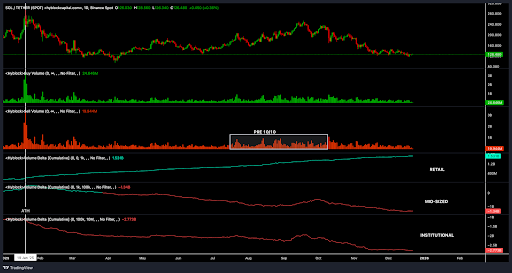
Solana has been on a clear downtrend since September, when it reached a lower high of around $247 compared to its January 19 all-time high of $293. One of the most important insights from Ardi’s analysis is that Solana’s January all-time high did not mark the start of distribution but rather the culmination of it. 

The chart attached to his post shows that selling volume was already increasing months earlier, well ahead of October, meaning that large holders were positioning for exits long before price reached its final peak. From that perspective, the January high looks less like the beginning of a new expansion phase and more like the last push of a rally. 
Solana

After that point, price action began forming lower highs, and each rebound attempt lacked the strength needed to reclaim the all-time high. Interestingly, Solana failed to reach a new all-time high, even as other large market cap cryptos like Bitcoin, Ethereum, XRP, and BNB pushed to new all-time highs during the year.

Another interesting feature of the data is the widening gap between retail behavior and that of larger players. Cumulative delta metrics on the chart show that retail-sized wallets have been consistently active throughout the year and are increasing their activity even as Solana’s price moved lower.

On the other hand, mid-sized and institutional wallets tell a very different story. Their activity has been trending downward for months, starting from the January peak and extending up until the time of writing.

Is Solana’s Price Becoming Dependent On Memecoin Activity?

Ardi’s analysis also raises a broader question about what is currently driving demand for Solana. Outside of retail activity on Solana itself, one of the few consistent sources of activity has been the memecoin sector. Successes and booms of meme coins like Cat in a Dogs World (MEW), Peanut the Squirrel (PNUT), and Fartcoin (FARTCOIN), which gained traction in the second half of 2024, contributed to Solana’s push to all-time highs during those periods.

Those meme coin successes culminated with the launch of the Official Trump ($TRUMP) token in January 2025 on Solana, which experienced eye-watering gains shortly after its launch. This, in turn, contributed to Solana’s all-time high in January. 

However, since then, the TRUMP token and other Solana-based meme coins have been trending downwards in recent months and no longer command the same level of attention or trading intensity they had this time last year. That has led to the view that Solana’s price is increasingly sensitive to the success of memecoins in its ecosystem. 

At the time of writing, Solana is trading at $121.50, down by about 58.6% from its January all-time high of $293.

Solana
Market Opportunity
WHY Logo
WHY Price(WHY)
$0.00000001619
$0.00000001619$0.00000001619
0.00%
USD
WHY (WHY) Live Price Chart
Disclaimer: The articles reposted on this site are sourced from public platforms and are provided for informational purposes only. They do not necessarily reflect the views of MEXC. All rights remain with the original authors. If you believe any content infringes on third-party rights, please contact service@support.mexc.com for removal. MEXC makes no guarantees regarding the accuracy, completeness, or timeliness of the content and is not responsible for any actions taken based on the information provided. The content does not constitute financial, legal, or other professional advice, nor should it be considered a recommendation or endorsement by MEXC.

You May Also Like

Santander’s Openbank Sparks Crypto Frenzy in Germany

Santander’s Openbank Sparks Crypto Frenzy in Germany

 In Germany, the digital bank Santander Openbank introduces trading in crypto, which offers BTC, ETH, LTC, POL, and ADA in the MiCA framework of the EU. Santander, the largest bank in Spain, has officially introduced cryptocurrency trading to its clients in Germany, using its digital division, Openbank.  With this new service, users can purchase, sell, […] The post Santander’s Openbank Sparks Crypto Frenzy in Germany appeared first on Live Bitcoin News.
Share
LiveBitcoinNews2025/09/18 04:30
China Blocks Nvidia’s RTX Pro 6000D as Local Chips Rise

China Blocks Nvidia’s RTX Pro 6000D as Local Chips Rise

The post China Blocks Nvidia’s RTX Pro 6000D as Local Chips Rise appeared on BitcoinEthereumNews.com. China Blocks Nvidia’s RTX Pro 6000D as Local Chips Rise China’s internet regulator has ordered the country’s biggest technology firms, including Alibaba and ByteDance, to stop purchasing Nvidia’s RTX Pro 6000D GPUs. According to the Financial Times, the move shuts down the last major channel for mass supplies of American chips to the Chinese market. Why Beijing Halted Nvidia Purchases Chinese companies had planned to buy tens of thousands of RTX Pro 6000D accelerators and had already begun testing them in servers. But regulators intervened, halting the purchases and signaling stricter controls than earlier measures placed on Nvidia’s H20 chip. Image: Nvidia An audit compared Huawei and Cambricon processors, along with chips developed by Alibaba and Baidu, against Nvidia’s export-approved products. Regulators concluded that Chinese chips had reached performance levels comparable to the restricted U.S. models. This assessment pushed authorities to advise firms to rely more heavily on domestic processors, further tightening Nvidia’s already limited position in China. China’s Drive Toward Tech Independence The decision highlights Beijing’s focus on import substitution — developing self-sufficient chip production to reduce reliance on U.S. supplies. “The signal is now clear: all attention is focused on building a domestic ecosystem,” said a representative of a leading Chinese tech company. Nvidia had unveiled the RTX Pro 6000D in July 2025 during CEO Jensen Huang’s visit to Beijing, in an attempt to keep a foothold in China after Washington restricted exports of its most advanced chips. But momentum is shifting. Industry sources told the Financial Times that Chinese manufacturers plan to triple AI chip production next year to meet growing demand. They believe “domestic supply will now be sufficient without Nvidia.” What It Means for the Future With Huawei, Cambricon, Alibaba, and Baidu stepping up, China is positioning itself for long-term technological independence. Nvidia, meanwhile, faces…
Share
BitcoinEthereumNews2025/09/18 01:37
Ripple-Backed Evernorth Faces $220M Loss on XRP Holdings Amid Market Slump

Ripple-Backed Evernorth Faces $220M Loss on XRP Holdings Amid Market Slump

TLDR Evernorth invested $947M in XRP, now valued at $724M, a loss of over $220M. XRP’s price dropped 16% in the last 30 days, leading to Evernorth’s paper losses
Share
Coincentral2025/12/26 03:56