In the first half of 2025, the blockchain industry suffered over $2.37 billion in losses due to security incidents, with the DeFi sector hit the hardest. Scams targeting individual users have also proliferated, with AI enabling increasingly sophisticated schemes. According…In the first half of 2025, the blockchain industry suffered over $2.37 billion in losses due to security incidents, with the DeFi sector hit the hardest. Scams targeting individual users have also proliferated, with AI enabling increasingly sophisticated schemes. According…

$2.4B lost in 2025 H1 crypto hacks — exchanges and DeFi hit hardest: report

4 min read

In the first half of 2025, the blockchain industry suffered over $2.37 billion in losses due to security incidents, with the DeFi sector hit the hardest. Scams targeting individual users have also proliferated, with AI enabling increasingly sophisticated schemes.

According to SlowMist’s mid-year “Blockchain Security and AML Report,” the blockchain industry saw approximately $2.37 billion in losses across 121 security incidents in the first half of 2025. This represents an almost 66% increase in financial losses compared to the same period in 2024, despite a decline in the number of incidents.
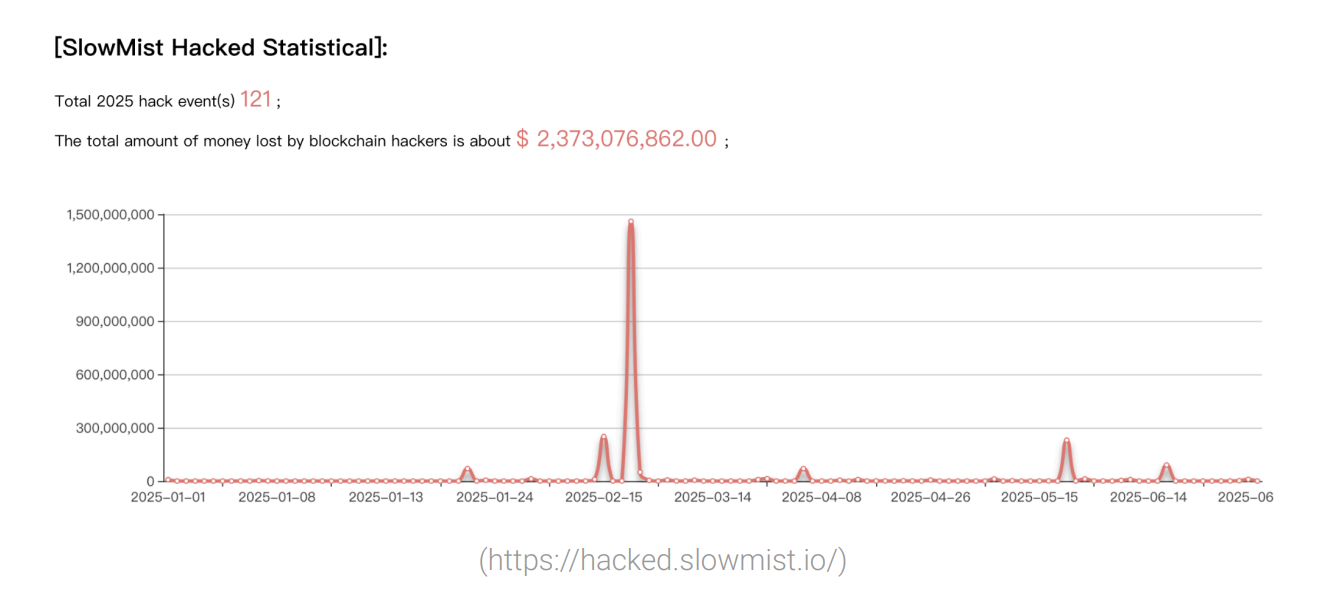
$2.4B lost in 2025 H1 crypto hacks — exchanges and DeFi hit hardest: report - 1

DeFi continues to be the most targeted sector, accounting for 76.03% of all incidents and approximately $470 million in losses. However, CEX platforms experienced $1.883 billion in losses from just 11 incidents, indicating high-value targets for attackers.

Account compromises were the leading cause of security incidents, followed by smart contract vulnerabilities.

Beyond direct attacks on projects, SlowMist’s report highlighted several fraud tactics targeting individual users that have characterized the first half of 2025:

Phishing Using EIP-7702

Attackers are exploiting new features of the EIP-7702 contract delegation mechanism that was introduced with Ethereum’s Pectra upgrade. On May 24, a user lost $146,551 after falling victim to a phishing attack that misused MetaMask’s EIP-7702 delegation feature. The scam, carried out by the Inferno Drainer group, tricked the user into authorizing a legitimate-looking contract, which then exploited bulk token approvals to drain funds.

Deepfakes

The rapid advancement of generative AI has ushered in a new wave of “trust-based scams.” In early 2025, a fake Zoom meeting using deepfakes led to the theft of all crypto assets from Mehdi Farooq, a partner at Hypersphere Ventures, after attackers impersonated known contacts and tricked him into downloading malware. Other high-profile cases include AI-generated videos of Elon Musk and Singapore officials promoting fake investment schemes.

Telegram Fake Safeguard Scams

These scams trick users into executing malicious code from their clipboard. Victims were lured through fake X accounts impersonating crypto influencers, then redirected to Telegram groups where “Tap to verify” links activated trojan-laced PowerShell commands. These attacks led to full device compromise, allowing remote access tools steal wallet files, private keys, and even control Telegram accounts across both Windows and macOS systems.

Malicious Browser Extensions

Disguised as “Web3 security tools” or exploiting automatic update mechanisms, these fake extensions hijack download links to install malicious software and steal mnemonic phrases, private keys, or login credentials. One high-profile case involved the “Osiris” extension, where attackers hijacked a legitimate developer’s Chrome Web Store account through a phishing-based OAuth exploit, pushing a stealthy malicious update to over 2.6 million users.

LinkedIn Recruitment Phishing

In 2025, LinkedIn-based phishing surged as attackers posed as blockchain startups to lure engineers into downloading malware disguised as technical tests. Scammers shared professional-looking project briefs and design documents, eventually sending victims to repositories containing heavily encrypted malicious payloads. Once executed, these backdoors steal host information, credentials, SSH private keys, and system Keychain data.

Social Engineering Attacks

Social engineering scams surged in early 2025, with the most high-profile case involving Coinbase. In this incident, attackers bribed overseas customer support staff to leak user data, then impersonated Coinbase reps using spoofed phone numbers and phishing messages to lure victims into transferring funds to wallets controlled by scammers. According to SlowMist, such coordinated attacks resulted in over $100 million in total user losses.

Backdoor Supply Chain Attacks via Low-Cost AI Tools

Developers seeking “unlimited access to advanced AI models” via unofficial channels risk installing malicious npm packages that deeply tamper with local applications. SlowMist flagged a case where a startup lost hundreds of thousands due to malicious code generated by such a tool, which installed backdoors via npm packages. Over 4,200 developers, mostly on macOS, were affected, allowing attackers remote control and credential theft.

Unrestricted Large Language Models

SlowMist’s report highlights several LLMs that have been “jailbroken” to bypass the ethical restrictions of their original versions. WormGPT specializes in generating malware-related content and phishing emails, while FraudGPT can produce fake crypto project materials and clones phishing pages. DarkBERT, trained on dark web data, enables highly targeted social engineering campaigns. GhostGPT can create deepfake scams impersonating exchange execs, among other malicious uses.

Market Opportunity
DeFi Logo
DeFi Price(DEFI)
$0.000338
$0.000338$0.000338
-4.24%
USD
DeFi (DEFI) Live Price Chart
Disclaimer: The articles reposted on this site are sourced from public platforms and are provided for informational purposes only. They do not necessarily reflect the views of MEXC. All rights remain with the original authors. If you believe any content infringes on third-party rights, please contact service@support.mexc.com for removal. MEXC makes no guarantees regarding the accuracy, completeness, or timeliness of the content and is not responsible for any actions taken based on the information provided. The content does not constitute financial, legal, or other professional advice, nor should it be considered a recommendation or endorsement by MEXC.

You May Also Like

Shibarium May No Longer Turbocharge Shiba Inu Price Rally, Here’s Reason

Shibarium May No Longer Turbocharge Shiba Inu Price Rally, Here’s Reason

The post Shibarium May No Longer Turbocharge Shiba Inu Price Rally, Here’s Reason appeared on BitcoinEthereumNews.com. Shibarium, the layer-2 blockchain of the Shiba Inu (SHIB) ecosystem, is battling to stay active. Shibarium has slipped from hitting transaction milestones to struggling to record any transactions on its platform, a development that could severely impact SHIB. Shibarium transactions crash from millions to near zero As per Shibariumscan data, the total daily transactions on Shibarium as of Sept. 16 stood at 11,600. This volume of transactions reflects how low the transaction count has dropped for the L2, whose daily average ranged between 3.5 million and 4 million last month. However, in the last week of August, daily transaction volume on Shibarium lost momentum, slipping from 1.3 million to 9,590 as of Aug. 28. This pattern has lingered for much of September, with the highest peak so far being on Sept. 5, when it posted 1.26 million transactions. The low user engagement has greatly affected the transaction count in recent days. In addition, the security breach over the weekend by malicious attackers on Shibarium has probably worsened issues. Although developer Kaal Dhairya reassured the community that the attack to steal millions of BONE tokens was successfully prevented, users’ confidence appears shaken. This has also impacted the price outlook for Shiba Inu, the ecosystem’s native token. Following reports of the malicious attack on Shibarium, SHIB dipped immediately into the red zone. Unlike on previous occasions where investors accumulated on the dip, market participants did not flock to Shiba Inu. Shiba Inu price struggles, can burn mechanism help? With the current near-zero crash in transaction volume for Shibarium, SHIB’s price cannot depend on it to support a rally. It might take a while to rebuild user confidence and for transactions to pick up again. In the meantime, Shiba Inu might have to rely on other means to boost prices from its low levels. This…
Share
BitcoinEthereumNews2025/09/18 07:57
👨🏿‍🚀TechCabal Daily – When banks go cashless

👨🏿‍🚀TechCabal Daily – When banks go cashless

In today's edition: South Africa's biggest banks are going cashless || Onafriq and PAPSS pilot Naira wallet transfers from Nigeria to Ghana || South Africa just
Share
Techcabal2026/02/04 14:02
Wormhole launches reserve tying protocol revenue to token

Wormhole launches reserve tying protocol revenue to token

The post Wormhole launches reserve tying protocol revenue to token appeared on BitcoinEthereumNews.com. Wormhole is changing how its W token works by creating a new reserve designed to hold value for the long term. Announced on Wednesday, the Wormhole Reserve will collect onchain and offchain revenues and other value generated across the protocol and its applications (including Portal) and accumulate them into W, locking the tokens within the reserve. The reserve is part of a broader update called W 2.0. Other changes include a 4% targeted base yield for tokenholders who stake and take part in governance. While staking rewards will vary, Wormhole said active users of ecosystem apps can earn boosted yields through features like Portal Earn. The team stressed that no new tokens are being minted; rewards come from existing supply and protocol revenues, keeping the cap fixed at 10 billion. Wormhole is also overhauling its token release schedule. Instead of releasing large amounts of W at once under the old “cliff” model, the network will shift to steady, bi-weekly unlocks starting October 3, 2025. The aim is to avoid sharp periods of selling pressure and create a more predictable environment for investors. Lockups for some groups, including validators and investors, will extend an additional six months, until October 2028. Core contributor tokens remain under longer contractual time locks. Wormhole launched in 2020 as a cross-chain bridge and now connects more than 40 blockchains. The W token powers governance and staking, with a capped supply of 10 billion. By redirecting fees and revenues into the new reserve, Wormhole is betting that its token can maintain value as demand for moving assets and data between chains grows. This is a developing story. This article was generated with the assistance of AI and reviewed by editor Jeffrey Albus before publication. Get the news in your inbox. Explore Blockworks newsletters: Source: https://blockworks.co/news/wormhole-launches-reserve
Share
BitcoinEthereumNews2025/09/18 01:55