

Why Bitcoin Prioritizes Simple Validation Over Complex Execution
The industry is realizing that Bitcoin was deliberately designed to prioritize simple, deterministic validation over complex on-chain execution. This design choice minimizes resource requirements, preserves decentralization, and reduces systemic risk even if it means pushing complex logic, programmability, and heavy computation to higher layers or external systems.
How Bitcoin Avoids Complex State Transitions
The fundamental limitation of Bitcoin is its inability to run heavy verification logic at a low cost, a core constraint that every BitVM-based bridge must navigate. According to the GOAT Network post on X, to address these issues, they are introducing a BitVM2 design that will ensure disputes are affordable enough to be executed under real fee conditions. The security mechanism is addressed through optimistic verification using garbled circuits (GC).
This operator, which is set to launch soon, publishes the garbled-circuit artifacts off-chain, while committing only the relevant labels on-chain. If the computation is correct, no on-chain action will be required. Meanwhile, if something is wrong, a challenger does not need to replay an expensive computation on-chain.
Instead, they produce a minimal fraud-proof to reveal the output “0” label that contradicts the operator’s claimed result. At that point, the on-chain step is about demonstrating a contradiction, which will reduce the cost of disputes and change the economics of security.
A practical detail in BitVM designs is that the garbled circuit size matters, and pairing heavy verification can cause bloated circuits. To avoid this, BitVM2 integrates a designated-verifier SNARK, which reduces verifier complexity so that the garbled circuits remain within realistic size limits. For end users, the implication is that the cheaper, more reliable depute paths make it harder for the bridge to stall when the fees spike.
Public Companies Are Becoming Bitcoin’s Strongest Buyers
While several projects are being introduced to improve the efficiency of Bitcoin, seasoned crypto expert and the founder of the Wealth Mastery Newspaper, Lark Davis, has revealed that many public companies are aggressively accumulating BTC. Currently, public companies collectively hold 1.09 million BTC, representing 5.1% of the total BTC supply, which is a new all-time high.
However, the latest major aggressive purchases have come from MicroStrategy and Metaplanet. Strategy just announced another 1,200 BTC purchase, pushing its total holdings to 672,000 BTC. Asia-based firm Metaplanet also bought an additional 4,200 BTC in December, bringing its total holdings to 35,000 BTC.
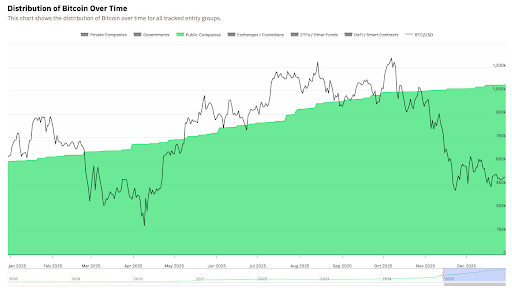
Davis pointed out that other recent purchases have come from Cango Inc., Bitdeer Technologies, and Anap Holdings. While retail investors are demonstrating weakening sentiment, public companies or institutional investors continue to stack regardless of the ongoing market.
You May Also Like

WLFI Expands Into Forex With World Swap Launch

BUZZ HPC Closes Acquisition of 7.2 MW Toronto Site to Build Data Centre for Sovereign AI Infrastructure

BitGo wins BaFIN nod to offer regulated crypto trading in Europe
BitGo’s move creates further competition in a burgeoning European crypto market that is expected to generate $26 billion revenue this year, according to one estimate. BitGo, a digital asset infrastructure company with more than $100 billion in assets under custody, has received an extension of its license from Germany’s Federal Financial Supervisory Authority (BaFin), enabling it to offer crypto services to European investors. The company said its local subsidiary, BitGo Europe, can now provide custody, staking, transfer, and trading services. Institutional clients will also have access to an over-the-counter (OTC) trading desk and multiple liquidity venues.The extension builds on BitGo’s previous Markets-in-Crypto-Assets (MiCA) license, also issued by BaFIN, and adds trading to the existing custody, transfer and staking services. BitGo acquired its initial MiCA license in May 2025, which allowed it to offer certain services to traditional institutions and crypto native companies in the European Union.Read more