Highlights of the first digital asset conference of the US "Crypto Tsar": Promoting market structure and stablecoin bills, and evaluating Bitcoin reserves
Author: Weilin, PANews
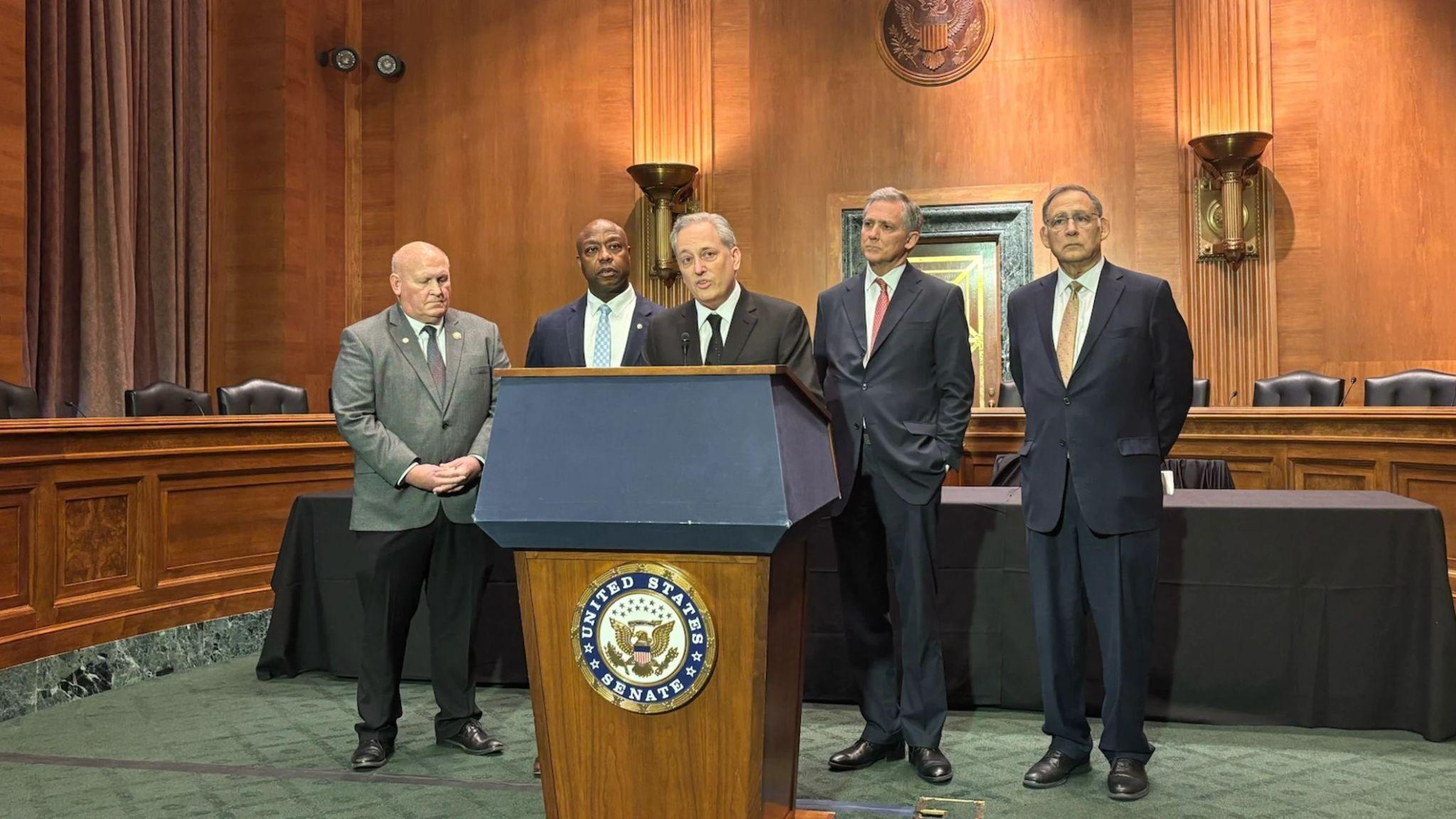
In the early morning of February 5th, Beijing time, David Sacks, the White House director of artificial intelligence and cryptocurrency, and several U.S. congressional lawmakers held their first press conference on digital assets on Capitol Hill, detailing the latest plans of the White House and Congress to implement the development of digital assets in the United States.
Sacks said at the meeting that he looks forward to working with congressional lawmakers to "create a golden age of digital assets." He revealed that the Bitcoin reserve proposal is being evaluated, although it is still in its early stages.
On the Securities and Exchange Commission (SEC), there are reports that the commission is reducing the team that was responsible for cryptocurrency enforcement actions and reassigning some lawyers, a move that marks a shift in the SEC's cryptocurrency regulation. At the same time, the SEC has launched a website for the cryptocurrency task force, and the head of the task force, Hester Peirce, has listed ten priority tasks, focusing on the classification and regulation of crypto assets.
David Sacks: Looking forward to "creating a golden age of digital assets" and evaluating Bitcoin reserve proposals
Sacks stressed at the launch event that he looks forward to working with Congress to “create a golden age for digital assets.” The event also featured Senate Banking Committee Chairman Tim Scott, Senate Agriculture Committee Chairman John Boozman, House Financial Services Committee Chairman French Hill, and House Agriculture Committee Chairman GT Thompson.
The committees are forming a bicameral committee to lead cryptocurrency regulation, planning to build on the market structure legislation "FIT21" bill passed by the House Financial Services Committee last year, and combine it with the new stablecoin bill released by Senator Bill Hagerty on February 4 to promote a new round of legislation. Senate Banking Committee Chairman Tim Scott said he plans to "do his best to actively" push these bills through the Senate within the first 100 days.
Sacks also confirmed that the President’s Digital Asset Task Force, established by Trump’s executive order, will first look at the feasibility of a Bitcoin reserve, but he noted that the initiative is still in its early stages as some members of the task force have yet to be confirmed.
Senator Bill Hagerty Introduces New Stablecoin Bill GENIUS
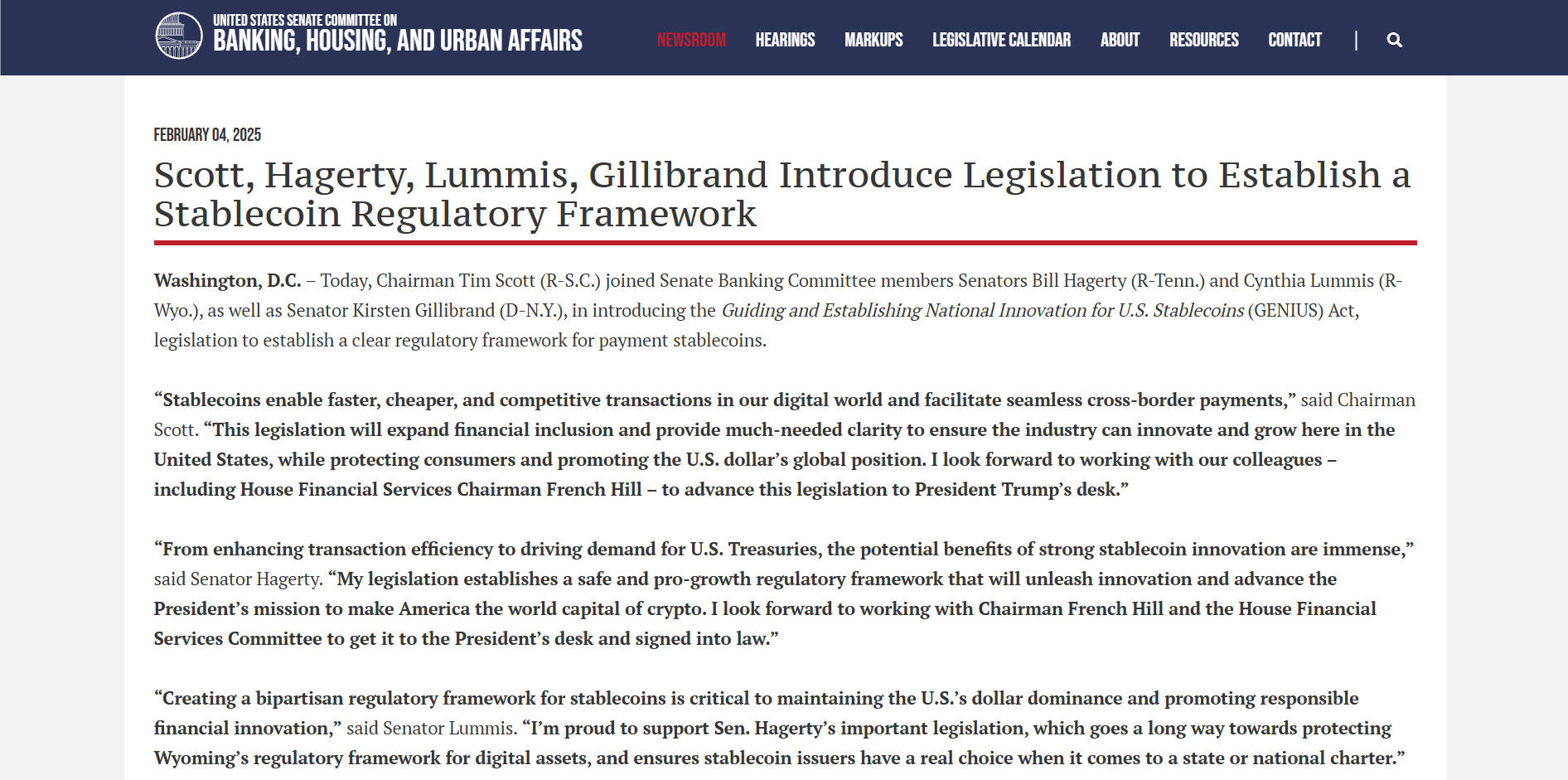
As mentioned above, on February 4, U.S. Senator Bill Hagerty proposed a bill to create a regulatory framework for stablecoins and bring tokens such as Tether and USDC under the Federal Reserve’s regulatory rules.
The stablecoin bill aims to create “a safe and pro-growth regulatory framework that unleashes the potential of innovation” and advance President Trump’s pledge to make the United States the “world capital of cryptocurrency.”
Hagerty’s “Guiding and Establishing a National Innovation for a United States Stablecoin (GENIUS) Act” is supported by Sen. Tim Scott, Sen. Kirsten Gillibrand, and Sen. Cynthia Lummis.
Hagerty added on the X platform that he looks forward to working with Rep. French Hill and the House Financial Services Committee to "get it to the president's desk and sign it into law."
Hagerty’s stablecoin bill revolves around a discussion draft he submitted for former Rep. Patrick McHenry’s Clarity for Payment Stablecoins Act, which he submitted last October.
The main contents of the GENIUS Act include:
- Defines a payment stablecoin as a digital asset used for payment or settlement that is pegged to a fixed monetary value;
- Establish clear procedures for institutions seeking licenses to issue stablecoins;
- Implement reserve requirements for stablecoin issuers and set lightweight, tailored regulatory standards;
- Adopt the Federal Reserve’s regulatory framework for depository institutions and the Office of the Comptroller of the Currency’s framework for non-bank issuers for stablecoin issuers with more than $10 billion in issuance;
- Allowing state regulation of issuers with a market capitalization of less than $10 billion and providing an exemption process for issuers above that threshold to continue to be regulated by the state;
- Establish a regulatory, inspection and enforcement mechanism with clear limits.
Tether (USDT) and Circle’s USD Coin (USDC) are the only two stablecoins with a market cap of more than $10 billion, according to data from CoinGecko.
Stablecoin issuers are also required to provide audited reserve reports on a monthly basis, and submitting false information could result in criminal penalties.
SEC launches crypto task force website to adjust regulatory strategy
On February 5, the New York Times reported that five people familiar with the matter revealed that the SEC has reduced a special team of more than 50 lawyers and staff members who were responsible for cryptocurrency enforcement actions. This move is one of the first concrete measures taken by Trump and his administration to reduce regulation of cryptocurrencies and other digital assets. One of Trump's first executive orders aims to promote the development of cryptocurrencies and "eliminate excessive regulation of digital assets."
Some lawyers on the cryptocurrency group are being assigned to other parts of the SEC, according to people familiar with the matter. A senior lawyer on the group was transferred out of the enforcement division.
Current SEC Acting Chairman Mark T. Uyeda made a series of appointments while reshuffling other top positions at the SEC. One of the first things Uyeda did upon taking office was to form a group to review the SEC’s approach to digital assets. The working group is led by SEC Commissioner and outspoken cryptocurrency supporter Hester Peirce.
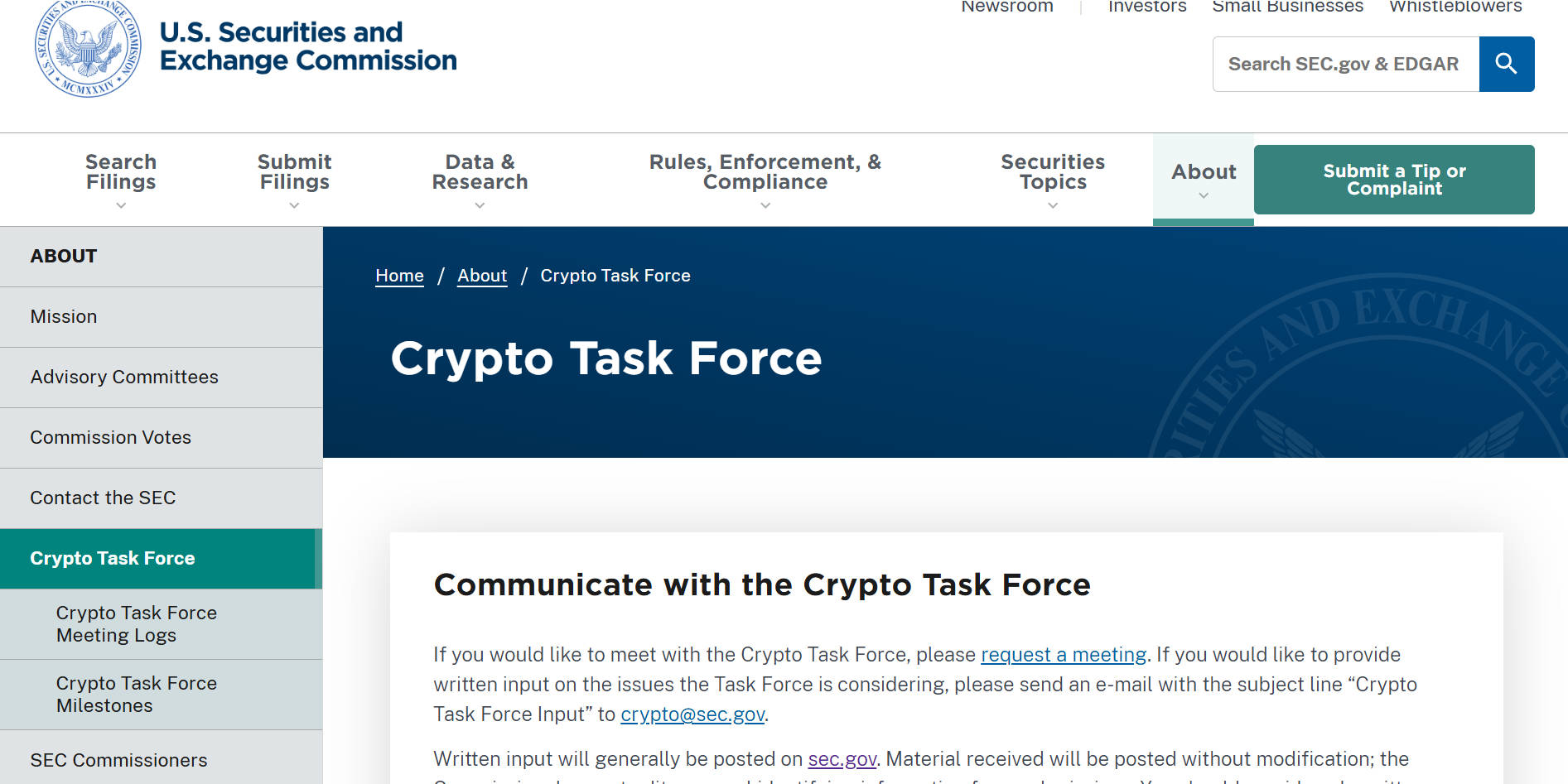
On February 4th local time, the U.S. Securities and Exchange Commission (SEC) launched the website page of the Cryptocurrency Task Force, listing the group's 10 priorities, including resolving the issue of what kind of cryptocurrencies are classified as securities rather than commodities, and creating a more "feasible" registration path by modifying the existing registration path of the U.S. Securities and Exchange Commission (SEC).
Other priorities include “clarifying whether crypto lending and staking programs are regulated by securities laws” and deciding which parts of the market fall outside the SEC’s jurisdiction.
At present, as the White House and the U.S. Congress work closely together to promote the development of digital assets, the legislative process of the United States in terms of cryptocurrency and stablecoin regulation is gradually accelerating. Although many proposals are still in the early stages, the framework around Bitcoin reserves and stablecoins is gradually taking shape. With the gradual adjustment of the SEC's crypto task force, whether the United States can lead crypto innovation globally is worth continuing to pay attention to.
You May Also Like

Ethereum unveils roadmap focusing on scaling, interoperability, and security at Japan Dev Conference

Here’s How Consumers May Benefit From Lower Interest Rates