Binance became the first global exchange to secure full authorization under ADGM’s internationally recognized framework and crossed 300 million registered.Binance became the first global exchange to secure full authorization under ADGM’s internationally recognized framework and crossed 300 million registered.

Binance’s 2025 End-of-Year Report: Trust, Liquidity, and Web3 Discovery
Binance’s 2025 End-Of-Year Report: Trust, Liquidity, And Web3 Discovery

Main Takeaways

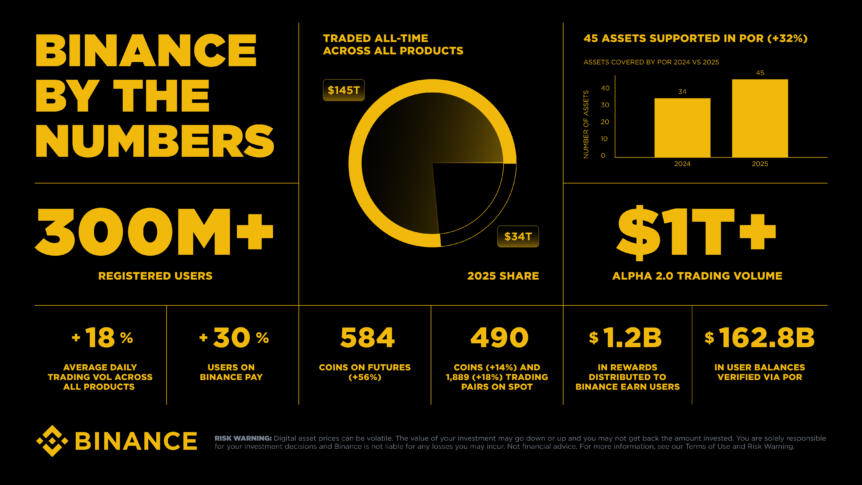
  • In 2025, Binance became the first global exchange to secure full authorization under ADGM’s internationally recognized framework and crossed 300 million registered users worldwide, signaling a new phase where scale and regulatory scrutiny advance together.

  • Binance remained a primary venue for global crypto liquidity, with $34 trillion traded on the platform in 2025 and spot volume exceeding $7.1 trillion, alongside an 18% increase in average daily trading volume across all products.

  • Crypto’s center of gravity expanded beyond the order book as Binance Alpha 2.0 surpassed $1 trillion in trading volume with 17 million users, while Binance’s security, compliance, risk, and governance efforts delivered measurable user protection outcomes at scale.

Binance’s State of the Blockchain 2025 year-in-review report is out, highlighting the most important themes and growth metrics across regulation, liquidity, Web3 discovery, institutional adoption, user protection, and the everyday use of crypto. For the full set of findings, product updates, and data points, you can read the full report available here in English.

Two milestones arrived close together at the end of 2025: Binance became the first crypto exchange to secure full authorization under the Financial Services Regulatory Authority (FSRA) of ADGM’s rigorous regulatory framework, allowing regulated global trading, and our community crossed 300 million registered users worldwide. Together, they reflect how expectations in our industry are changing as crypto platforms are increasingly judged as financial infrastructure – on governance, resilience, user protection, and the ability to perform under stress, in addition to scale, liquidity, and the strength of the user community.

Trust as Infrastructure: Regulation, Resilience, and Measurable Outcomes

The ADGM framework covers governance, risk management, custody, clearing, and consumer protection, aligning crypto market structure more closely with the expectations placed on traditional financial venues.

The report also emphasizes that trust can be measured in outcomes. Since 2023, Binance has reduced direct exposure to major illicit funds categories by 96%. In 2025, Binance’s controls helped prevent $6.69 billion in potential fraud and scam losses for 5.4 million users. Over the same period, Binance processed 71,000+ law enforcement requests, supported the confiscation of around $131 million linked to illicit activity by law enforcement partners, and delivered 160+ law enforcement training sessions.

Trust is also built by reducing unnecessary friction for legitimate users. One example that the report highlights is Enhanced Due Diligence redesign, where we simplified submission steps and improved pass rates in a short implementation cycle, aiming to make compliance stronger without making user experience harder than it needs to be.

Where Liquidity Lives: Depth, Participation, and New Discovery Flows

Liquidity still determines the trading experience users actually get: spreads, slippage, and execution reliability. In 2025, Binance processed $34 trillion in trading volume across all products, with spot trading volume above $7.1 trillion. All-time traded volume reached $145 trillion across all products.

At the same time, participation is becoming more diverse. Binance expanded spot markets to 490 coins and 1,889 spot trading pairs, and futures coverage to 584 coins. Tools also shifted user behavior toward more structured participation, including simulation and automation. Binance Demo Trading, a unified spot and futures demo environment with virtual funds, was used by more than 300,000 users as a way to learn interfaces and test strategies before trading with real funds. In futures, more than 1.2 million users subscribed to Smart Money, a live suite for tracking aggregated behavior signals from profitable traders.

The report also highlights a meaningful shift in where users discover and engage with new projects. Binance Alpha 2.0 became a major discovery surface integrated into the Binance experience, surpassing $1 trillion in trading volume and onboarding 17 million users in 2025. It distributed $782 million in rewards across 254 airdrops. With that scale came added integrity requirements: the report notes that risk controls blocked 270,000 dishonest reward participants attempting to game campaigns, helping keep rewards aligned with real users rather than bot activity.

Institutions in Motion: From Pilot Programs to Operational Workflows

Another theme running through the report is institutional adoption shifting from experimentation to integration. Institutions are increasingly looking for crypto infrastructure that fits governance, collateral, reporting, and settlement requirements they already use. The increasing scale of their presence was reflected on Binance over the past year as institutional trading volume grew by 21% compared to the year before, and OTC fiat trading volume shot up by 210%.

In 2025, tokenization moved closer to operational use cases, including tokenized funds used as eligible off-exchange collateral under Binance’s institutional collateral framework. The report also describes how modular offerings, including white-label rails through Crypto-as-a-Service, are enabling regulated firms to offer digital assets without rebuilding full exchange infrastructure from scratch. Account structures offered through Fund Accounts, Binance Wealth, and Binance Prestige reflect how capital is organized in traditional finance, with formats that support managed strategies, entity onboarding, and dedicated service models.

Everyday Crypto: Local Rails, Payments, and Earning

Beyond trading and discovery, crypto adoption depends on whether users can fund accounts in local currency, move value easily, and choose earning tools that match their risk preferences. In 2025, Fiat and P2P volume grew 38%; Binance Pay users grew 30% year over year, and acceptance expanded massively to more than 20 million merchants. Across its line of products, Binance Earn distributed $1.2 billion in rewards to users in 2025.

Final Thoughts

Digital finance is becoming more standards-driven, more liquid where execution is reliable, and more user-directed as discovery and participation become easier. Binance’s 2025 numbers show scale, but the deeper point is what that scale requires: regulatory anchors like ADGM authorization, resilience and security programs that prevent real losses, strong data protection and AI governance, and product design that reduces friction for legitimate users while raising the cost of abuse. This blog only summarizes a selection of the report’s findings. The full report includes deeper breakdowns, supporting context, and additional product and infrastructure updates.

Read the complete State of the Blockchain 2025 report here.

This article was originally published as Binance’s 2025 End-of-Year Report: Trust, Liquidity, and Web3 Discovery on Crypto Breaking News – your trusted source for crypto news, Bitcoin news, and blockchain updates.

Market Opportunity
Intuition Logo
Intuition Price(TRUST)
$0.07679
$0.07679$0.07679
+3.79%
USD
Intuition (TRUST) Live Price Chart
Disclaimer: The articles reposted on this site are sourced from public platforms and are provided for informational purposes only. They do not necessarily reflect the views of MEXC. All rights remain with the original authors. If you believe any content infringes on third-party rights, please contact service@support.mexc.com for removal. MEXC makes no guarantees regarding the accuracy, completeness, or timeliness of the content and is not responsible for any actions taken based on the information provided. The content does not constitute financial, legal, or other professional advice, nor should it be considered a recommendation or endorsement by MEXC.

You May Also Like

Momentous Grayscale ETF: GDLC Fund’s Historic Conversion Set to Trade Tomorrow

Momentous Grayscale ETF: GDLC Fund’s Historic Conversion Set to Trade Tomorrow

BitcoinWorld Momentous Grayscale ETF: GDLC Fund’s Historic Conversion Set to Trade Tomorrow Get ready for a significant shift in the world of digital asset investing! A truly momentous event is unfolding as Grayscale’s Digital Large Cap Fund (GDLC) makes its highly anticipated transition into a spot crypto exchange-traded fund. This isn’t just a name change; it’s a pivotal moment for the broader cryptocurrency market, bringing a new era of accessibility and institutional participation through the Grayscale ETF. What’s Happening with the Grayscale ETF Conversion? Tomorrow marks a historic day for Grayscale’s Digital Large Cap Fund (GDLC). This existing spot crypto basket is officially scheduled to begin trading under its new identity: the Grayscale CoinDesk Crypto5 ETF. This exciting development comes directly after the U.S. Securities and Exchange Commission (SEC) gave its stamp of approval to Grayscale’s application for this conversion. As Bloomberg ETF analyst Eric Balchunas highlighted, this move has been keenly watched. The approval and subsequent launch underscore a growing acceptance of crypto-backed financial products within traditional markets. For investors, this conversion of the Grayscale ETF represents a more streamlined and regulated way to gain exposure to a diversified basket of large-cap digital assets. Why is the Grayscale ETF a Game-Changer for Investors? The conversion of GDLC into a Grayscale ETF offers several compelling benefits, fundamentally changing how investors can access the crypto market. Firstly, ETFs are known for their ease of trading. They can be bought and sold on traditional stock exchanges, just like company shares, making them incredibly accessible to a wider range of investors who might be hesitant to directly hold cryptocurrencies. Consider these key advantages: Enhanced Accessibility: Investors can gain exposure to a diversified crypto portfolio without needing to set up crypto wallets or manage private keys. Increased Liquidity: Trading on major exchanges typically means higher liquidity, allowing for easier entry and exit points. Regulatory Oversight: As an SEC-approved product, the Grayscale ETF operates under a regulated framework, potentially offering greater investor protection and confidence. Diversification: The Grayscale CoinDesk Crypto5 ETF tracks a basket of large-cap cryptocurrencies, offering immediate diversification rather than exposure to a single asset. This development is a strong indicator of the maturation of the digital asset space. It signals a bridge between the innovative world of crypto and the established financial system. Navigating the New Grayscale ETF Landscape While the launch of the Grayscale CoinDesk Crypto5 ETF brings exciting opportunities, it’s also important for investors to understand its implications. The shift from a closed-end fund structure (GDLC) to an open-ended ETF means that the fund’s shares can now be created and redeemed daily. This mechanism helps keep the ETF’s market price closely aligned with the net asset value (NAV) of its underlying holdings. Historically, closed-end funds like GDLC could trade at significant premiums or discounts to their NAV. The ETF structure is designed to mitigate these discrepancies, providing a more efficient pricing mechanism. This change offers a more transparent and potentially less volatile investment experience for those looking to invest in a Grayscale ETF. What’s Next for Crypto ETFs and Grayscale? The successful conversion and launch of the Grayscale CoinDesk Crypto5 ETF could pave the way for similar transformations of other Grayscale products. It also sets a precedent for how existing crypto investment vehicles might evolve to meet market demand for regulated, accessible products. The increasing number of spot crypto ETFs, including this new Grayscale ETF, reflects a growing institutional appetite for digital assets. This trend suggests a future where cryptocurrency investing becomes an even more integrated part of mainstream financial portfolios. As regulatory clarity continues to improve, we can anticipate further innovation and expansion in the crypto ETF landscape, offering investors diverse options to participate in the digital economy. The launch of the Grayscale CoinDesk Crypto5 ETF is more than just a new product; it’s a testament to the persistent efforts to bring digital assets into the mainstream financial fold. By offering a regulated, accessible, and diversified investment vehicle, Grayscale is not only expanding opportunities for investors but also reinforcing the legitimacy and staying power of the crypto market. This momentous step truly reshapes the investment landscape, making it easier for a broader audience to engage with the exciting potential of cryptocurrencies through a trusted Grayscale ETF. Frequently Asked Questions (FAQs) What is the Grayscale CoinDesk Crypto5 ETF? The Grayscale CoinDesk Crypto5 ETF is the new name and structure for Grayscale’s former Digital Large Cap Fund (GDLC). It’s a spot crypto basket that holds a diversified portfolio of large-cap digital assets, now trading as an exchange-traded fund. When will the Grayscale ETF begin trading? The Grayscale CoinDesk Crypto5 ETF is scheduled to begin trading tomorrow, following its approval by the U.S. Securities and Exchange Commission (SEC). How does an ETF differ from the previous GDLC fund? As an ETF, the fund’s shares can be created and redeemed daily, which helps keep its market price closely aligned with the value of its underlying assets. The previous GDLC fund was a closed-end fund that could trade at significant premiums or discounts to its net asset value. What are the benefits of investing in the Grayscale ETF? Benefits include enhanced accessibility (trading on traditional exchanges), increased liquidity, regulatory oversight by the SEC, and immediate diversification into a basket of large-cap cryptocurrencies. Is the Grayscale ETF suitable for all investors? While the Grayscale ETF offers a regulated and accessible way to invest in crypto, all investments carry risks. Investors should conduct their own research and consider their financial goals and risk tolerance before investing in any ETF, including this Grayscale ETF. Did you find this article informative? Share this exciting news about the Grayscale ETF conversion with your friends, family, and fellow investors on social media to keep them informed about the latest developments in the crypto world! To learn more about the latest crypto market trends, explore our article on key developments shaping Bitcoin and Ethereum price action. This post Momentous Grayscale ETF: GDLC Fund’s Historic Conversion Set to Trade Tomorrow first appeared on BitcoinWorld.
Share
Coinstats2025/09/19 17:45
The UA Sprinkler Fitters Local 669 JATC – Notice of Privacy Incident

The UA Sprinkler Fitters Local 669 JATC – Notice of Privacy Incident

Landover, Maryland, February 6, 2026– The UA Sprinkler Fitters Local 669 Joint Apprenticeship and Training Committee (“JATC”) is providing notice of an event that
Share
AI Journal2026/02/07 07:30
Vitalik Buterin Reveals Ethereum’s (ETH) Future Plans – Here’s What’s Planned

Vitalik Buterin Reveals Ethereum’s (ETH) Future Plans – Here’s What’s Planned

The post Vitalik Buterin Reveals Ethereum’s (ETH) Future Plans – Here’s What’s Planned appeared on BitcoinEthereumNews.com. Ethereum founder Vitalik Buterin presented the network’s new roadmap, which includes its short-, medium-, and long-term goals, at the Developer Conference held in Japan today. Scalability, cross-layer compatibility, privacy, and security were the prominent topics in Buterin’s speech. Buterin stated that the short-term focus will be on increasing gas limits on the Ethereum mainnet (L1). He said that tools such as block-level access lists, ZK-EVMs, gas price restructuring, and slot optimization will be used in this context. The goal is to maintain the network’s decentralization while increasing scalability. The medium-term goal is to enable trustless asset transfers between Layer-2 (L2) networks and achieve faster transaction finality. In this context, “Stage 2 Rollup” solutions, proof-of-conduct combinations, and optimizations for reading data from L1 are on the agenda. Furthermore, network optimizations such as shortening slot times, fast finality protocols, and erasure coding are planned to improve user experience and security. Buterin emphasized that privacy is a priority for both the short and medium term. Zero-knowledge (ZK) proofs, anonymous pools, encrypted voting, and scrambling network solutions are highlighted to protect the privacy of users’ on-chain payments, voting, DeFi transactions, and account changes. Furthermore, secure execution environments, secret query techniques, and the ability to conceal fraudulent requests and data access patterns are also targeted when reading data from the chain. Buterin’s long-term vision highlights a minimalist, secure, and simple Ethereum. This roadmap includes resistance to the risks posed by quantum computers, securing the protocol with mathematical methods (formal verification), and transitioning to ideal cryptographic solutions. Buterin stated that these strategic steps will transform Ethereum into a more scalable, user-friendly, and secure infrastructure. With the strengthening of L2 networks, more users will be able to use Ethereum with less trust assumptions. The ultimate goal is for Ethereum to become a reliable foundational infrastructure for global…
Share
BitcoinEthereumNews2025/09/18 15:57