The National Collegiate Athletic Association has asked the US Commodity Futures Trading Commission to immediately suspend college sports prediction markets, warningThe National Collegiate Athletic Association has asked the US Commodity Futures Trading Commission to immediately suspend college sports prediction markets, warning

NCAA Demands CFTC Halt $320M College Sports Betting Markets—Citing Student Safety

3 min read

The National Collegiate Athletic Association has asked the US Commodity Futures Trading Commission to immediately suspend college sports prediction markets, warning that the fast-growing sector is exposing student-athletes to heightened risks and undermining the integrity of college competition.

The request targets an estimated $320 million in active college sports markets, a figure that reflects how quickly prediction platforms have expanded into territory long dominated by regulated sportsbooks.

As Prediction Markets Grow, NCAA Pushes for Safeguards

In a letter dated January 14, 2026, NCAA President Charlie Baker urged CFTC Chairman Michael Selig to halt collegiate sports prediction trading until stronger safeguards are put in place.
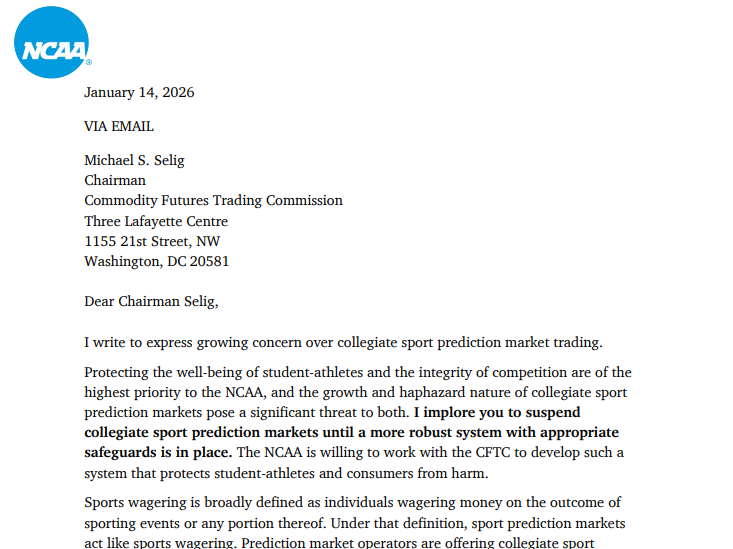
Source: NCAA

Baker argued that although prediction markets are often framed as financial products, many now function in practice like sports wagering.

NCAA noted that platforms are offering moneyline, spread, and total markets on college games that closely mirror traditional betting, while operating under a lighter regulatory framework.

The timing of the letter comes as prediction markets experience explosive growth. Total daily trading volume across major platforms reached a record $701.7 million on January 12, with sports accounting for a growing share of activity.

Source: Dune analysis

Platforms such as Kalshi and Polymarket together processed tens of billions of dollars in trades during 2025, and sports markets now represent roughly three-quarters of Kalshi’s weekly volume and nearly 40% of Polymarket’s.

That scale has drawn institutional interest, but it has also raised alarms among regulators and sports bodies.

At the center of the NCAA’s concern is student safety. Baker warned that college prediction markets often allow participants as young as 18, compared with the 21-and-over requirement in most states for sports betting.

NCAA surveys show that 58 percent of individuals aged 18 to 22 have participated in sports betting, with a significant portion reporting academic, financial, and mental health consequences.

The letter also highlighted gaps in advertising rules. While sportsbooks face restrictions on marketing to college campuses, similar limits do not consistently apply to prediction markets.

The NCAA said some students may mistakenly view prediction trading as a form of investing rather than gambling, despite the inherent unpredictability of sports outcomes.

NCAA Cites Harassment and Integrity Gaps in College Prediction Platforms

That framing, Baker argued, increases the risk of excessive participation and financial harm.

Integrity monitoring was another key issue, as the NCAA monitors more than 23,000 contests annually for suspicious activity and relies on detailed data, including bettor geolocation, to investigate irregularities.

Baker said many prediction platforms lack this level of oversight and are not required to share integrity alerts with other operators or governing bodies.

He pointed to recent efforts by prediction platforms to seek approval for markets tied to the college transfer portal as an example of activity that could create severe risks for athletes if left unchecked.

The NCAA also raised concerns about harassment, as Baker said student-athletes frequently report abuse from bettors, including online harassment tied to game outcomes.

He argued that prediction markets should be required to enforce anti-harassment measures across platforms, including banning participants who target athletes.

Harm reduction resources were also cited as missing, with the NCAA noting that many states direct sportsbook revenue toward gambling education and treatment programs on campuses, a mechanism that prediction markets do not consistently provide.

The request places the CFTC in a difficult position, as prediction markets fall under federal commodities law rather than state gambling statutes, and the agency has previously approved certain sports-related contracts.

However, the rapid growth of college-focused markets and the entry of major sports betting and fantasy operators into the space have intensified scrutiny.

Disclaimer: The articles reposted on this site are sourced from public platforms and are provided for informational purposes only. They do not necessarily reflect the views of MEXC. All rights remain with the original authors. If you believe any content infringes on third-party rights, please contact service@support.mexc.com for removal. MEXC makes no guarantees regarding the accuracy, completeness, or timeliness of the content and is not responsible for any actions taken based on the information provided. The content does not constitute financial, legal, or other professional advice, nor should it be considered a recommendation or endorsement by MEXC.

You May Also Like

Shibarium May No Longer Turbocharge Shiba Inu Price Rally, Here’s Reason

Shibarium May No Longer Turbocharge Shiba Inu Price Rally, Here’s Reason

The post Shibarium May No Longer Turbocharge Shiba Inu Price Rally, Here’s Reason appeared on BitcoinEthereumNews.com. Shibarium, the layer-2 blockchain of the Shiba Inu (SHIB) ecosystem, is battling to stay active. Shibarium has slipped from hitting transaction milestones to struggling to record any transactions on its platform, a development that could severely impact SHIB. Shibarium transactions crash from millions to near zero As per Shibariumscan data, the total daily transactions on Shibarium as of Sept. 16 stood at 11,600. This volume of transactions reflects how low the transaction count has dropped for the L2, whose daily average ranged between 3.5 million and 4 million last month. However, in the last week of August, daily transaction volume on Shibarium lost momentum, slipping from 1.3 million to 9,590 as of Aug. 28. This pattern has lingered for much of September, with the highest peak so far being on Sept. 5, when it posted 1.26 million transactions. The low user engagement has greatly affected the transaction count in recent days. In addition, the security breach over the weekend by malicious attackers on Shibarium has probably worsened issues. Although developer Kaal Dhairya reassured the community that the attack to steal millions of BONE tokens was successfully prevented, users’ confidence appears shaken. This has also impacted the price outlook for Shiba Inu, the ecosystem’s native token. Following reports of the malicious attack on Shibarium, SHIB dipped immediately into the red zone. Unlike on previous occasions where investors accumulated on the dip, market participants did not flock to Shiba Inu. Shiba Inu price struggles, can burn mechanism help? With the current near-zero crash in transaction volume for Shibarium, SHIB’s price cannot depend on it to support a rally. It might take a while to rebuild user confidence and for transactions to pick up again. In the meantime, Shiba Inu might have to rely on other means to boost prices from its low levels. This…
Share
BitcoinEthereumNews2025/09/18 07:57
👨🏿‍🚀TechCabal Daily – When banks go cashless

👨🏿‍🚀TechCabal Daily – When banks go cashless

In today's edition: South Africa's biggest banks are going cashless || Onafriq and PAPSS pilot Naira wallet transfers from Nigeria to Ghana || South Africa just
Share
Techcabal2026/02/04 14:02
Wormhole launches reserve tying protocol revenue to token

Wormhole launches reserve tying protocol revenue to token

The post Wormhole launches reserve tying protocol revenue to token appeared on BitcoinEthereumNews.com. Wormhole is changing how its W token works by creating a new reserve designed to hold value for the long term. Announced on Wednesday, the Wormhole Reserve will collect onchain and offchain revenues and other value generated across the protocol and its applications (including Portal) and accumulate them into W, locking the tokens within the reserve. The reserve is part of a broader update called W 2.0. Other changes include a 4% targeted base yield for tokenholders who stake and take part in governance. While staking rewards will vary, Wormhole said active users of ecosystem apps can earn boosted yields through features like Portal Earn. The team stressed that no new tokens are being minted; rewards come from existing supply and protocol revenues, keeping the cap fixed at 10 billion. Wormhole is also overhauling its token release schedule. Instead of releasing large amounts of W at once under the old “cliff” model, the network will shift to steady, bi-weekly unlocks starting October 3, 2025. The aim is to avoid sharp periods of selling pressure and create a more predictable environment for investors. Lockups for some groups, including validators and investors, will extend an additional six months, until October 2028. Core contributor tokens remain under longer contractual time locks. Wormhole launched in 2020 as a cross-chain bridge and now connects more than 40 blockchains. The W token powers governance and staking, with a capped supply of 10 billion. By redirecting fees and revenues into the new reserve, Wormhole is betting that its token can maintain value as demand for moving assets and data between chains grows. This is a developing story. This article was generated with the assistance of AI and reviewed by editor Jeffrey Albus before publication. Get the news in your inbox. Explore Blockworks newsletters: Source: https://blockworks.co/news/wormhole-launches-reserve
Share
BitcoinEthereumNews2025/09/18 01:55