Bitcoin fell below $88,000 amid weekend weakness and U.S. shutdown risk, while traders bet 76% on a government closure by month's end. The post Bitcoin Dips BelowBitcoin fell below $88,000 amid weekend weakness and U.S. shutdown risk, while traders bet 76% on a government closure by month's end. The post Bitcoin Dips Below

Bitcoin Dips Below $88K as Weekend Weakness Meets Rising U.S. Shutdown Risk

3 min read
  • Bitcoin declined below $88,000 during thin weekend trading, triggering approximately $224 million in leveraged position liquidations across derivatives markets.
  • U.S. political uncertainty has intensified, with Senate Democrats potentially blocking spending packages over Department of Homeland Security provisions, pushing shutdown probability to 78% by month’s end.
  • Bitcoin behaved as a high-beta risk asset rather than a defensive hedge, falling alongside broader crypto de-risking while traditional safe havens like gold and silver surged to record highs.
  • Geopolitical tensions – including U.S. tariff threats against Canada and yen strength  – compounded market volatility, demonstrating Bitcoin’s tight integration with global liquidity cycles rather than independence as a hedge.

The United States faces the prospect of another partial government shutdown only weeks after federal agencies resumed full operations following a funding lapse that lasted from 1 October to 12 November 2025.

That episode, which forced departments to operate with reduced staffing and delayed discretionary spending, has made investors more wary of fiscal standoffs in Washington. 

Renewed uncertainty has emerged after Senate Democratic leader Chuck Schumer indicated his party could block a spending package unless contentious provisions relating to the Department of Homeland Security are removed.

Such standoffs are familiar, yet their timing matters. Markets are already contending with stretched positioning across risk assets and a fragile macroeconomic backdrop. On decentralised prediction platform Polymarket, traders now place a 78% probability on a shutdown by the end of the month.
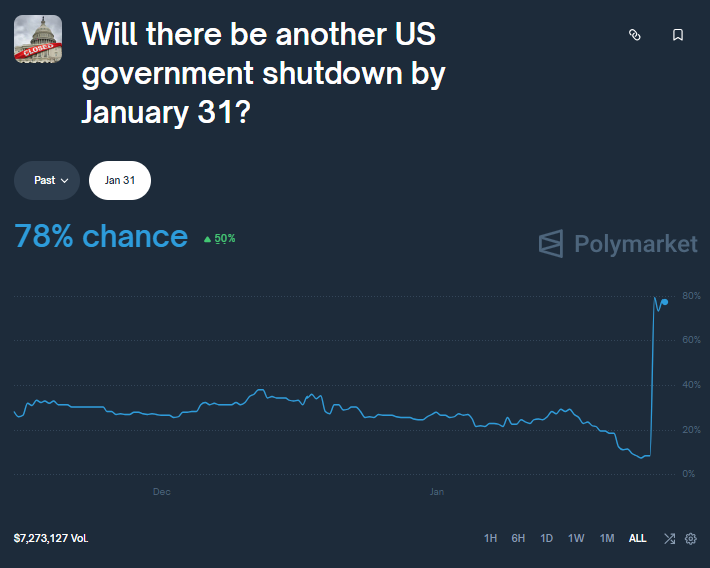
Odds of US Government shutdown, source: Polymarket

Historically, similar episodes have coincided with near-term selling pressure in Bitcoin, followed by sharp recoveries once political outcomes crystallise and liquidity conditions stabilise.

Related: Ripple CEO: Crypto Set to Smash Records in 2026

Crypto Markets Drop Further

That pattern appears to be repeating. Bitcoin slipped below US$88,000 (AU$127,050) in thin weekend trading, extending a week-long correction that has weighed on the broader crypto market. 

The decline triggered roughly US$224 million (AU$323.4 million) in liquidations of leveraged long positions, underscoring the degree to which price action remains amplified by derivatives markets and automated margin calls rather than spot flows. Ether and other large-cap tokens recorded steeper percentage losses, reflecting a generalised de-risking rather than asset-specific news.

The pullback has occurred alongside turbulence in traditional markets. The Japanese yen gained 0.7% against the dollar amid renewed speculation about official intervention following abrupt moves late last week.

Elsewhere, U.S. President Donald Trump threatened punitive tariffs on Canada should it advance a trade agreement with China, adding another layer of geopolitical uncertainty, even as tensions over Greenland eased after conciliatory rhetoric.

Related: No Turning Back for Crypto in Wall Street’s Engine Room, Says PwC

Notably, Bitcoin’s recent behaviour has more closely resembled that of a high-beta risk asset than a defensive hedge. While digital assets struggled, traditional commodities rallied strongly. Silver reached a fresh record near US$109 (AU$157.19) an ounce, and gold breached the US$5,000 (AU$7,218) threshold, buoyed by demand for inflation protection and geopolitical insurance.

The divergence suggests that, despite its decentralised architecture and fixed supply, Bitcoin remains tightly integrated into global liquidity cycles and investor risk appetite, rather than functioning as a substitute for conventional safe havens.

The post Bitcoin Dips Below $88K as Weekend Weakness Meets Rising U.S. Shutdown Risk appeared first on Crypto News Australia.

Disclaimer: The articles reposted on this site are sourced from public platforms and are provided for informational purposes only. They do not necessarily reflect the views of MEXC. All rights remain with the original authors. If you believe any content infringes on third-party rights, please contact service@support.mexc.com for removal. MEXC makes no guarantees regarding the accuracy, completeness, or timeliness of the content and is not responsible for any actions taken based on the information provided. The content does not constitute financial, legal, or other professional advice, nor should it be considered a recommendation or endorsement by MEXC.

You May Also Like

Ethereum unveils roadmap focusing on scaling, interoperability, and security at Japan Dev Conference

Ethereum unveils roadmap focusing on scaling, interoperability, and security at Japan Dev Conference

The post Ethereum unveils roadmap focusing on scaling, interoperability, and security at Japan Dev Conference appeared on BitcoinEthereumNews.com. Key Takeaways Ethereum’s new roadmap was presented by Vitalik Buterin at the Japan Dev Conference. Short-term priorities include Layer 1 scaling and raising gas limits to enhance transaction throughput. Vitalik Buterin presented Ethereum’s development roadmap at the Japan Dev Conference today, outlining the blockchain platform’s priorities across multiple timeframes. The short-term goals focus on scaling solutions and increasing Layer 1 gas limits to improve transaction capacity. Mid-term objectives target enhanced cross-Layer 2 interoperability and faster network responsiveness to create a more seamless user experience across different scaling solutions. The long-term vision emphasizes building a secure, simple, quantum-resistant, and formally verified minimalist Ethereum network. This approach aims to future-proof the platform against emerging technological threats while maintaining its core functionality. The roadmap presentation comes as Ethereum continues to compete with other blockchain platforms for market share in the smart contract and decentralized application space. Source: https://cryptobriefing.com/ethereum-roadmap-scaling-interoperability-security-japan/
Share
BitcoinEthereumNews2025/09/18 00:25
Here’s How Consumers May Benefit From Lower Interest Rates

Here’s How Consumers May Benefit From Lower Interest Rates

The post Here’s How Consumers May Benefit From Lower Interest Rates appeared on BitcoinEthereumNews.com. Topline The Federal Reserve on Wednesday opted to ease interest rates for the first time in months, leading the way for potentially lower mortgage rates, bond yields and a likely boost to cryptocurrency over the coming weeks. Average long-term mortgage rates dropped to their lowest levels in months ahead of the central bank’s policy shift. Copyright{2018} The Associated Press. All rights reserved. Key Facts The central bank’s policymaking panel voted this week to lower interest rates, which have sat between 4.25% and 4.5% since December, to a new range of 4% and 4.25%. How Will Lower Interest Rates Impact Mortgage Rates? Mortgage rates tend to fall before and during a period of interest rate cuts: The average 30-year fixed-rate mortgage dropped to 6.35% from 6.5% last week, the lowest level since October 2024, mortgage buyer Freddie Mac reported. Borrowing costs on 15-year fixed-rate mortgages also dropped to 5.5% from 5.6% as they neared the year-ago rate of 5.27%. When the Federal Reserve lowered the funds rate to between 0% and 0.25% during the pandemic, 30-year mortgage rates hit record lows between 2.7% and 3% by the end of 2020, according to data published by Freddie Mac. Consumers who refinanced their mortgages in 2020 saved about $5.3 billion annually as rates dropped, according to the Consumer Financial Protection Bureau. Similarly, mortgage rates spiked around 7% as interest rates were hiked in 2022 and 2023, though mortgage rates appeared to react within weeks of the Fed opting to cut or raise rates. How Do Treasury Bonds Respond To Lower Interest Rates? Long-term Treasury yields are more directly influenced by interest rates, as lower rates tend to result in lower yields. When the Fed pushed rates to near zero during the pandemic, 10-year Treasury yields fell to an all-time low of 0.5%. As…
Share
BitcoinEthereumNews2025/09/18 05:59
The Giants Are Stumbling: Why BlockDAG’s 20-Exchange Launch is the Market’s New Safe Haven

The Giants Are Stumbling: Why BlockDAG’s 20-Exchange Launch is the Market’s New Safe Haven

The cryptocurrency market seems to have caught headwinds entering February. Portfolios across the globe are flashing red as the flash crash of February 2nd wreaks
Share
Captainaltcoin2026/02/04 02:30