Dogecoin (DOGE) is coiling tightly near the $0.122 level, with price action forming a classic triangle pattern that’s getting closer to a breakout. The post DogecoinDogecoin (DOGE) is coiling tightly near the $0.122 level, with price action forming a classic triangle pattern that’s getting closer to a breakout. The post Dogecoin

Dogecoin Price Prediction: When This Triangle Breaks, the Next Move Could Be Violent

3 min read

The meme coin continues to make lower highs and higher lows, compressing volatility into an increasingly narrow range.

Each retest of the $0.123 support has held strong so far, hinting that pressure is building for a decisive move.

Meanwhile, Dogecoin-linked ETFs are quietly gaining traction. On January 26, DOGE ETFs pulled in $246K in fresh inflows, bringing total investment to over $6.4 million, with Grayscale’s GDOG fund leading the charge.

This tightening pattern and growing institutional interest suggest that when DOGE finally breaks out, the move could be fast and explosive.

DOGE Price Analysis: Next Move Decides Everything

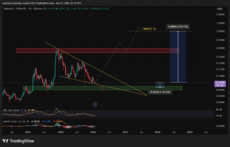
Analyst Ali Martinez’s chart shows a clean symmetrical triangle formed by DOGE on the 1-hour chart.

Sellers cap price along a falling trendline while buyers defend a rising base. Control remains balanced, but time favors a break rather than continuation.

A breakout from Dogecoin’s current triangle formation could trigger a price swing of around 7%.
Source: TradingView

If bulls manage to push the price above the upper trendline, the first short-term target sits at the $0.130 mark.

From there, a sustained rally and growing demand could bring the long-term goal of $1 back into focus, a level that continues to inspire retail enthusiasm.

However, bulls must first secure a clean break above the triangle top to take control.

Failure to hold rising support would shift momentum in favor of the bears.

If DOGE dips below $0.123, a flush of downside liquidity could follow, potentially dragging the price down to the $0.10 to $0.095 demand zone, a nearly 20% decline from current levels.

New $HYPER Presale Brings Solana Speeds and Costs to the Bitcoin Blockchain

Bitcoin acts as a store of value but it is terrible at everything else. Transactions are slow, fees spike during demand, and anything beyond simple transfers feels bolted on.

Bitcoin Hyper ($HYPER) enters not to replace Bitcoin, but to sit on top of it and make it usable for the kind of activity Bitcoin has never handled well.

The project is building a Bitcoin Layer 2 that borrows heavily from Solana’s design choices. Speed, low fees, and high throughput are the selling points.

The idea is to bring DeFi, NFTs, memes, games, and more to the Bitcoin ecosystem by keeping BTC as the settlement layer while pushing execution to a faster environment.

Also, the $HYPER presale has already raised over $31 million, placing it well ahead of the typical low-effort retail launches seen across the market.

This is not just another token. $HYPER is building a complete ecosystem from day one, including custom wallets, block explorers, cross-chain bridging, staking tools, and meme-friendly infrastructure.

Early backers can earn a 38% APY by staking their tokens, making this one of the most rewarding crypto presales live right now.

To buy the $HYPER token, simply go to the official Bitcoin Hyper website and connect a supported wallet (like Best Wallet).

Once done, use a debit/credit card or existing crypto to complete your buy in seconds.

next

The post Dogecoin Price Prediction: When This Triangle Breaks, the Next Move Could Be Violent appeared first on Coinspeaker.

Disclaimer: The articles reposted on this site are sourced from public platforms and are provided for informational purposes only. They do not necessarily reflect the views of MEXC. All rights remain with the original authors. If you believe any content infringes on third-party rights, please contact service@support.mexc.com for removal. MEXC makes no guarantees regarding the accuracy, completeness, or timeliness of the content and is not responsible for any actions taken based on the information provided. The content does not constitute financial, legal, or other professional advice, nor should it be considered a recommendation or endorsement by MEXC.

You May Also Like

Cashing In On University Patents Means Giving Up On Our Innovation Future

Cashing In On University Patents Means Giving Up On Our Innovation Future

The post Cashing In On University Patents Means Giving Up On Our Innovation Future appeared on BitcoinEthereumNews.com. “It’s a raid on American innovation that would deliver pennies to the Treasury while kneecapping the very engine of our economic and medical progress,” writes Pipes. Getty Images Washington is addicted to taxing success. Now, Commerce Secretary Howard Lutnick is floating a plan to skim half the patent earnings from inventions developed at universities with federal funding. It’s being sold as a way to shore up programs like Social Security. In reality, it’s a raid on American innovation that would deliver pennies to the Treasury while kneecapping the very engine of our economic and medical progress. Yes, taxpayer dollars support early-stage research. But the real payoff comes later—in the jobs created, cures discovered, and industries launched when universities and private industry turn those discoveries into real products. By comparison, the sums at stake in patent licensing are trivial. Universities collectively earn only about $3.6 billion annually in patent income—less than the federal government spends on Social Security in a single day. Even confiscating half would barely register against a $6 trillion federal budget. And yet the damage from such a policy would be anything but trivial. The true return on taxpayer investment isn’t in licensing checks sent to Washington, but in the downstream economic activity that federally supported research unleashes. Thanks to the bipartisan Bayh-Dole Act of 1980, universities and private industry have powerful incentives to translate early-stage discoveries into real-world products. Before Bayh-Dole, the government hoarded patents from federally funded research, and fewer than 5% were ever licensed. Once universities could own and license their own inventions, innovation exploded. The result has been one of the best returns on investment in government history. Since 1996, university research has added nearly $2 trillion to U.S. industrial output, supported 6.5 million jobs, and launched more than 19,000 startups. Those companies pay…
Share
BitcoinEthereumNews2025/09/18 03:26
XRP Ledger Unlocks Permissioned Domains With 91% Validator Backing

XRP Ledger Unlocks Permissioned Domains With 91% Validator Backing

XRP Ledger activated XLS-80 after 91% validator approval, enabling permissioned domains for credential-gated use on the public XRPL. The XRP Ledger has activated
Share
LiveBitcoinNews2026/02/06 13:00
XRPL Adds Institutional Lending and Privacy Tools in Ripple’s 2026 Roadmap

XRPL Adds Institutional Lending and Privacy Tools in Ripple’s 2026 Roadmap

Ripple shared a new Institutional DeFi roadmap showing how the XRP Ledger is being shaped for everyday use by banks, asset managers, and regulated financial firms
Share
Tronweekly2026/02/06 13:00