Jamie Dimon confronts Brian Armstrong at Davos over crypto legislation disagreements and stablecoin yields.Jamie Dimon confronts Brian Armstrong at Davos over crypto legislation disagreements and stablecoin yields.

Dimon Challenges Coinbase CEO Armstrong on Crypto Policies
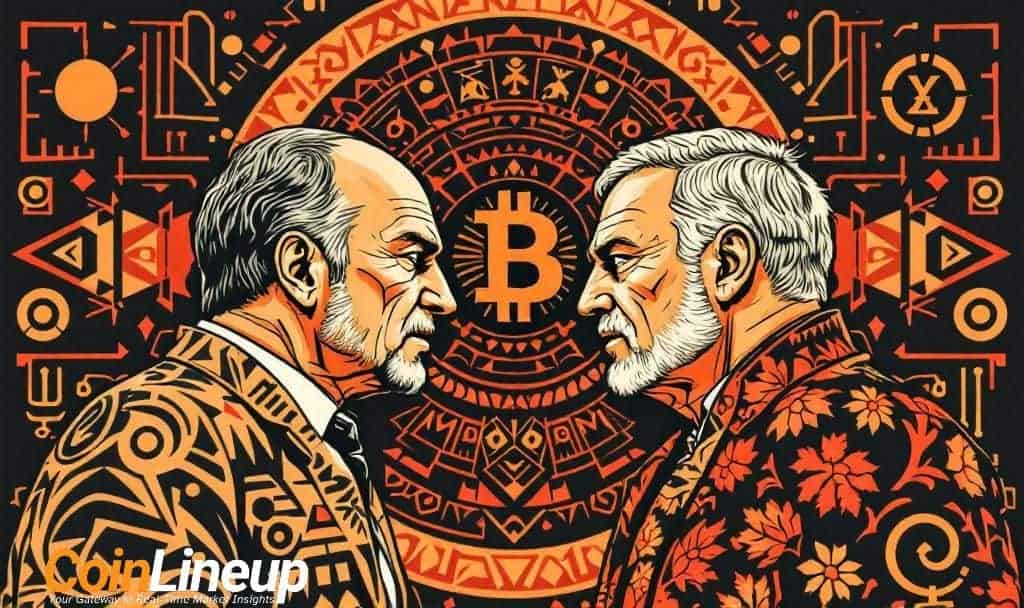
Dimon Challenges Coinbase CEO Armstrong on Crypto Policies
Key Points:
  • Main event involves crypto and banking leaders at Davos.
  • Dimon accuses Armstrong of deceptive practices.
  • Potential regulatory disputes emerge in cryptocurrency sector.

Coinbase CEO Brian Armstrong faces skepticism from JPMorgan Chase CEO Jamie Dimon, who criticized crypto policies at a Davos meeting. Armstrong advocates free-market competition despite challenges from banking leaders on stablecoin yields.

The disagreement between Jamie Dimon and Brian Armstrong underscores longstanding tensions in crypto regulation, impacting market dynamics and legislative initiatives.

At Davos, Jamie Dimon challenged Brian Armstrong in front of influential figures, questioning his claims on bank interference with crypto legislation. Brian Armstrong defended Coinbase, citing his advocacy for clear regulations.

The confrontation could affect crypto laws and heightened awareness within the banking sector. Armstrong’s desire for transparent crypto laws clashed with banking leaders’ concerns over compliance.

The exchange reflects deep-seated resistance within traditional finance towards cryptocurrencies. Crypto markets and associated technologies may face additional scrutiny. Dimon’s stance indicates ongoing obstacles for crypto’s mainstream acceptance, as he remarked, “You are full of it.”

Coinbase’s financial model, heavily reliant on stablecoin yields, may face setbacks if regulatory changes severely curb these practices. Crypto exchanges must adapt to survive potential legislative crackdowns highlighted in this high-profile encounter.

Armstrong’s withdrawal from supporting certain legislative efforts, such as the CLARITY Act, also showcases the power struggle between crypto proponents and traditional financial institutions. This incident at Davos highlights the complexities of balancing innovation with regulatory demands in finance.

Disclaimer: The articles reposted on this site are sourced from public platforms and are provided for informational purposes only. They do not necessarily reflect the views of MEXC. All rights remain with the original authors. If you believe any content infringes on third-party rights, please contact service@support.mexc.com for removal. MEXC makes no guarantees regarding the accuracy, completeness, or timeliness of the content and is not responsible for any actions taken based on the information provided. The content does not constitute financial, legal, or other professional advice, nor should it be considered a recommendation or endorsement by MEXC.

You May Also Like

OUSG (OUSG) - Complete Fundamental Analysis

OUSG (OUSG) - Complete Fundamental Analysis

OUSG (OUSG) Cryptocurrency Overview ## Core Technology and Blockchain Architecture OUSG is a tokenized short-term U.S. Treasury bills ETF managed by Ondo Finance

Share
Coinstats2026/02/01 09:01
Headwind Helps Best Wallet Token

Headwind Helps Best Wallet Token

The post Headwind Helps Best Wallet Token appeared on BitcoinEthereumNews.com. Google has announced the launch of a new open-source protocol called Agent Payments Protocol (AP2) in partnership with Coinbase, the Ethereum Foundation, and 60 other organizations. This allows AI agents to make payments on behalf of users using various methods such as real-time bank transfers, credit and debit cards, and, most importantly, stablecoins. Let’s explore in detail what this could mean for the broader cryptocurrency markets, and also highlight a presale crypto (Best Wallet Token) that could explode as a result of this development. Google’s Push for Stablecoins Agent Payments Protocol (AP2) uses digital contracts known as ‘Intent Mandates’ and ‘Verifiable Credentials’ to ensure that AI agents undertake only those payments authorized by the user. Mandates, by the way, are cryptographically signed, tamper-proof digital contracts that act as verifiable proof of a user’s instruction. For example, let’s say you instruct an AI agent to never spend more than $200 in a single transaction. This instruction is written into an Intent Mandate, which serves as a digital contract. Now, whenever the AI agent tries to make a payment, it must present this mandate as proof of authorization, which will then be verified via the AP2 protocol. Alongside this, Google has also launched the A2A x402 extension to accelerate support for the Web3 ecosystem. This production-ready solution enables agent-based crypto payments and will help reshape the growth of cryptocurrency integration within the AP2 protocol. Google’s inclusion of stablecoins in AP2 is a massive vote of confidence in dollar-pegged cryptocurrencies and a huge step toward making them a mainstream payment option. This widens stablecoin usage beyond trading and speculation, positioning them at the center of the consumption economy. The recent enactment of the GENIUS Act in the U.S. gives stablecoins more structure and legal support. Imagine paying for things like data crawls, per-task…
Share
BitcoinEthereumNews2025/09/18 01:27
RLUSD Attestation Strengthens Institutional Confidence as Liquidity Venues Expand

RLUSD Attestation Strengthens Institutional Confidence as Liquidity Venues Expand

The post RLUSD Attestation Strengthens Institutional Confidence as Liquidity Venues Expand appeared on BitcoinEthereumNews.com. RLUSD is gaining momentum as independent
Share
BitcoinEthereumNews2026/02/01 09:33