The post Solana Risks Deeper Pullback as Loss of $103 Opens Path Toward $63 Support appeared on BitcoinEthereumNews.com. Key Insights: Solana drops 18% in 30 daysThe post Solana Risks Deeper Pullback as Loss of $103 Opens Path Toward $63 Support appeared on BitcoinEthereumNews.com. Key Insights: Solana drops 18% in 30 days

Solana Risks Deeper Pullback as Loss of $103 Opens Path Toward $63 Support

Key Insights:

  • Solana drops 18% in 30 days with $165M in long liquidations and $11M ETF outflows reported.
  • Network activity jumps: 2.29B transactions, 81% fee rise, and 62% increase in active wallet addresses.
  • Perp funding hits -17% as bearish sentiment grows, signaling extreme fear among traders and market caution.
Solana Risks Deeper Pullback as Loss of $103 Opens Path Toward $63 Support

Solana (SOL) dropped below a key price level of $103, raising the chance of a further decline. The current price stands around $101.14, down nearly 0.13% in the past 24 hours. Analysts warn that a break below this zone could push the token toward the next major support at $63.

The drop follows broader market pressure, with Bitcoin, AI stocks, gold, and silver also facing selling. Solana is now down around 18% in the last 30 days.

Price Weakness Linked to Broader Market Pullback

Solana fell to around $95–$100, its lowest price since April 2025. This comes during a broad wave of risk-off trading. Other assets, including Bitcoin and equities tied to AI, also moved lower during the same period. The drop in investor confidence pushed traders to reduce exposure to crypto and risk assets.

More than $165 million in long Solana positions were liquidated over the month. In addition, Phursey highlighted the ETF flows linked to Solana showed an $11 million outflow. This added selling pressure to an already weak market.

Despite the lower price, Solana’s network data shows increased activity. Over the last 30 days, transaction counts reached 2.29 billion. Network fees rose by 81%, and active wallet addresses grew by 62%. These metrics suggest that the use of the network is still rising.

Falling Solana Volume Signals Fear as Network Grows

Trading volume has dropped to around $22.8 billion, a clear decline from mid-2025 when Solana experienced strong rallies. This signals a shift in trader activity from fast rallies to quieter market conditions. The reduced volume suggests lower participation as investors wait for better signals.

SOL Trading Volume Drop | Source: Coinglass

Despite the lower price, Solana’s network data shows increased activity. Over the last 30 days, transaction counts reached 2.29 billion. Network fees rose by 81%, and active wallet addresses grew by 62%. These metrics suggest that the use of the network is still rising.

Funding rates on perpetual futures dropped to -17%, which suggests heavy bearish positioning. Traders betting against the price could face risk if the trend reverses. The current market conditions point to fear-driven price action. 

With the $103 support level broken, attention now shifts to $63 as the next major area of buyer interest. Solana price action shows that traders are cautious, especially with weak global sentiment, suggesting that fear is not limited to crypto markets.

DISCLAIMER: The information on this website is provided as general market commentary and does not constitute investment advice. We encourage you to do your own research before investing.

Source: https://coincu.com/analysis/solana-deeper-pullback-loss-103-to-63/
Disclaimer: The articles reposted on this site are sourced from public platforms and are provided for informational purposes only. They do not necessarily reflect the views of MEXC. All rights remain with the original authors. If you believe any content infringes on third-party rights, please contact service@support.mexc.com for removal. MEXC makes no guarantees regarding the accuracy, completeness, or timeliness of the content and is not responsible for any actions taken based on the information provided. The content does not constitute financial, legal, or other professional advice, nor should it be considered a recommendation or endorsement by MEXC.

You May Also Like

Hadron Labs Launches Bitcoin Summer on Neutron, Offering 5–10% BTC Yield

Hadron Labs Launches Bitcoin Summer on Neutron, Offering 5–10% BTC Yield

Hadron Labs launches 'Bitcoin Summer' on Neutron, BTC vaults for WBTC, eBTC, solvBTC, uniBTC and USDC. Earn 5–10% BTC via maxBTC, with up to 10x looping.
Share
Blockchainreporter2025/09/18 02:00
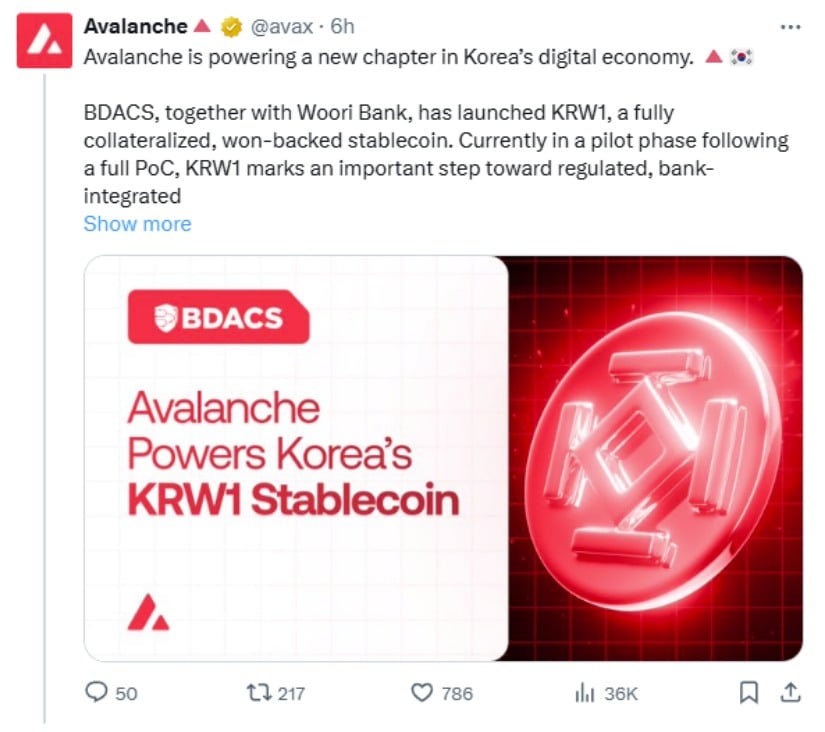
South Korea Launches First Won-Backed Stablecoin KRW1 on Avalanche

South Korea Launches First Won-Backed Stablecoin KRW1 on Avalanche

South Korea made history this week by launching its first Korean won-backed stablecoin.
Share
Brave Newcoin2025/09/19 03:15
Curve Finance votes on revenue-sharing model for CRV holders

Curve Finance votes on revenue-sharing model for CRV holders

The post Curve Finance votes on revenue-sharing model for CRV holders appeared on BitcoinEthereumNews.com. Curve Finance has proposed a new protocol called Yield Basis that would share revenue directly with CRV holders, marking a shift from one-off incentives to sustainable income. Summary Curve Finance has put forward a revenue-sharing protocol to give CRV holders sustainable income beyond emissions and fees. The plan would mint $60M in crvUSD to seed three Bitcoin liquidity pools (WBTC, cbBTC, tBTC), with 35–65% of revenue distributed to veCRV stakers. The DAO vote runs from up to Sept. 24, with the proposal seen as a major step to strengthen CRV tokenomics after past liquidity and governance challenges. Curve Finance founder Michael Egorov has introduced a proposal to give CRV token holders a more direct way to earn income, launching a system called Yield Basis that aims to turn the governance token into a sustainable, yield-bearing asset.  The proposal has been published on the Curve DAO (CRV) governance forum, with voting open until Sept. 24. A new model for CRV rewards Yield Basis is designed to distribute transparent and consistent returns to CRV holders who lock their tokens for veCRV governance rights. Unlike past incentive programs, which relied heavily on airdrops and emissions, the protocol channels income from Bitcoin-focused liquidity pools directly back to token holders. To start, Curve would mint $60 million worth of crvUSD, its over-collateralized stablecoin, with proceeds allocated across three pools — WBTC, cbBTC, and tBTC — each capped at $10 million. 25% of Yield Basis tokens would be reserved for the Curve ecosystem, and between 35% and 65% of Yield Basis’s revenue would be given to veCRV holders. By emphasizing Bitcoin (BTC) liquidity and offering yields without the short-term loss risks associated with automated market makers, the protocol hopes to draw in professional traders and institutions. Context and potential impact on Curve Finance The proposal comes as Curve continues to modify…
Share
BitcoinEthereumNews2025/09/18 14:37