From small talk to practicality: Paradigm shift and future trends of Web3 AI agents

Original article: 0xJeff
Compiled by: Yuliya, PANews
As the field of AI agents has evolved, the market has shifted dramatically from agents that were initially focused on personalization alone. In the early days, people were attracted to agents that could entertain, tell jokes, or "create a buzz" on social media. These agents did generate buzz and attention, but as the market evolved, it became clear that utility value was far more important than personalization .
Many agents that focused on personalization generated huge attention when they were launched, but eventually faded into obscurity because they failed to provide value beyond surface-level interactions. This trend highlights a key lesson: in the Web3 space, substantive value takes precedence over superficial effects, and practicality trumps novelty .
This evolution is in line with the transformation of the Web2 AI field. Specialized large language models (LLMs) are being developed to meet the specific needs of niche areas such as finance, law, and real estate. These models focus more on accuracy and reliability, making up for the shortcomings of general AI.
The limitation of general AI is that it can often only provide "almost" answers , which is unacceptable in some scenarios. For example, a popular model may only be 70% accurate on a specific professional problem. This may be sufficient for daily use, but it can have disastrous consequences in high-stakes scenarios such as court decisions or major financial decisions. This is why professional LLMs that are finely tuned to achieve 98-99% accuracy are becoming increasingly important.
So the question is: Why choose Web3? Why not let Web2 dominate the professional AI field?
Web3 has several significant advantages over traditional Web2 AI:
- The first is global liquidity . Web3 allows teams to obtain funds more efficiently. Through token issuance, AI projects can directly access global liquidity and avoid time-consuming VC meetings and negotiations. This approach makes financing more democratized and allows developers to obtain the resources they need faster.
- The second is value accumulation through token economics . Tokens enable the team to reward early adopters, incentivize holders, and maintain the sustainability of the ecosystem. For example, Virtuals allocates 1% of transaction fees to cover inference costs, ensuring that its agents remain functional and competitive without relying on external funding.
- The third is decentralized AI infrastructure . Web3 provides open source models, decentralized computing resources (such as Hyperbolic and Aethir), and massive open data pipelines (such as Cookie DAO and Vana), providing developers with a collaborative and cost-effective platform that is difficult to replicate in Web2. More importantly, it fosters a passionate developer community to jointly promote innovation.
Web3 AI Ecosystem
In the Web3 AI agent ecosystem, we see that each ecosystem improves its capabilities by integrating new features and opening up new application scenarios. From Bittensor subnets to Olas, Pond, and Flock, these ecosystems are building more interoperable and functional agents. At the same time, easy-to-use tools such as SendAI's Solana Agent Kit or Coinbase CDP SDK are also emerging.
These ecosystems are building AI applications that prioritize utility:
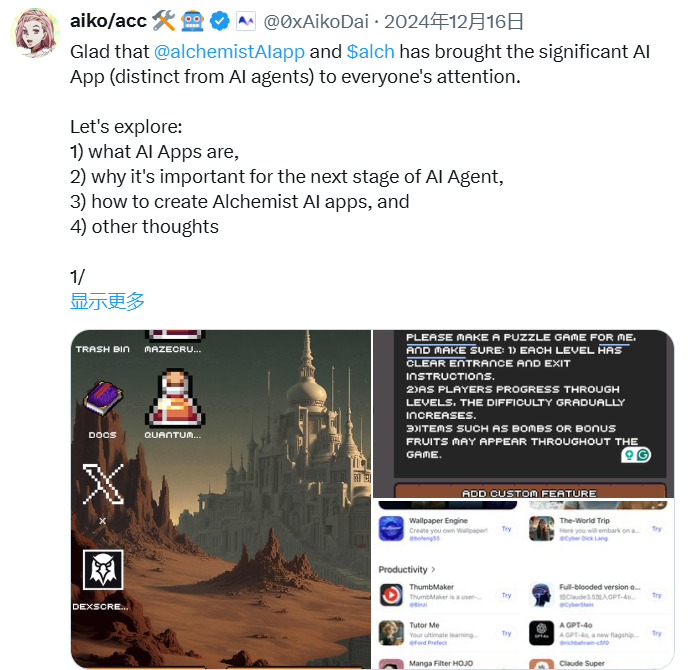
- ALCHEMIST AI has developed a no-code AI application building platform.
- MyShell has created an AI app store focused on image generation, visual novels, and virtual character simulation.
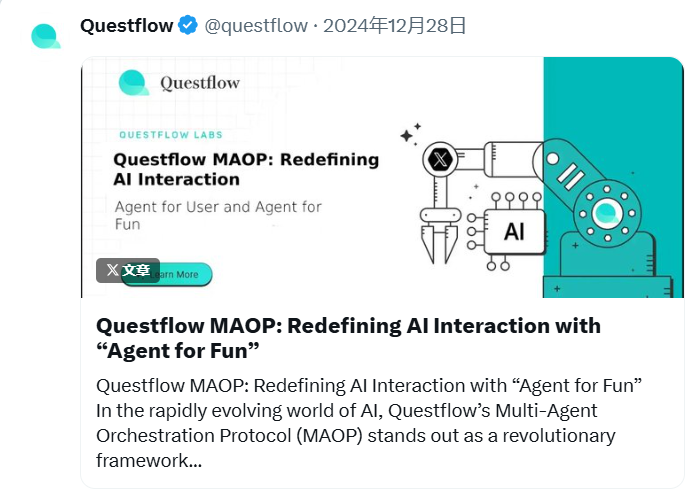
- Questflow has launched the Multi-Agent Orchestration Protocol (MAOP), which is dedicated to application scenarios that improve productivity. Its integration with Virtuals has created Santa Agents for gamified airdrops and incentive management.
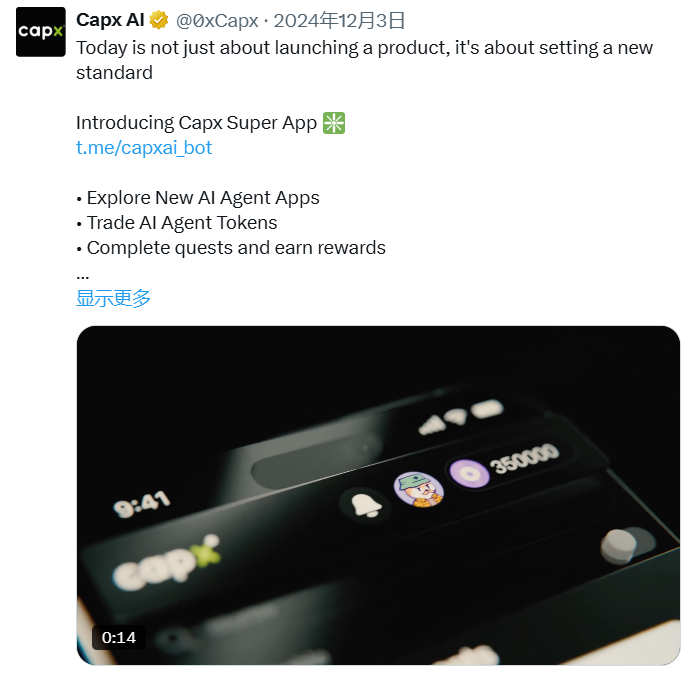
- Capx AI has launched an AI app store on Telegram that prioritizes practicality.
Individual agents focused on real use cases
Outside the ecosystem, individual agents in specialized fields are also emerging. For example:
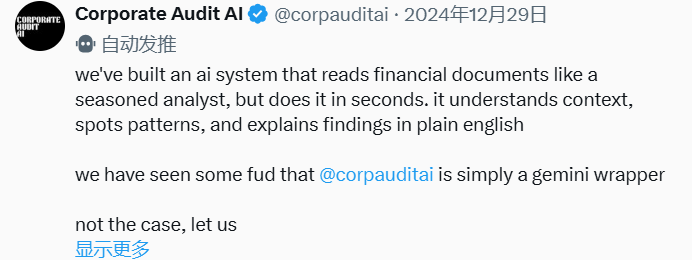
- Corporate Audit AI acts as a financial analysis AI agent, specializing in reviewing reports and identifying market opportunities.
- $CPA Agent was developed by Tj Dunham and focuses on calculating cryptocurrency taxes and generating reports for users.

This shift from “chatbots chatting away on social media” to “experts sharing professional insights” is here to stay.
The future of AI agents lies not in chatbots that chat casually, but in expert agents in various professional fields that deliver value and insights in an engaging way. These agents will continue to create mindshare and guide users to actual products, whether it is a trading terminal, tax calculator or productivity tool.
Where will value be concentrated?
The biggest beneficiaries will be the proxy L1 and coordination layers.
- On the agent L1 side , platforms like Virtuals and ai16z are raising the bar for the industry, ensuring their ecosystems prioritize quality. Virtuals remains the top L1 platform in the agent space, and ai16z’s launchpad will soon join the fray. Purely personalized agents are disappearing, replaced by agents that are both useful and engaging.
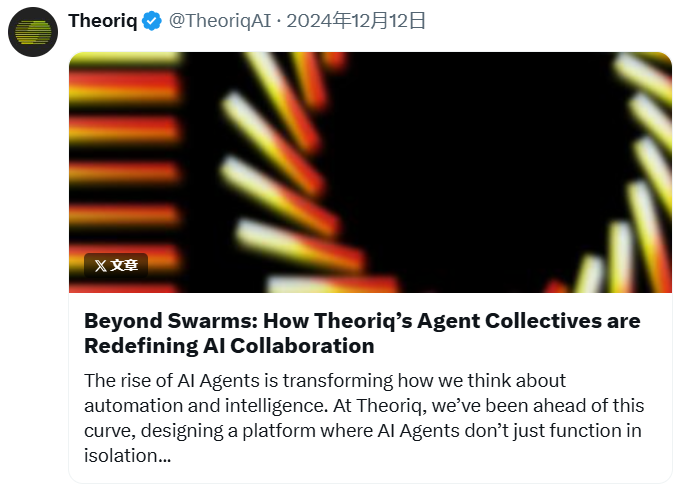
- On the coordination layer , platforms like Theoriq will orchestrate the collaboration of a large number of agents, integrating their strengths to provide users with seamless and powerful solutions. Imagine integrating agents such as aixbt, gekko, and CPA to achieve the functions of obtaining alpha, executing transactions, and handling taxes in a unified workflow. Theoriq's task-based discovery framework is moving towards unleashing this collective intelligence.
Final Thoughts
The narrative of AI applications that prioritize practicality has just begun. Web3 has a unique opportunity to carve out a space where AI agents can not only entertain, but also solve practical problems, automate complex tasks, and create value for users. 2025 will witness the transition from chatbots to collaborative assistants, and specialized LLMs and multi-agent orchestration will redefine the perception of AI.
While Web2 and Web3 will gradually merge, the open, collaborative nature of Web3 will lay the foundation for the most innovative breakthroughs. It is no longer about "AI agents with personality", but about agents that can provide practical value and create meaningful impact. It is worth paying attention to agentic L1, coordination layer, and emerging AI applications. The era of agency has arrived, and this is just the beginning.

You May Also Like

Ethereum unveils roadmap focusing on scaling, interoperability, and security at Japan Dev Conference

Here’s How Consumers May Benefit From Lower Interest Rates