Solana price slid deeper into the red on Feb.4, extending its recent downtrend as sellers continued to press the market. At press time, SOL was trading near $97Solana price slid deeper into the red on Feb.4, extending its recent downtrend as sellers continued to press the market. At press time, SOL was trading near $97

Solana price prints bearish continuation — can bulls defend psychological $100 level?

3 min read

Solana price slid deeper into the red on Feb.4, extending its recent downtrend as sellers continued to press the market.

Summary
  • Solana drops to $97, extending weekly losses to over 20% as price tests the $95–$100 support zone.
  • Despite price weakness, network usage and ETF inflows suggest longer-term interest remains intact.
  • Oversold conditions could lead to a short-term relief bounce.

At press time, SOL was trading near $97, down 6.1% over the past 24 hours. The move leaves Solana sitting near the lower end of its seven-day range between $96 and $127.

Solana (SOL) has dropped 23% over the last week and 31% over the last month. The token is now back to a range that many traders consider critical, having retraced roughly 66% from its peak of $293 in January 2025.

Activity has increased despite the decline. As the price tests support, Solana’s 24-hour spot trading volume increased 32% to $6.55 billion, suggesting increased participation.

Derivatives show a similar trend. CoinGlass data reports futures volume jumping 40% to $17.17 billion, while open interest edged 0.65% higher to $6.48 billion, suggesting traders are adding exposure rather than fully stepping aside.

Network strength contrasts with price pressure

The weakness comes even as Solana’s fundamentals continue to improve. As previously reported by crypto.news, the network processed more than 2.34 billion transactions in January, a 33% increase from the past month and more than Ethereum, Base, and BNB Chain combined.

Institutional interest has also shown signs of growth. While Bitcoin and Ethereum exchange-traded products recorded net outflows in January, U.S. spot Solana ETFs attracted $104 million in inflows, pointing to rising interest from traditional investors during the pullback.

Still, price expectations have been adjusted by some analysts. Standard Chartered recently lowered its 2026 Solana price target to $250 from $310, citing near-term market pressure.

At the same time, the bank raised its longer-term outlook, forecasting SOL at $400 by the end of 2027, $700 by end-2028, $1,200 by end-2029, and $2,000 by 2030. The bank’s analysts argue Solana is positioned to benefit from growth in stablecoin usage and micropayments as it moves beyond a meme-driven phase.

Solana price technical analysis

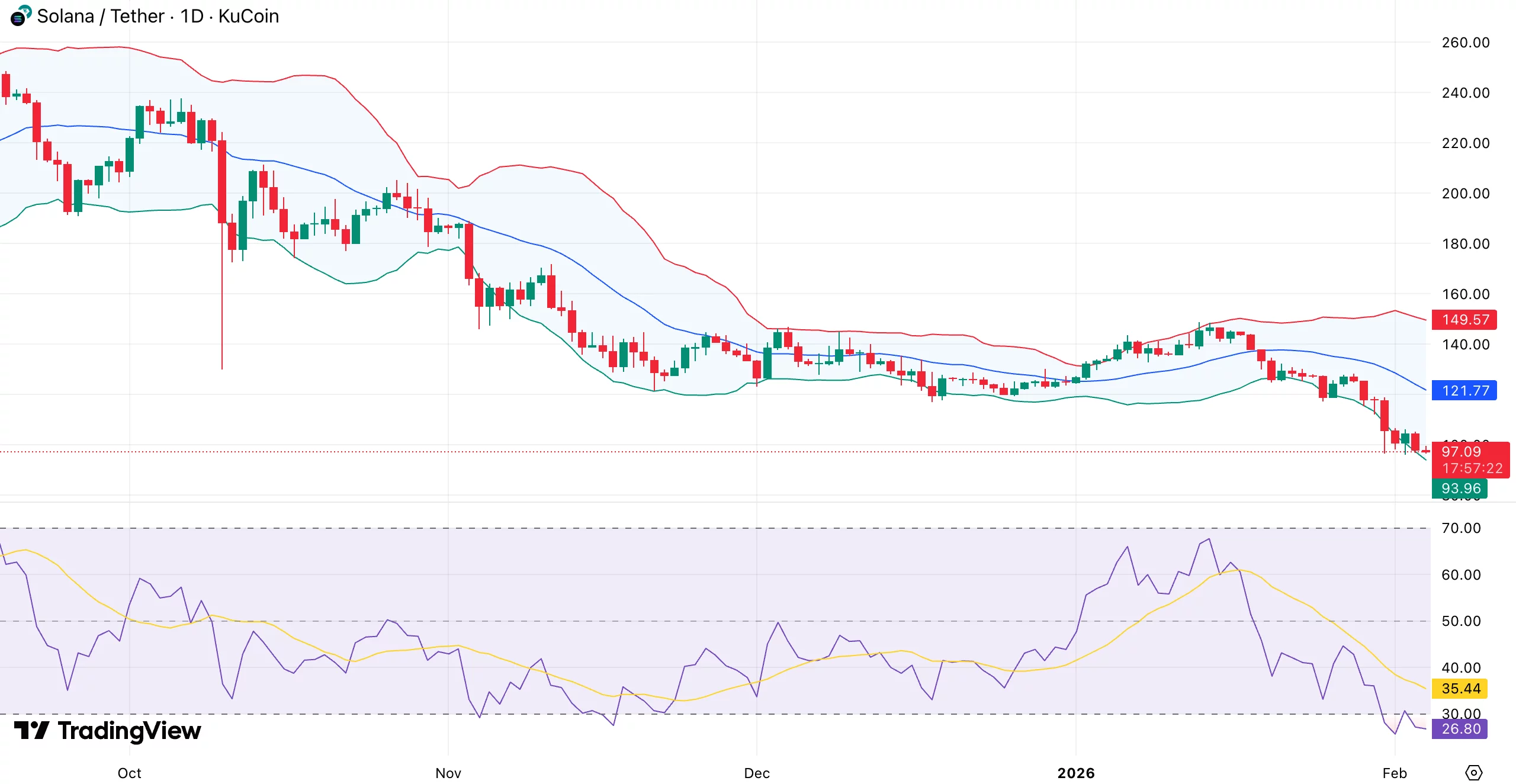
From a chart perspective, Solana continues to trade in a clear bearish structure. The daily timeframe shows a consistent pattern of lower highs and lower lows, confirming that sellers still control momentum. The earlier breakdown below the $115–$120 consolidation zone has turned that area into resistance.
Solana price prints bearish continuation — can bulls defend psychological $100 level? - 1

Price remains well below the declining daily moving average, now near $121, and repeated attempts to reclaim it have failed. This reinforces the idea that recent rebounds have been corrective rather than trend-changing.

Volatility has expanded to the downside. Strong selling pressure is evident as SOL is trading below the lower Bollinger Band. Although this often puts the market in short-term oversold territory, the absence of a significant reversal indicates that the downside momentum has not yet been completely exhausted.

That view is echoed by momentum indicators. The relative strength index is deep in oversold territory, at 26–28. The likelihood of an instant reversal is low because there isn’t any obvious bullish divergence at this point. In strong downtrends, RSI can remain oversold for extended periods.

The $100 level stands out as the most important near-term line. A sustained close below it would likely expose the $95–$93 zone, followed by a broader support area near $85–$90 if selling intensifies.

On the upside, any rebound is likely to face resistance near $120–$122, where the declining moving average and prior support converge.

Disclaimer: The articles reposted on this site are sourced from public platforms and are provided for informational purposes only. They do not necessarily reflect the views of MEXC. All rights remain with the original authors. If you believe any content infringes on third-party rights, please contact service@support.mexc.com for removal. MEXC makes no guarantees regarding the accuracy, completeness, or timeliness of the content and is not responsible for any actions taken based on the information provided. The content does not constitute financial, legal, or other professional advice, nor should it be considered a recommendation or endorsement by MEXC.

You May Also Like

Woman shot 5 times by DHS to stare down Trump at State of the Union address

Woman shot 5 times by DHS to stare down Trump at State of the Union address

A House Democrat has invited Marimar Martinez to attend President Donald Trump's State of the Union address in Washington, D.C., after she was shot by Customs and
Share
Rawstory2026/02/06 03:36
What is Play-to-Earn Gaming? Unlocking New Possibilities

What is Play-to-Earn Gaming? Unlocking New Possibilities

The post What is Play-to-Earn Gaming? Unlocking New Possibilities appeared on BitcoinEthereumNews.com. The Play-to-Earn (P2E) model is playing a key role in the advancement of the crypto industry. Users are able to earn crypto by playing games and get involved with global communities of gamers, creators, and developers. In this article, we’ll explore the functionalities of P2E gaming, its core features, potential risks, benefits, legal issues, and highlight some of the most impactful games shaping the Web3 gaming frontier.  What is Play-to-Earn Gaming? As its name implies, you gain rewards for playing the game. Players in Play-to-Earn games get involved with blockchain networks and can receive crypto assets or NFTs as prizes. The assets you acquire can be sold, traded or kept as an investment to see if their value rises. In Axie Infinity, players gathered and combated Axies, which are fantastical creatures. The game gave players SLP, a coin that works the same as money and could be traded for fiat currencies or other coins. Due to its success, it has grown into a more advanced and eco-friendly economy on current gaming platforms. How P2E Works? Most P2E gaming relies on Ethereum and Layer 2 networks, including Immutable, Ronin, and Base. Users are given both tokens and NFTs for accomplishing various game goals, such as: Completing missions or winning battles Trading or crafting in-game items Participating in tournaments or community events Staking assets or voting in DAOs The main difference between P2E games and traditional ones is that players can truly own what they earn in the game. Weapons, land, avatars, and resources on the Web3 game are tokenized, enabling you to trade or transfer them elsewhere. For example, users in Decentraland are able to purchase virtual land as NFTs, set up experiences and earn money from events or the services they provide. They are different from other items since they…
Share
BitcoinEthereumNews2025/09/19 21:33
DBS Partners With Franklin Templeton and Ripple for Tokenized Lending Platform

DBS Partners With Franklin Templeton and Ripple for Tokenized Lending Platform

TLDR DBS Digital Exchange, Franklin Templeton, and Ripple signed a memorandum of understanding to launch tokenized trading and lending services on the XRP Ledger DBS will list Franklin Templeton’s sgBENJI token alongside Ripple’s RLUSD stablecoin, allowing real-time swaps for institutional investors The partnership enables portfolio rebalancing and yield generation during volatile market conditions through tokenized [...] The post DBS Partners With Franklin Templeton and Ripple for Tokenized Lending Platform appeared first on CoinCentral.
Share
Coincentral2025/09/18 17:06