

Gold Climbs Back Above $5,000 on Iran Military Tensions
TLDR
- Gold recovered to $5,060 per ounce on Wednesday after losing over $1,000 in value during last week’s historic selloff.
- U.S. military shot down an Iranian drone over the Arabian Sea, boosting demand for safe haven assets like gold.
- Silver jumped 2.8% to $87.50 per ounce while platinum gained 3% as precious metals extended their rebound.
- Chinese gold ETFs recorded $1 billion in outflows on Tuesday, showing investor nervousness after the volatile price swings.
- Major banks including Deutsche Bank and Goldman Sachs maintain bullish price targets with forecasts reaching $6,000 per ounce.
Gold prices pushed above $5,000 per ounce on Wednesday as military tensions between the United States and Iran sent investors looking for safe assets. The yellow metal has now gained for two straight sessions after suffering a brutal selloff last week.
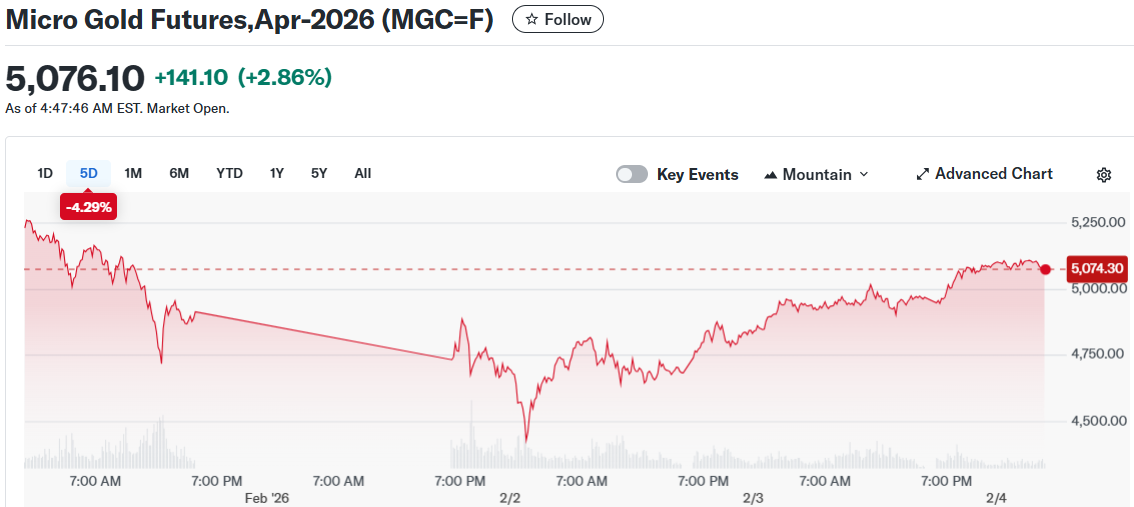 Micro Gold Futures,Apr-2026 (MGC=F)
Spot gold increased 2.3% to $5,060.28 per ounce in Asian trading. Gold futures rose 2.9% to $5,078.96 per ounce. The recovery follows a dramatic plunge that wiped out more than $1,000 in value from record highs.
The U.S. Navy shot down an Iranian drone over the Arabian Sea on Tuesday. Iranian gunboats also approached a U.S.-linked oil tanker in the Strait of Hormuz. These military incidents happened just days before planned diplomatic talks between the two nations scheduled for Friday.
Last week’s collapse saw gold fall from its all-time high of nearly $5,600 per ounce reached on January 29. Silver posted its largest single-day drop in history during the same period. The selloff began during Asian hours on Friday and continued through Monday.
Price Drop Triggers Massive Selling in China
China’s four largest gold-backed exchange-traded funds saw nearly $1 billion leave on Tuesday. This represents the biggest one-day outflow ever recorded for these funds. Just days earlier, the same ETFs were experiencing record inflows as gold hit peak prices.
TD Securities strategist Daniel Ghali said forced sales have likely finished in precious metals markets. He noted that intense volatility over the past week could keep retail investors away. These smaller investors had become an important source of buying power.
Despite the turbulence, gold remains up 15-17% for 2026. Other precious metals also posted gains on Wednesday. Silver climbed 2.8% to $87.50 per ounce. Platinum rallied 3% to $2,286.72 per ounce.
OCBC bank analysts said the rebound shows that forced selling and margin liquidation pressures have eased. However, they warned that markets remain sensitive to the U.S. dollar and Federal Reserve policy changes. The bank called the price drop a normalization rather than a reversal of the upward trend.
Wall Street Maintains Bullish Gold Forecasts
Deutsche Bank reaffirmed its prediction for gold to reach $6,000 per ounce. Goldman Sachs analysts said they see upside risk to their year-end target of $5,400. Bank of America expects volatility to stay elevated but maintains a positive long-term view.
Fidelity Fund sold some gold holdings before the crash but is now looking for opportunities to buy again. Portfolio manager George Efstathopoulos confirmed the fund wants to re-enter the market at lower prices.
ANZ bank said the fundamental drivers behind gold’s strength remain intact. These include safe haven demand, physical buying from consumers, and central bank purchases. OCBC kept its end-2026 price targets at $5,600 per ounce for gold and $133 per ounce for silver.
The January rally was fueled by speculative trading, geopolitical worries, and concerns about Federal Reserve independence under President Trump’s nominee Kevin Warsh. Chinese funds and Western retail investors built large positions before the crash. Leveraged ETF products and options trading amplified both the rise and subsequent fall.
President Trump said diplomatic talks with Iran continue despite the recent military confrontations in the Arabian Sea and Strait of Hormuz.
The post Gold Climbs Back Above $5,000 on Iran Military Tensions appeared first on Blockonomi.
You May Also Like
SEC Approves Grayscale’s Digital Large Cap Fund for Trading

The Role of Technology in Effective Decision Processes
