Blockchain analytics firm Glassnode released a new report on Wednesday highlighting a growing list of warning signals for Bitcoin (BTC), as the market’s leadingBlockchain analytics firm Glassnode released a new report on Wednesday highlighting a growing list of warning signals for Bitcoin (BTC), as the market’s leading

Bitcoin Crash To $72,000 Signals Major Reset: On-Chain Metrics Deteriorate

2026/02/05 18:00
3 min read

Blockchain analytics firm Glassnode released a new report on Wednesday highlighting a growing list of warning signals for Bitcoin (BTC), as the market’s leading cryptocurrency slid back to the $72,000 level during the latest market downturn. 

The firm’s findings suggest that both structural and behavioral indicators are aligning around a more defensive market phase, raising concerns about near‑term stability.

Shift Toward Deeper Bear Phase

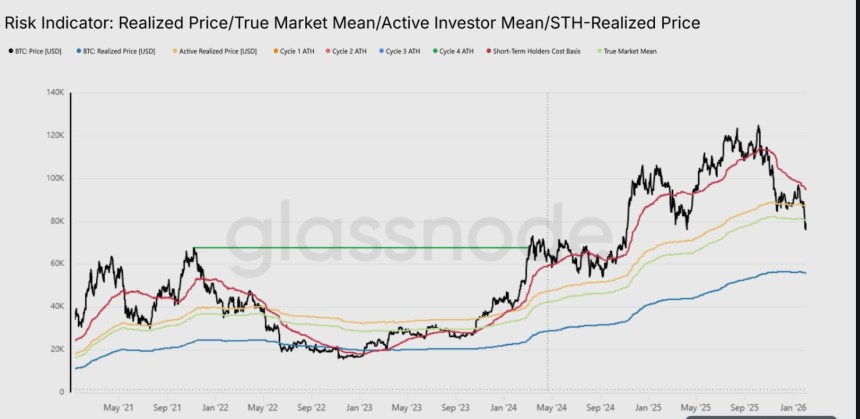
Glassnode pointed first to the breakdown of the True Market Mean, a metric that reflects the aggregate cost basis of actively circulating Bitcoin while excluding long‑inactive coins such as lost supply, early miner holdings, and Satoshi‑era coins. 

Its recent failure, Glassnode said, confirms a deterioration that has been developing since late November of last year, with market conditions beginning to resemble the early‑2022 shift from prolonged consolidation into a deeper bear market. 
Bitcoin

Weak follow‑through from buyers, combined with persistent selling pressure, indicates the market is now operating in a far more fragile balance.

From a medium‑term valuation standpoint, Bitcoin’s price is becoming increasingly confined within a wider corridor. The former support level at the True Market Mean, now sitting near $80,200, has flipped into overhead resistance.

On the lower end, the Realized Price — currently around $55,800 — continues to define the zone where long‑term capital has historically re‑entered the market. 

With this structural reset now in place, Glassnode said attention is turning toward identifying where downside stabilization could occur and where a more durable bottom might eventually form.

Key Bitcoin Demand Zones

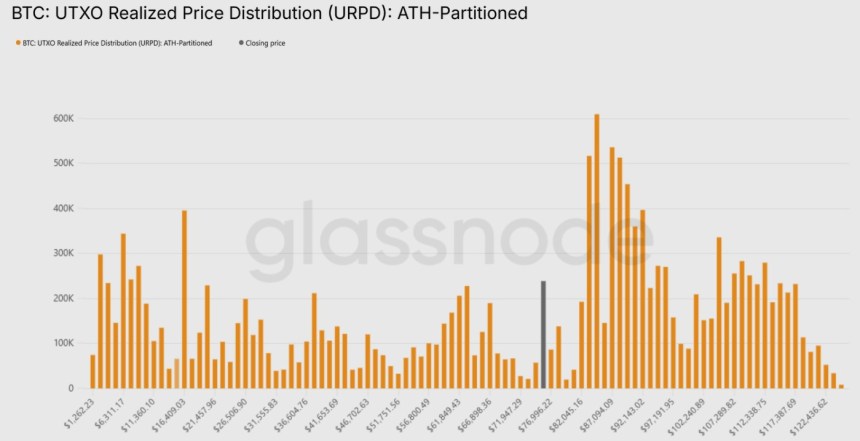
While no single indicator can pinpoint a market low, several on‑chain metrics offer clues about where near‑term demand could emerge. One such tool is the UTXO Realized Price Distribution, which shows how much Bitcoin supply is held at various cost bases. 

Current data reveals meaningful accumulation by newer market participants in the $70,000 to $80,000 range, suggesting that some buyers are willing to step in amid weakness. 
Bitcoin

Below that area, a dense concentration of supply between roughly $66,900 and $70,600 stands out as a high‑conviction zone. Historically, regions with heavy cost‑basis clustering have often acted as short‑term shock absorbers, where selling pressure is more easily met by responsive demand.

In its conclusion, Glassnode said Bitcoin has moved deeper into a defensive regime, with on‑chain and off‑chain indicators pointing in the same bearish direction. 

Profitability metrics show that unrealized gains have been heavily eroded, while realized losses continue to climb as investors reduce exposure into weakness. Thin spot liquidity is adding to the problem, as muted participation makes it difficult for rallies to gain traction.

For now, Glassnode emphasized that the key variable remains spot demand. Without a meaningful return of buyers and consistent inflows, Bitcoin remains exposed to further downside and unstable rebounds. 

Until conviction rebuilds and participation improves, the firm asserts that the balance of risk continues to tilt lower, suggesting that any recovery is likely to require time, absorption, and renewed confidence from the market.

Bitcoin

At the time of writing, the leading cryptocurrency was trading at approximately $73,099, marking a significant 18% retracement over the course of the week. 

Featured image from OpenArt, chart from TradingView.com 

Market Opportunity
Nowchain Logo
Nowchain Price(NOW)
$0.0016
$0.0016$0.0016
+67.64%
USD
Nowchain (NOW) Live Price Chart
Disclaimer: The articles reposted on this site are sourced from public platforms and are provided for informational purposes only. They do not necessarily reflect the views of MEXC. All rights remain with the original authors. If you believe any content infringes on third-party rights, please contact service@support.mexc.com for removal. MEXC makes no guarantees regarding the accuracy, completeness, or timeliness of the content and is not responsible for any actions taken based on the information provided. The content does not constitute financial, legal, or other professional advice, nor should it be considered a recommendation or endorsement by MEXC.

You May Also Like

Cashing In On University Patents Means Giving Up On Our Innovation Future

Cashing In On University Patents Means Giving Up On Our Innovation Future

The post Cashing In On University Patents Means Giving Up On Our Innovation Future appeared on BitcoinEthereumNews.com. “It’s a raid on American innovation that would deliver pennies to the Treasury while kneecapping the very engine of our economic and medical progress,” writes Pipes. Getty Images Washington is addicted to taxing success. Now, Commerce Secretary Howard Lutnick is floating a plan to skim half the patent earnings from inventions developed at universities with federal funding. It’s being sold as a way to shore up programs like Social Security. In reality, it’s a raid on American innovation that would deliver pennies to the Treasury while kneecapping the very engine of our economic and medical progress. Yes, taxpayer dollars support early-stage research. But the real payoff comes later—in the jobs created, cures discovered, and industries launched when universities and private industry turn those discoveries into real products. By comparison, the sums at stake in patent licensing are trivial. Universities collectively earn only about $3.6 billion annually in patent income—less than the federal government spends on Social Security in a single day. Even confiscating half would barely register against a $6 trillion federal budget. And yet the damage from such a policy would be anything but trivial. The true return on taxpayer investment isn’t in licensing checks sent to Washington, but in the downstream economic activity that federally supported research unleashes. Thanks to the bipartisan Bayh-Dole Act of 1980, universities and private industry have powerful incentives to translate early-stage discoveries into real-world products. Before Bayh-Dole, the government hoarded patents from federally funded research, and fewer than 5% were ever licensed. Once universities could own and license their own inventions, innovation exploded. The result has been one of the best returns on investment in government history. Since 1996, university research has added nearly $2 trillion to U.S. industrial output, supported 6.5 million jobs, and launched more than 19,000 startups. Those companies pay…
Share
BitcoinEthereumNews2025/09/18 03:26
XRP Ledger Unlocks Permissioned Domains With 91% Validator Backing

XRP Ledger Unlocks Permissioned Domains With 91% Validator Backing

XRP Ledger activated XLS-80 after 91% validator approval, enabling permissioned domains for credential-gated use on the public XRPL. The XRP Ledger has activated
Share
LiveBitcoinNews2026/02/06 13:00
XRPL Adds Institutional Lending and Privacy Tools in Ripple’s 2026 Roadmap

XRPL Adds Institutional Lending and Privacy Tools in Ripple’s 2026 Roadmap

Ripple shared a new Institutional DeFi roadmap showing how the XRP Ledger is being shaped for everyday use by banks, asset managers, and regulated financial firms
Share
Tronweekly2026/02/06 13:00