Bitcoin’s next major leg higher may depend less on halving lore and more on personnel politics in Washington. In an August 18 market note on X, economist and crypto analyst Alex Krüger argued that the cycle’s duration will be set by the Federal Reserve’s leadership change—specifically, who President Trump nominates to replace Jerome Powell—rather than by any fixed four-year pattern. “I have a high degree of confidence this cycle is not over because I am expecting changes in the Fed to bring on considerably more dovish monetary policy, which is not priced in at the moment; this would start to get priced in once Trump announces his nominee to replace Powell,” Krüger wrote. Bitcoin Bull Run Depends On New Fed Chair Krüger dismissed worries that a pullback from record highs marks the top, calling it “remarkable how every time you get a correction from new highs so many people start to fret about the cycle top. Over and over again.” He reiterated his longstanding critique of the halving-cycle orthodoxy: “The concept of a 4 year cycle in 2025 is misplaced; [it] died two cycles ago, and 2021 was a coincidence, as it was macro driven.” In his view, the last cycle ended because the Fed turned “ultra-hawkish in January 2022,” not because of any endogenous Bitcoin dynamic. Related Reading: Crypto Braces For Impact As JPow’s Jackson Hole Speech Looms The nomination clock is visible. Powell’s current four-year term as chair ends on May 15, 2026, and reporting over the past two weeks indicates the White House has narrowed a shortlist to “three or four” names, with an announcement potentially coming sooner than expected. Candidates floated in mainstream coverage include former Fed governor Kevin Warsh and NEC Director Kevin Hassett among others, underscoring the market’s focus on how dovish—or not—the next chair might be. In the nearer term, the policy calendar still drives the tape. Powell’s final Jackson Hole appearance, scheduled during the Aug. 21–23 symposium, is widely framed as a tone-setting moment before the September FOMC. Consensus coverage flags the risk that Powell leans hawkish to preserve optionality, even as rates markets handicap a cut next month; Krüger leans “slightly bearish into it as a hawkish speech (to reduce the odds of a September cut) makes sense, for the Fed to retain optionality and not let the market push itself into a corner.” Technically, Bitcoin has cooled after printing fresh all-time highs in mid-July and again last week. Traders are watching the previous $112,000 high as initial downside cushion, with the psychologically critical $100,000 level, the overhead reference remains the $122,000–$124,000 zone of recent peaks. Krüger also highlights that “BTC is having a very hard time going up sans leverage without triggers,” a point echoed by derivatives signals showing compressed risk appetite. Related Reading: Bitcoin Bulls Must Survive Brutal September Before Q4 Hope, Analyst Predicts Derivatives and volatility gauges corroborate the “low-vol, slow ascent” regime he describes. Implied volatility on BTC options (DVOL/BVIV) has sat near two-year lows, and open interest on institutional venues remains off July highs, signaling a more measured stance from levered players into Jackson Hole. Krüger also observed that futures basis had eased alongside the pullback—a classic sign of froth leaking out—while options markets show a renewed bid for downside protection on dips. The macro through-line is straightforward: if the Fed chair nomination tilts dovish, markets will begin discounting a looser stance well before the first policy move, extending the cycle; if the candidate (and subsequent guidance) skews restrictive, the liquidity impulse that powered Bitcoin’s post-ETF advance will fade at the margin. For now, the immediate catalysts are stacked—Powell at Jackson Hole, followed by PCE, NFP, CPI and PPI into September’s FOMC—while price trades between well-defined levels with volatility suppressed. As Krüger put it, bull markets “don’t end because of valuations or over-extension; the end needs a major trigger.” In 2025, that trigger may well be a name. At press time, BTC traded at $115,683. Featured image created with DALL.E, chart from TradingView.comBitcoin’s next major leg higher may depend less on halving lore and more on personnel politics in Washington. In an August 18 market note on X, economist and crypto analyst Alex Krüger argued that the cycle’s duration will be set by the Federal Reserve’s leadership change—specifically, who President Trump nominates to replace Jerome Powell—rather than by any fixed four-year pattern. “I have a high degree of confidence this cycle is not over because I am expecting changes in the Fed to bring on considerably more dovish monetary policy, which is not priced in at the moment; this would start to get priced in once Trump announces his nominee to replace Powell,” Krüger wrote. Bitcoin Bull Run Depends On New Fed Chair Krüger dismissed worries that a pullback from record highs marks the top, calling it “remarkable how every time you get a correction from new highs so many people start to fret about the cycle top. Over and over again.” He reiterated his longstanding critique of the halving-cycle orthodoxy: “The concept of a 4 year cycle in 2025 is misplaced; [it] died two cycles ago, and 2021 was a coincidence, as it was macro driven.” In his view, the last cycle ended because the Fed turned “ultra-hawkish in January 2022,” not because of any endogenous Bitcoin dynamic. Related Reading: Crypto Braces For Impact As JPow’s Jackson Hole Speech Looms The nomination clock is visible. Powell’s current four-year term as chair ends on May 15, 2026, and reporting over the past two weeks indicates the White House has narrowed a shortlist to “three or four” names, with an announcement potentially coming sooner than expected. Candidates floated in mainstream coverage include former Fed governor Kevin Warsh and NEC Director Kevin Hassett among others, underscoring the market’s focus on how dovish—or not—the next chair might be. In the nearer term, the policy calendar still drives the tape. Powell’s final Jackson Hole appearance, scheduled during the Aug. 21–23 symposium, is widely framed as a tone-setting moment before the September FOMC. Consensus coverage flags the risk that Powell leans hawkish to preserve optionality, even as rates markets handicap a cut next month; Krüger leans “slightly bearish into it as a hawkish speech (to reduce the odds of a September cut) makes sense, for the Fed to retain optionality and not let the market push itself into a corner.” Technically, Bitcoin has cooled after printing fresh all-time highs in mid-July and again last week. Traders are watching the previous $112,000 high as initial downside cushion, with the psychologically critical $100,000 level, the overhead reference remains the $122,000–$124,000 zone of recent peaks. Krüger also highlights that “BTC is having a very hard time going up sans leverage without triggers,” a point echoed by derivatives signals showing compressed risk appetite. Related Reading: Bitcoin Bulls Must Survive Brutal September Before Q4 Hope, Analyst Predicts Derivatives and volatility gauges corroborate the “low-vol, slow ascent” regime he describes. Implied volatility on BTC options (DVOL/BVIV) has sat near two-year lows, and open interest on institutional venues remains off July highs, signaling a more measured stance from levered players into Jackson Hole. Krüger also observed that futures basis had eased alongside the pullback—a classic sign of froth leaking out—while options markets show a renewed bid for downside protection on dips. The macro through-line is straightforward: if the Fed chair nomination tilts dovish, markets will begin discounting a looser stance well before the first policy move, extending the cycle; if the candidate (and subsequent guidance) skews restrictive, the liquidity impulse that powered Bitcoin’s post-ETF advance will fade at the margin. For now, the immediate catalysts are stacked—Powell at Jackson Hole, followed by PCE, NFP, CPI and PPI into September’s FOMC—while price trades between well-defined levels with volatility suppressed. As Krüger put it, bull markets “don’t end because of valuations or over-extension; the end needs a major trigger.” In 2025, that trigger may well be a name. At press time, BTC traded at $115,683. Featured image created with DALL.E, chart from TradingView.com

Bitcoin Bull Run Hinges On Trump’s Pick For Fed Chair: Analyst

2025/08/20 03:00
4 min read

Bitcoin’s next major leg higher may depend less on halving lore and more on personnel politics in Washington. In an August 18 market note on X, economist and crypto analyst Alex Krüger argued that the cycle’s duration will be set by the Federal Reserve’s leadership change—specifically, who President Trump nominates to replace Jerome Powell—rather than by any fixed four-year pattern. “I have a high degree of confidence this cycle is not over because I am expecting changes in the Fed to bring on considerably more dovish monetary policy, which is not priced in at the moment; this would start to get priced in once Trump announces his nominee to replace Powell,” Krüger wrote.

Bitcoin Bull Run Depends On New Fed Chair

Krüger dismissed worries that a pullback from record highs marks the top, calling it “remarkable how every time you get a correction from new highs so many people start to fret about the cycle top. Over and over again.” He reiterated his longstanding critique of the halving-cycle orthodoxy: “The concept of a 4 year cycle in 2025 is misplaced; [it] died two cycles ago, and 2021 was a coincidence, as it was macro driven.” In his view, the last cycle ended because the Fed turned “ultra-hawkish in January 2022,” not because of any endogenous Bitcoin dynamic.

The nomination clock is visible. Powell’s current four-year term as chair ends on May 15, 2026, and reporting over the past two weeks indicates the White House has narrowed a shortlist to “three or four” names, with an announcement potentially coming sooner than expected. Candidates floated in mainstream coverage include former Fed governor Kevin Warsh and NEC Director Kevin Hassett among others, underscoring the market’s focus on how dovish—or not—the next chair might be.

In the nearer term, the policy calendar still drives the tape. Powell’s final Jackson Hole appearance, scheduled during the Aug. 21–23 symposium, is widely framed as a tone-setting moment before the September FOMC. Consensus coverage flags the risk that Powell leans hawkish to preserve optionality, even as rates markets handicap a cut next month; Krüger leans “slightly bearish into it as a hawkish speech (to reduce the odds of a September cut) makes sense, for the Fed to retain optionality and not let the market push itself into a corner.”

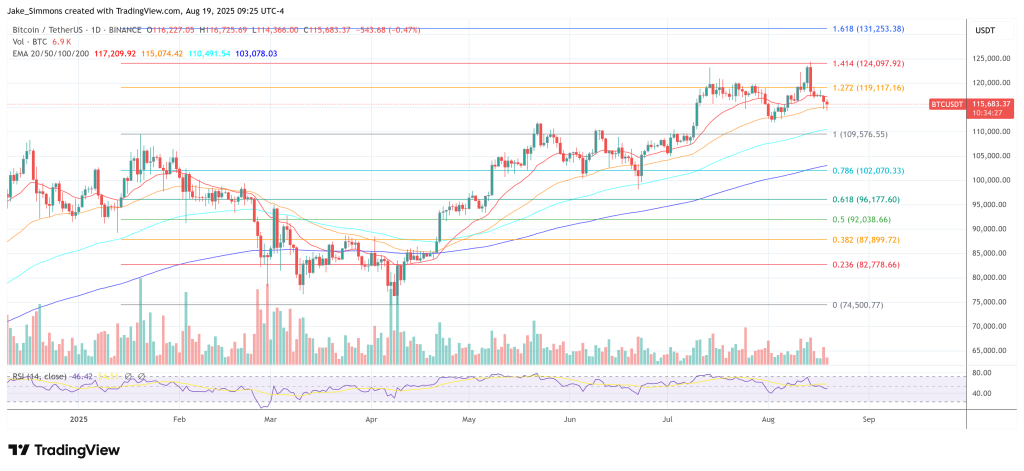
Technically, Bitcoin has cooled after printing fresh all-time highs in mid-July and again last week. Traders are watching the previous $112,000 high as initial downside cushion, with the psychologically critical $100,000 level, the overhead reference remains the $122,000–$124,000 zone of recent peaks. Krüger also highlights that “BTC is having a very hard time going up sans leverage without triggers,” a point echoed by derivatives signals showing compressed risk appetite.

Derivatives and volatility gauges corroborate the “low-vol, slow ascent” regime he describes. Implied volatility on BTC options (DVOL/BVIV) has sat near two-year lows, and open interest on institutional venues remains off July highs, signaling a more measured stance from levered players into Jackson Hole. Krüger also observed that futures basis had eased alongside the pullback—a classic sign of froth leaking out—while options markets show a renewed bid for downside protection on dips.

The macro through-line is straightforward: if the Fed chair nomination tilts dovish, markets will begin discounting a looser stance well before the first policy move, extending the cycle; if the candidate (and subsequent guidance) skews restrictive, the liquidity impulse that powered Bitcoin’s post-ETF advance will fade at the margin.

For now, the immediate catalysts are stacked—Powell at Jackson Hole, followed by PCE, NFP, CPI and PPI into September’s FOMC—while price trades between well-defined levels with volatility suppressed. As Krüger put it, bull markets “don’t end because of valuations or over-extension; the end needs a major trigger.” In 2025, that trigger may well be a name.

At press time, BTC traded at $115,683.
Bitcoin price
Disclaimer: The articles reposted on this site are sourced from public platforms and are provided for informational purposes only. They do not necessarily reflect the views of MEXC. All rights remain with the original authors. If you believe any content infringes on third-party rights, please contact service@support.mexc.com for removal. MEXC makes no guarantees regarding the accuracy, completeness, or timeliness of the content and is not responsible for any actions taken based on the information provided. The content does not constitute financial, legal, or other professional advice, nor should it be considered a recommendation or endorsement by MEXC.

You May Also Like

Over 60% of crypto press releases linked to high-risk or scam projects: Report

Over 60% of crypto press releases linked to high-risk or scam projects: Report

A data analysis shows crypto press release wires are dominated by scam-linked projects, hype-driven content and low-impact announcements, raising concerns about
Share
Crypto.news2026/02/04 22:02
Outlook remains cautious – TD Securities

Outlook remains cautious – TD Securities

The post Outlook remains cautious – TD Securities appeared on BitcoinEthereumNews.com. TD Securities analysts anticipate that the Bank of England’s Monetary Policy
Share
BitcoinEthereumNews2026/02/04 22:15
Trump Announces New U.S. Visa Program for Wealthy Foreigners

Trump Announces New U.S. Visa Program for Wealthy Foreigners

The post Trump Announces New U.S. Visa Program for Wealthy Foreigners appeared on BitcoinEthereumNews.com. Key Points: President Trump introduces the “Gold Card” visa program for affluent foreigners with tremendous monetary contributions. Program aims to boost U.S. revenue through significant financial gifts to the Treasury. No direct link to cryptocurrencies reported in official channels. On September 19, President Donald Trump announced the “Gold Card,” a new U.S. visa program offering expedited residency for high-net-worth individuals contributing financially to the nation. This initiative highlights policy shifts in U.S. immigration, targeting wealthy foreigners and promising substantial revenue gains, yet raises questions about potential economic and security impacts. Ethereum (ETH) Market Data Amidst New Immigration Reform Ethereum (ETH) is trading at $4,469.34, with a market cap of $539.47 billion, according to CoinMarketCap. 24-hour trading volume decreased by 20.37%, reaching $24.02 billion. ETH’s price has shown a 103% increase over the past 90 days, maintaining a market dominance of 13.37%. Despite its emphasis on financial inflows, the Gold Card program has yet to demonstrate tangible effects on the cryptocurrency market, according to the Coincu research team. While there is no significant crypto price movement attributed to it, experts caution potential regulatory and economic implications for international crypto investors seeking U.S. residency. Donald Trump, President, United States, “To advance that policy, I hereby announce the Gold Card, a visa program overseen by the Secretary of Commerce that will facilitate the entry of aliens who have demonstrated their ability and desire to advance the interests of the United States by voluntarily providing a significant financial gift to the Nation.” Market Data Did you know? The “Gold Card” visa program is positioned as a faster alternative to the existing EB-5 Investor Visa, appealing to international elites looking for expedited U.S. residency without direct job creation requirements. Ethereum (ETH) is trading at $4,469.34, with a market cap of $539.47 billion, according to CoinMarketCap.…
Share
BitcoinEthereumNews2025/09/20 22:11