BlackRock's "bet" on UNI: Deconstructing the business logic behind its partnership with Uniswap
Author: Jae, PANews
On February 11, global asset management giant BlackRock announced that it would deploy its approximately $2.2 billion tokenized government bond fund, BUIDL, to the UniswapX protocol for on-chain transactions.

Meanwhile, BlackRock confirmed it has purchased Uniswap's native governance token, UNI. While the amount was not disclosed, this marks the first time the financial empire managing $14 trillion in assets has directly exposed its balance sheet to a DeFi (decentralized finance) governance token.
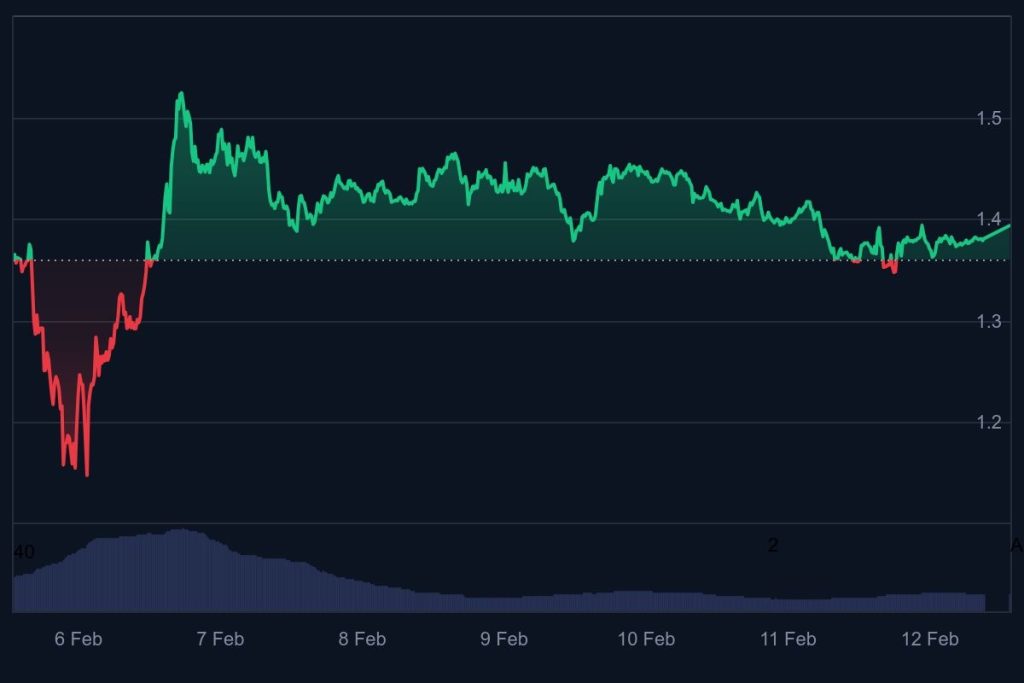
Following the announcement, the UNI token surged by over 25%. Uniswap founder Hayden Adams stated: "DeFi has reached a significant day. This collaboration will leverage Uniswap's market structure to provide BUIDL investors with on-chain trading, with settlement on Ethereum. This is a major step towards 'virtually any value can be traded on-chain.'"
This event is not merely a simple asset listing, but a new trial in financial infrastructure. For the first time, Wall Street has proactively entered the DeFi space, sat down, handed out business cards, and pulled out its checkbook. Tony Edward, founder of the Thinking Crypto Podcast, pointed out: This is a major adoption of cryptocurrency; BlackRock is embracing DeFi.
For Uniswap, this means it is transforming from a retail-dominated platform into an invisible back-end for institutional-grade liquidity. For BlackRock, it means it finally believes that DEXs (decentralized exchanges) have matured enough to be entrusted as underlying financial infrastructure.
BUIDL invests $2.2 billion in Uniswap, turning government bonds into USD.
To understand the significance of this collaboration, it's essential to clarify a key fact: BUIDL wasn't simply dumped into a Uniswap V2 or V3 liquidity pool like a regular token; instead, it was embedded in UniswapX.
Since its launch, BUIDL has grown into the largest institutional-grade tokenized fund on the blockchain, with its assets primarily backed by US Treasury bonds, cash, and repurchase agreements.
However, the liquidity of such assets has long been limited by traditional over-the-counter (OTC) transactions or specific redemption cycles, which restricts their utility in the digital asset market.
UniswapX is an intent-based trading aggregation protocol launched by Uniswap Labs. Its core mechanism is the Request for Quote (RFQ) framework, which will provide institutional investors with a trading environment with no gas fees, protection against MEV (miner extractable value), and optimal prices.
In other words, users don't need to find the transaction path themselves, pay gas fees, or worry about MEV attacks. They only need to express "I want to exchange BUIDL for USDC", and the rest is handled by professional market makers.
The biggest difference between this architecture and the traditional AMM (Automated Market Maker) is that it is programmable and compliant.
In the BUIDL trading process, Securitize Markets will act as a "regulatory gatekeeper," responsible for pre-qualifying and whitelisting all participating investors. Only qualified investors with assets exceeding $5 million can enter this trading ecosystem. Market makers such as Wintermute and Flowdesk have also undergone pre-screening.
This means that although BUIDL is a decentralized protocol, its participants are still subject to strict KYC/AML regulations.
This "compliance mezzanine" concept resolves the conflict between the anonymity of decentralized protocols and the compliance requirements of traditional finance. Simply put, transactions occur on the Uniswap interface, settlements take place on the Ethereum ledger, but the compliance pressure is shifted forward to Securitize.
Uniswap is able to maintain the permissionless nature of its underlying protocol while attracting institutional capital. This is a full application of the "intent-driven" transaction model: users express their intentions, and fillers execute them within compliance.
Even more disruptive is the leap in settlement efficiency.
Traditional money market fund settlements typically require T+1 or even longer. However, BUIDL's integration with UniswapX will enable atomic, instant settlement.
This means that holders can instantly convert their 4% annualized government bond shares into USDC at any time (including weekends and holidays), significantly improving capital efficiency.
For institutions, this level of liquidity will give tokenized assets an unparalleled advantage over traditional assets in terms of collateral management and risk hedging.
This essentially creates a highly liquid secondary market for "interest-bearing stablecoins." UniswapX provides a low-loss conversion channel between these interest-bearing rights and immediate purchasing power.
UNI is no longer just a token for air pollution control; BlackRock is pouring real money into it.
If the launch of BUIDL was a business collaboration, then BlackRock's purchase of UNI tokens was a capital alliance.
For a long time, UNI was jokingly referred to as a "worthless governance token." Holders, aside from participating in voting, could not directly receive any economic share from the protocol's hundreds of billions of dollars in annual transaction volume. However, this situation will end at the end of 2025.
The adoption of the "UNIInation" proposal rewrote UNI's value narrative.
Under the “UNIFication” framework, Uniswap officially enabled the protocol fee switch and introduced a smart contract system of “TokenJar + Firepit”.
All protocol fees from Uniswap V2, V3, and L2 Unichain flow into TokenJar, and the only way to extract this value is by burning an equivalent amount of UNI tokens through Firepit.
This programmatic buyback and burn mechanism, for the first time, directly translates the protocol's trading volume into the deflationary force of the UNI token.
As of February 12, based on DeFiLlama's data estimates, the annualized revenue of the Uniswap protocol will exceed $26 million.
BlackRock's purchase of UNI tokens at this juncture demonstrates its keen sense of capital.
UNI is no longer just a symbolic voting right, but a blue-chip asset with "productive asset" attributes. As the trading volume of RWA assets such as BUIDL continues to increase on Uniswap, the fees captured by the protocol will rise accordingly, thereby accelerating the burning of UNI and enhancing the intrinsic value of the token.
However, the strategic intent behind this deal goes far beyond financial returns; it lies in gaining a "voice" in the global decentralized liquidity infrastructure. As a capital giant managing over $14 trillion in assets, BlackRock needs to ensure that the trading protocols underlying its tokenized assets can operate stably and that there will be no radical governance changes that would be detrimental to the institution.
Holding a sufficient proportion of UNI tokens means:
- Anti-discriminatory pricing policy: Prevents excessive charges from being levied on the UniswapX path where BUIDL resides.
- Promoting the standardization of compliant Hooks: In Uniswap V4's Hooks architecture, BlackRock can use its voting rights to support clearing Hooks that meet regulatory requirements, thereby creating a more institutionally friendly trading environment.
- Asset value endorsement: By holding the tokens directly, BlackRock will also send a signal to other traditional financial institutions that some DeFi tokens are mature enough to be used as part of a diversified asset allocation.
The partnership between BlackRock and Uniswap is not a chance encounter of capital, but rather marks DeFi's formal transition from "experimental finance" to "infrastructure finance".
By bringing in a player of BlackRock's caliber, Uniswap is carving out a new moat in the increasingly competitive DEX market.
You May Also Like

WLFI Expands Into Forex With World Swap Launch

Usdt stablecoin could challenge Bitcoin leadership