The post Ethereum Supply Shock Brews as Institutions Buy appeared on BitcoinEthereumNews.com. Corporate treasuries, led by firms like Bitmine, now hold over 3.3 million ETH (2.75% of supply). Spot Ethereum ETFs have rapidly accumulated nearly 5% of the total ETH supply, led by BlackRock. This massive institutional accumulation is creating a supply squeeze under the surface of the market. Corporate treasuries and ETFs now control nearly 8% of Ethereum’s total supply, a stunning accumulation that signals a stealthy, institutional-led supply shock is underway. While the token trades near $4,590, the quiet removal of millions of ETH from the open market by major players like BlackRock and a new class of corporate buyers points to a major shift in the market’s structure. Who Are the Biggest Institutional Buyers? Asset manager BlackRock is a primary driver of this trend. Since May, the firm has accumulated more than 2.26 million ETH. While these holdings are for clients, the sheer pace of the buys, including the latest $300 million purchase, signals a massive spike in institutional demand. This activity follows the success of its Bitcoin ETF, leading to speculation that a similar supply squeeze could happen with Ethereum. Corporate treasuries have also become major players. Six months ago, corporate ETH allocations were small. Today, companies collectively hold over 3.3 million ETH, or 2.75% of the total supply, worth about $14.5 billion.  Bitmine, led by analyst Tom Lee, has been the most aggressive, buying 1.7 million ETH in the past 50 days alone. Lee stated that Bitmine’s goal is to own 5% of the total ETH supply. How Is This Affecting ETH Supply? This multi-front accumulation is creating a supply shock. Ethereum ETFs now hold around 5% of the supply, a figure that is quickly approaching the 6% held by Bitcoin ETFs. Analysts increasingly refer to ETH as “digital oil,” an essential commodity that backs stablecoin and… The post Ethereum Supply Shock Brews as Institutions Buy appeared on BitcoinEthereumNews.com. Corporate treasuries, led by firms like Bitmine, now hold over 3.3 million ETH (2.75% of supply). Spot Ethereum ETFs have rapidly accumulated nearly 5% of the total ETH supply, led by BlackRock. This massive institutional accumulation is creating a supply squeeze under the surface of the market. Corporate treasuries and ETFs now control nearly 8% of Ethereum’s total supply, a stunning accumulation that signals a stealthy, institutional-led supply shock is underway. While the token trades near $4,590, the quiet removal of millions of ETH from the open market by major players like BlackRock and a new class of corporate buyers points to a major shift in the market’s structure. Who Are the Biggest Institutional Buyers? Asset manager BlackRock is a primary driver of this trend. Since May, the firm has accumulated more than 2.26 million ETH. While these holdings are for clients, the sheer pace of the buys, including the latest $300 million purchase, signals a massive spike in institutional demand. This activity follows the success of its Bitcoin ETF, leading to speculation that a similar supply squeeze could happen with Ethereum. Corporate treasuries have also become major players. Six months ago, corporate ETH allocations were small. Today, companies collectively hold over 3.3 million ETH, or 2.75% of the total supply, worth about $14.5 billion.  Bitmine, led by analyst Tom Lee, has been the most aggressive, buying 1.7 million ETH in the past 50 days alone. Lee stated that Bitmine’s goal is to own 5% of the total ETH supply. How Is This Affecting ETH Supply? This multi-front accumulation is creating a supply shock. Ethereum ETFs now hold around 5% of the supply, a figure that is quickly approaching the 6% held by Bitcoin ETFs. Analysts increasingly refer to ETH as “digital oil,” an essential commodity that backs stablecoin and…

Ethereum Supply Shock Brews as Institutions Buy

3 min read
  • Corporate treasuries, led by firms like Bitmine, now hold over 3.3 million ETH (2.75% of supply).
  • Spot Ethereum ETFs have rapidly accumulated nearly 5% of the total ETH supply, led by BlackRock.
  • This massive institutional accumulation is creating a supply squeeze under the surface of the market.

Corporate treasuries and ETFs now control nearly 8% of Ethereum’s total supply, a stunning accumulation that signals a stealthy, institutional-led supply shock is underway. While the token trades near $4,590, the quiet removal of millions of ETH from the open market by major players like BlackRock and a new class of corporate buyers points to a major shift in the market’s structure.

Who Are the Biggest Institutional Buyers?

Asset manager BlackRock is a primary driver of this trend. Since May, the firm has accumulated more than 2.26 million ETH. While these holdings are for clients, the sheer pace of the buys, including the latest $300 million purchase, signals a massive spike in institutional demand. This activity follows the success of its Bitcoin ETF, leading to speculation that a similar supply squeeze could happen with Ethereum.

Corporate treasuries have also become major players. Six months ago, corporate ETH allocations were small. Today, companies collectively hold over 3.3 million ETH, or 2.75% of the total supply, worth about $14.5 billion. 

Bitmine, led by analyst Tom Lee, has been the most aggressive, buying 1.7 million ETH in the past 50 days alone. Lee stated that Bitmine’s goal is to own 5% of the total ETH supply.

How Is This Affecting ETH Supply?

This multi-front accumulation is creating a supply shock. Ethereum ETFs now hold around 5% of the supply, a figure that is quickly approaching the 6% held by Bitcoin ETFs. Analysts increasingly refer to ETH as “digital oil,” an essential commodity that backs stablecoin and blockchain infrastructure for the entire financial services industry. With institutional adoption accelerating, the current price volatility may represent a key buying opportunity before the end of the year.

ETH Short-Term Price Outlook Based on Institutional Buys

The short-term technicals are sending mixed signals. Ethereum has been volatile, hitting intraday highs of $4,650 before dropping below $4,500. 

Trading volumes fell nearly 19% to $40.77 billion over the last 24 hours, showing a pause in market activity.

Technical indicators present mixed signals. The Relative Strength Index (RSI) is at 57.41, above neutral but below recent highs, pointing to slight momentum.

The Moving Average Convergence Divergence (MACD) indicator shows a small bearish divergence, though ETH remains supported above longer-term averages. 

Analysts note that a decisive break above the $4,650–$4,700 range would open a path toward $4,900 and potentially challenge the $4,800 resistance for a rally toward $6,000.

Disclaimer: The information presented in this article is for informational and educational purposes only. The article does not constitute financial advice or advice of any kind. Coin Edition is not responsible for any losses incurred as a result of the utilization of content, products, or services mentioned. Readers are advised to exercise caution before taking any action related to the company.

Source: https://coinedition.com/ethereum-eth-supply-shock-institutional-accumulation/

Market Opportunity
NEAR Logo
NEAR Price(NEAR)
$0.963
$0.963$0.963
-9.23%
USD
NEAR (NEAR) Live Price Chart
Disclaimer: The articles reposted on this site are sourced from public platforms and are provided for informational purposes only. They do not necessarily reflect the views of MEXC. All rights remain with the original authors. If you believe any content infringes on third-party rights, please contact service@support.mexc.com for removal. MEXC makes no guarantees regarding the accuracy, completeness, or timeliness of the content and is not responsible for any actions taken based on the information provided. The content does not constitute financial, legal, or other professional advice, nor should it be considered a recommendation or endorsement by MEXC.

You May Also Like

Once Upon a Farm Announces Pricing of Initial Public Offering

Once Upon a Farm Announces Pricing of Initial Public Offering

BERKELEY, Calif.–(BUSINESS WIRE)–Once Upon a Farm today announced the pricing of its initial public offering of 10,997,209 shares of its common stock, 7,631,537
Share
AI Journal2026/02/06 08:15
Forward Industries Bets Big on Solana With $4B Capital Plan

Forward Industries Bets Big on Solana With $4B Capital Plan

The firm has filed with the U.S. Securities and Exchange Commission to launch a $4 billion at-the-market (ATM) equity program, […] The post Forward Industries Bets Big on Solana With $4B Capital Plan appeared first on Coindoo.
Share
Coindoo2025/09/18 04:15
332M accounts and $28B TVL,

332M accounts and $28B TVL,

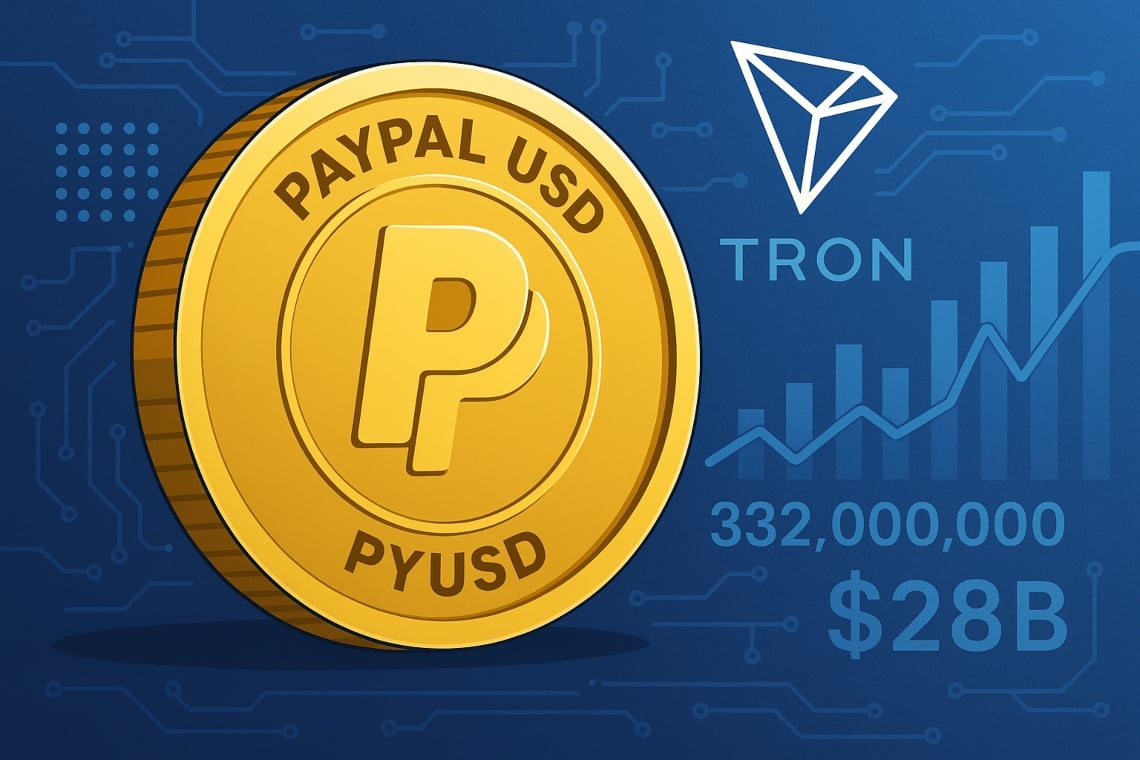
The post 332M accounts and $28B TVL, appeared on BitcoinEthereumNews.com. PayPal USD debuts on TRON as a permissionless token PYUSD0, enabled by LayerZero’s OFT standard and the Stargate Hydra extension. The announcement on September 18, 2025 (Geneva) introduces native interoperability between chains and transfers without manual steps for users; the news echoes elements already communicated by PayPal at the launch of PYUSD PayPal Newsroom. The move concerns an ecosystem that includes 332 million accounts and over $28 billion in TVL. In this context, the fungibility of a stablecoin regulated across multiple networks and the use of TRON as a settlement layer for payments and remittances is at stake. According to the data collected by TRONSCAN updated as of September 18, 2025, the network metrics confirm the cited volumes and highlighted traffic patterns. Our editorial team has verified the transaction logs and monitored the public chain metrics to corroborate the reported figures; the observations on daily flows and TVL are consistent with the network dashboards. Industry analysts observe that the entry of a regulated issuer like PayPal tends to increase institutional interest, provided there is transparency on reserves and compliance checks. What is PYUSD0 on TRON and why is it relevant PYUSD0 is the representation of PayPal USD on TRON. It is pegged one-to-one to PYUSD through the OFT standard: the two tokens remain a single stablecoin, fungible and reconciled across chains. The integration is made possible by Stargate Hydra, now operational through LayerZero. According to the founder of TRON, Justin Sun, the extension on TRON expands access and trust for users and institutions. For Bryan Pellegrino (CEO of LayerZero Labs), stablecoins represent a pillar of global payments and remittances, as the native compatibility between chains enables their operational scalability. It must be said that the alignment between issuer, cross-chain infrastructure, and settlement network is a key element. Key Numbers: TRON…
Share
BitcoinEthereumNews2025/09/19 08:18