Ethereum co-founder Vitalik Buterin says the network’s clearest value proposition may not be smart contracts or payments, but something more foundational: actingEthereum co-founder Vitalik Buterin says the network’s clearest value proposition may not be smart contracts or payments, but something more foundational: acting

Vitalik Buterin Argues Ethereum’s Biggest Use Case Is Data Availability

2026/03/14 00:00
3 min read
For feedback or concerns regarding this content, please contact us at crypto.news@mexc.com

Ethereum co-founder Vitalik Buterin says the network’s clearest value proposition may not be smart contracts or payments, but something more foundational: acting as a censorship-resistant public data layer. In a post reflecting on conversations at Real World Crypto and related events, Buterin argued that stepping outside “blockchain baggage” makes ETH’s core utility easier to see.

“I was recently at Real World Crypto (that’s crypto as in cryptography) and the associated side events, and one thing that struck me was that it was a clarifying experience in terms of understanding what blockchains are for,” Buterin wrote. “We blockchain people (myself included) often have a tendency to start off from the perspective that we are Ethereum, and therefore we need to go around and find use cases for Ethereum.”

Ethereum’s Core Value Starts With A ‘Public Bulletin Board’

His point was less about defending Ethereum as a brand than re-evaluating it as infrastructure. “For a moment, let us forget that we are ‘the Ethereum community’. Rather, we are maintainers of the Ethereum tool,” he wrote, asking where the network adds value when viewed with “zero attachment to Ethereum specifically.”

The first answer, he said, is “not what you think.” It is “not smart contracts, it’s not even payments,” but what cryptographers call a “public bulletin board”, a publicly readable and writable place to post data blobs. That matters because a range of cryptographic systems, including secure online voting, software and website version control, and certificate revocation, depend on exactly that kind of shared infrastructure.

“This does not require any computation functionality,” Buterin wrote. “In fact, it does not directly require money, though it does indirectly require money, because if you want permissionless anti-spam it has to be economic. The only thing it fundamentally requires is data availability.”

That framing leads directly to Ethereum’s recent scaling work. Buterin highlighted PeerDAS, which he said increased Ethereum’s data availability capacity by 2.3x, with a roadmap to push that another 10x to 100x higher. In his telling, that makes Ethereum increasingly relevant not just for onchain finance, but for a broader class of open, privacy-preserving internet infrastructure.

Payments still matter, but as a secondary layer in the stack. Buterin argued that many systems need value transfer not primarily for commerce, but for anti-spam, sybil resistance, and machine-to-machine coordination. He pointed to Ethereum plus ZK payment channels as a strong design for permissionless APIs, and said ETH can serve as a “natural backstop” for applications that want to resist fake-account abuse without relying on phone numbers or other centralized identity rails.

Smart contracts come after that. Here, Buterin described them as useful for security deposits, for implementing constructs like ZK payment channels, and for managing pointers to “digital objects” tied to socially recognized external entities. Technically, he said, most non-ETH use cases could be handled by treating the chain as a bulletin board and using ZK-SNARKs for computation off-chain. In practice, though, standardizing that model is difficult, and shared execution remains the more interoperable route.

The broader claim is that Ethereum works best when understood as “global shared memory” inside a decentralized software stack. Buterin suggested adoption may still lag that reality because many builders are operating with outdated assumptions from 2020 to 2022, when fees were far higher and scaling looked less mature. Today, he argued, fees are “extremely low,” the roadmap is stronger, and tooling to shield users from fee volatility has improved.

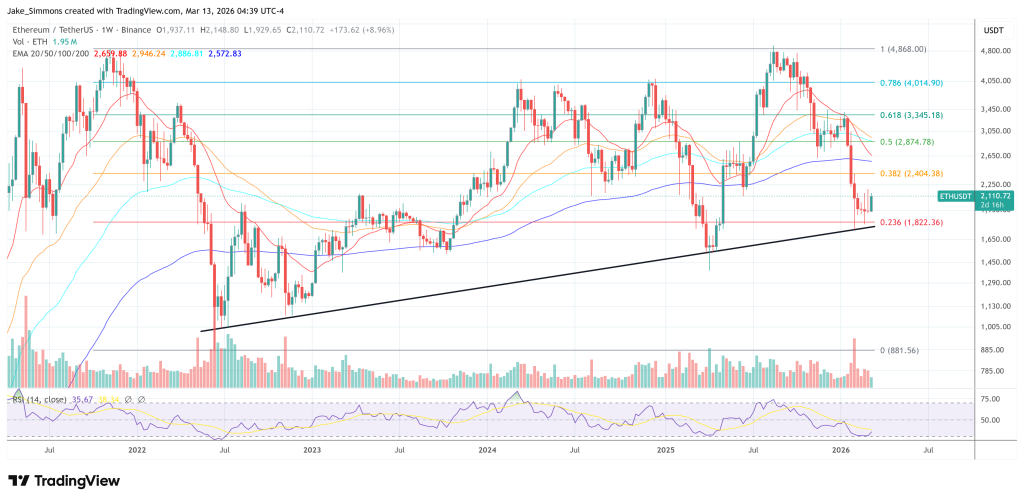
At press time, ETH traded at 2,110.
Ethereum price chart
Market Opportunity
Notcoin Logo
Notcoin Price(NOT)
$0.0004037
$0.0004037$0.0004037
-2.34%
USD
Notcoin (NOT) Live Price Chart
Disclaimer: The articles reposted on this site are sourced from public platforms and are provided for informational purposes only. They do not necessarily reflect the views of MEXC. All rights remain with the original authors. If you believe any content infringes on third-party rights, please contact crypto.news@mexc.com for removal. MEXC makes no guarantees regarding the accuracy, completeness, or timeliness of the content and is not responsible for any actions taken based on the information provided. The content does not constitute financial, legal, or other professional advice, nor should it be considered a recommendation or endorsement by MEXC.

You May Also Like

Crypto News: Donald Trump-Aligned Fed Governor To Speed Up Fed Rate Cuts?

Crypto News: Donald Trump-Aligned Fed Governor To Speed Up Fed Rate Cuts?

The post Crypto News: Donald Trump-Aligned Fed Governor To Speed Up Fed Rate Cuts? appeared on BitcoinEthereumNews.com. In recent crypto news, Stephen Miran swore in as the latest Federal Reserve governor on September 16, 2025, slipping into the board’s last open spot right before the Federal Open Market Committee kicks off its two-day rate discussion. Traders are betting heavily on a 25-basis-point trim, which would bring the federal funds rate down to 4.00%-4.25%, based on CME FedWatch Tool figures from September 15, 2025. Miran, who’s been Trump’s top economic advisor and a supporter of his trade ideas, joins a seven-member board where just three governors come from Democratic picks, according to the Fed’s records updated that same day. Crypto News: Miran’s Background and Quick Path to Confirmation The Senate greenlit Miran on September 15, 2025, with a tight 48-47 vote, following his nomination on September 2, 2025, as per a recent crypto news update. His stint runs only until January 31, 2026, stepping in for Adriana D. Kugler, who stepped down in August 2025 for reasons not made public. Miran earned his economics Ph.D. from Harvard and worked at the Treasury back in Trump’s first go-around. Afterward, he moved to Hudson Bay Capital Management as an economist, then looped back to the White House in December 2024 to head the Council of Economic Advisers. There, he helped craft Trump’s “reciprocal tariffs” approach, aimed at fixing trade gaps with China and the EU. He wouldn’t quit his White House gig, which irked Senator Elizabeth Warren at the September 7, 2025, confirmation hearings. That limited time frame means Miran gets to cast a vote straight away at the FOMC session starting September 16, 2025. The full board now features Chair Jerome H. Powell (Trump pick, term ends 2026), Vice Chair Philip N. Jefferson (Biden, to 2036), and folks like Lisa D. Cook (Biden, to 2028) and Michael S. Barr…
Share
BitcoinEthereumNews2025/09/18 03:14
FCA, crackdown on crypto

FCA, crackdown on crypto

The post FCA, crackdown on crypto appeared on BitcoinEthereumNews.com. The regulation of cryptocurrencies in the United Kingdom enters a decisive phase. The Financial Conduct Authority (FCA) has initiated a consultation to set minimum standards on transparency, consumer protection, and digital custody, in order to strengthen market confidence and ensure safer operations for exchanges, wallets, and crypto service providers. The consultation was published on May 2, 2025, and opened a public discussion on operational responsibilities and safeguarding requirements for digital assets (CoinDesk). The goal is to make the rules clearer without hindering the sector’s evolution. According to the data collected by our regulatory monitoring team, in the first weeks following the publication, the feedback received from professionals and operators focused mainly on custody, incident reporting, and insurance requirements. Industry analysts note that many responses require technical clarifications on multi-sig, asset segregation, and recovery protocols, as well as proposals to scale obligations based on the size of the operator. FCA Consultation: What’s on the Table The consultation document clarifies how to apply rules inspired by traditional finance to the crypto perimeter, balancing innovation, market integrity, and user protection. In this context, the goal is to introduce minimum standards for all firms under the supervision of the FCA, an essential step for a more transparent and secure sector, with measurable benefits for users. The proposed pillars Obligations towards consumers: assessment on the extension of the Consumer Duty – a requirement that mandates companies to provide “good outcomes” – to crypto services, with outcomes for users that are traceable and verifiable. Operational resilience: introduction of continuity requirements, incident response plans, and periodic testing to ensure the operational stability of platforms even in adverse scenarios. Financial Crime Prevention: strengthening AML/CFT measures through more stringent transaction monitoring and structured counterpart checks. Custody and safeguarding: definition of operational methods for the segregation of client assets, secure…
Share
BitcoinEthereumNews2025/09/18 05:40
Why XRP Could Be More Important Than Anyone Realised: DTCC, Mastercard and DBS Explained

Why XRP Could Be More Important Than Anyone Realised: DTCC, Mastercard and DBS Explained

The post Why XRP Could Be More Important Than Anyone Realised: DTCC, Mastercard and DBS Explained appeared first on Coinpedia Fintech News XRP is trading at $1.
Share
CoinPedia2026/03/14 00:54