

Cardano Founder Blasts Ghost Chain Critics: ‘Cavalry Is Coming’
Broadcasting “from rough and rugged Wyoming” late on September 14, Cardano founder Charles Hoskinson delivered a forceful rebuttal to what he called years of dismissive “ghost chain” narratives, arguing that the industry has “moved the goalposts” away from decentralization and toward VC-favored speed and token economics.
“It sucks to go to cryptocurrency Reddit and no matter what you say or do, you’re criticized and demeaned and attacked,” he said, after reading a community post lamenting the “overwhelming negative sentiment outside of our community.” Hoskinson’s message: Cardano will stick to its original brief—resilience, censorship resistance, and self-governance—and the payoff is near. “Keep the faith and don’t give up hope. The cavalry is coming. We are moving exactly as we need to,” he said.
Hoskinson Blasts Cardano Critics And ‘VC Chains’
The livestream’s central theme was a clash of first principles. Hoskinson traced early crypto’s mission to “disintermediation and decentralization,” saying the sector has since rewarded throughput and speculative manias—NFTs, GameFi, memecoins, and now RWAs—over credible neutrality. “The goalpost moved from disintermediation and decentralization to, well, let’s build high-performance systems and we don’t particularly care if those systems are resilient or decentralized,” he argued.
In his telling, Cardano’s refusal to compromise on those design goals explains both the network’s slower, research-driven cadence and its perceived under-appreciation in Web3 circles: “We’ve beat that drum and we’ve built protocol after protocol doing things the right way. Not the sexy way, not the VC-friendly way.”
Hoskinson framed the project’s past decade as an exercise in building durable primitives: the extended UTXO model for deterministic smart contracts; “liquid non-custodial staking”; the Ouroboros family of protocols; the Hard Fork Combinator for “telescoping” upgrades; end-to-end on-chain governance and treasury; and newer concepts such as isomorphic state channels, a partner-chains paradigm, and “Bitcoin DeFi” to align with what he called a principles-first ecosystem. “Every year, Cardano continues to get more decentralized, more resilient,” he said. “We’re able to take the best of all the ideas in the space, but never once have we compromised on who we are.”
On scalability, Hoskinson said Cardano is “on the dawn” of its next phase. He stated that “Leios is now in a SIP,” describing it as “the last stage before implementation” and “the foundation of a scalability agenda that is endless,” language he linked to a co-evolution with Hydra and advances in zero-knowledge cryptography. Taken together, he said, these efforts aim at “infinite scale just in time to absorb the needs of the economic, political and social systems abroad and at home.” He pointed to Hydra’s maturation—from a “toy” to demonstrations including a “vending machine” and tests he described as “a million transactions a second”—as a key pillar of the network’s L2 posture.
The founder set out a go-to-market plan that deliberately looks beyond crypto natives. “Less than 5% of the world is in the cryptocurrency space,” he said. “So why do we particularly care about a minority of a minority when there’s a big wide world out there?”
He urged “physicalizing Cardano,” citing Hydra-backed point-of-sale and ATM integrations, and stressed “rational privacy for all” through Midnight. He also cast Cardano as “the best place to launch a new blockchain,” linking that claim to the partner-chains initiative and what he called the “best AVS experience in the space.” Bitcoin remains the critical ally in this strategy, he said: “We have to partner with ecosystems that are principles first like Bitcoin… And we’re doing this with Bitcoin DeFi.”
Cavalry Coming?
Geographically, Hoskinson highlighted Argentina and Africa. He said Input Output maintains the “largest cryptocurrency office” in Buenos Aires and hosts biweekly events, adding that Cardano “continues to grow throughout Latin America.” In Africa, he said the long-trailed identity push is “almost ready to roll out,” with 2026 targeted to “turn on the ability to bring economic identity to the millions eventually billions who don’t have it.” Throughout, he contrasted these efforts with what he characterized as short-lived hype cycles: “To be truly a visionary, you have to accept that you have to go alone sometimes into the wilderness… And we’ve done that for 10 years.”
Governance milestones formed another through-line. Hoskinson declared the project’s “Voltaire” era “mission accomplished,” citing a community-elected constitutional committee, “hundreds of DReps,” a ratified on-chain constitution, and an annual budget. “We’re already talking about the next constitution and an incredible suite of governance tools,” he said, arguing that this collective machinery lets the ecosystem “speak with one voice,” ratify upgrades, and “converge to a budget” without compromising liveness or safety. “We are the only chain in the history of the cryptocurrency industry to do this,” he asserted.
The address included rare self-critique. Hoskinson said he wished Cardano had “moved faster in certain areas,” made “slightly different decisions about the ordering of the roadmap,” and staffed partnerships more aggressively. He nonetheless credited the privacy-focused Midnight initiative with “more than a hundred partnerships,” positioning it as a commercial bridge that “will bring hundreds more, if not thousands.”
He also revisited longstanding allegations from rival communities, saying he is “still inundated” with claims he “stole $600 million,” and added that a “128-page” forensic audit “gave complete exoneration,” a result he said received little attention from crypto media. “The asymmetries of information sting long, hard, and unfortunately take years or decades to undo,” he said.
Hoskinson closed by returning to community morale, urging Cardano’s governance participants to “forget the past and… look to the future,” redirecting energy toward entrepreneurs who can “bring in the countless millions to tens of millions to hundreds of millions of users.” The core bet, he said, is unchanged: that decentralization, credible governance, and research-led engineering will ultimately outlast every hype cycle.
“The next 24 to 36 months, Cardano will be in a position where it’s the fastest, most secure, and frankly speaking, best platform… to build anything at scale for anyone,” Hoskinson concluded, adding: “Cardano’s best days are ahead of it. I will always believe that. And that’s because Cardano has the best people.”
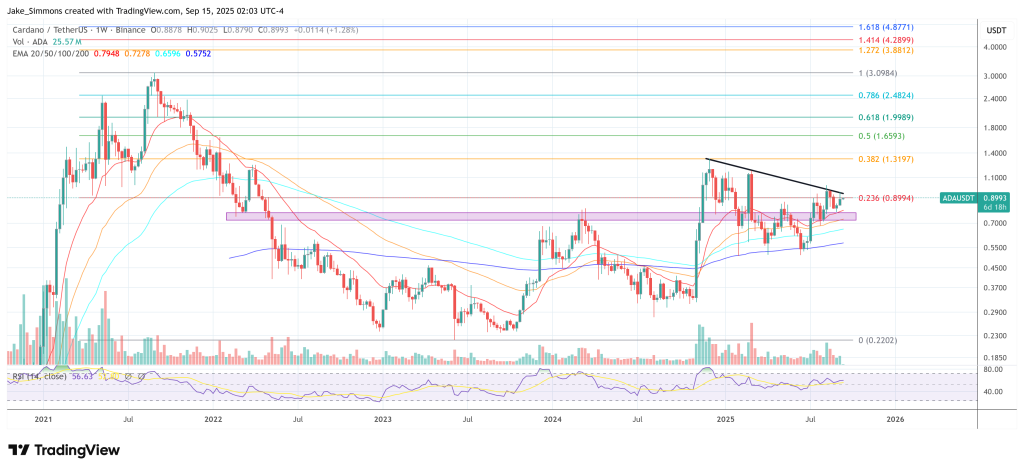
At press time, ADA traded at $0.89.
You May Also Like

XRP Enters ‘Washout Zone,’ Then Targets $30, Crypto Analyst Says
Republicans are 'very concerned about Texas' turning blue: GOP senator
