BORA (BORA) Price Prediction 2026, 2027–2030: Can It Recover From Past Lows?
The post BORA (BORA) Price Prediction 2026, 2027–2030: Can It Recover From Past Lows? appeared first on Coinpedia Fintech News
Story Highlights
- The live price of Bore token is $ 0.03668609
- BORA could reach up to $0.12 in 2026 if real adoption grows through gaming apps and stronger ecosystem integration.
- Long-term growth depends on actual usage, successful game launches, and deeper integration within the Kaia ecosystem.
- By 2030, BORA may approach $2.74, but only if it becomes widely used across apps, not just driven by speculation.
BORA is a South Korean blockchain ecosystem focused on gaming and entertainment. It aims to solve common problems like high fees and slow transactions for content platforms.
It uses a dual-chain system. The main BORA token runs on the public Klaytn blockchain, where it is traded. At the same time, a separate BORA Chain handles app data and transactions, making the system faster and more efficient.
At its peak in 2021, BORA surged alongside GameFi hype. But when that cycle faded, so did most of its demand.
Since then, the project hasn’t disappeared; it has quietly continued building tools for game studios, content platforms, and in-app economies.
So, can Bora ride the next wave of Web3 gaming and entertainment?
Let’s explore CoinPedia’s Bora (BORA) Price Prediction 2026, 2027 – 2030.
BORA Price Today
| Cryptocurrency | BORA |
| Token | BORA |
| Price | $0.0367  0.98% 0.98% |
| Market Cap | $ 40,345,526.88 |
| 24h Volume | $ 399,897.4770 |
| Circulating Supply | 1,099,750,000.00 |
| Total Supply | 1,205,750,000.00 |
| All-Time High | $ 1.6559 on 25 November 2021 |
| All-Time Low | $ 0.0062 on 18 January 2020 |
Table of contents
- CoinPedia’s BORA (BORA) Price Prediction
- BORA (BORA) Price Targets For March 2026
- Technical Analysis
- BORA (BORA) Price Prediction 2026
- BORA Price Prediction 2026 – 2030
- BORA (BORA) Price Prediction 2026
- BORA Price Prediction 2027
- BORA Price Targets 2028
- BORA Coin Price Prediction 2029
- BORA (BORA) Price Prediction 2030
- What Does The Market Say?
- FAQs
CoinPedia’s BORA (BORA) Price Prediction
Bora is not competing globally; it’s competing locally inside one of the strongest digital ecosystems in Asia. Meanwhile, that’s both its biggest strength and biggest limitation.
If Kakao-linked platforms actually push blockchain into real user-facing products, Bora could quietly grow without hype.
But if usage remains limited to speculation and inactive apps, the token will likely struggle to break past resistance zones.
Based on the current trajectory, CoinPedia expects the Bora token to reach a 2026 high of $0.12.
| Year | Potential Low ($) | Potential Average ($) | Potential High ($) |
| 2026 | $0.0032 | $0.0475 | $0.12 |
BORA (BORA) Price Targets For March 2026
2026 is likely to be a make-or-break year for BORA, not because of market hype, but because of execution.
The Web3 gaming sector is evolving. Users are no longer satisfied with basic token rewards; they expect real gameplay, ownership, and value.
One of the important factors is South Korea’s regulatory environment. If regulations become more favorable toward blockchain gaming and tokenized assets, Bora could benefit significantly due to its regional dominance. Bora Points also play an important role. Users can start without crypto and later convert points into BORA. This makes it easier for new users to join.
However, considering the bullish and bearish targets, the Potential high price may find its base at $0.0475 by the end of March 2026.
| Month | Potential Low ($) | Potential Average ($) | Potential High ($) |
| Bora Price Prediction March 2026 | $0.0342 | $0.03990 | $0.04759 |
Technical Analysis
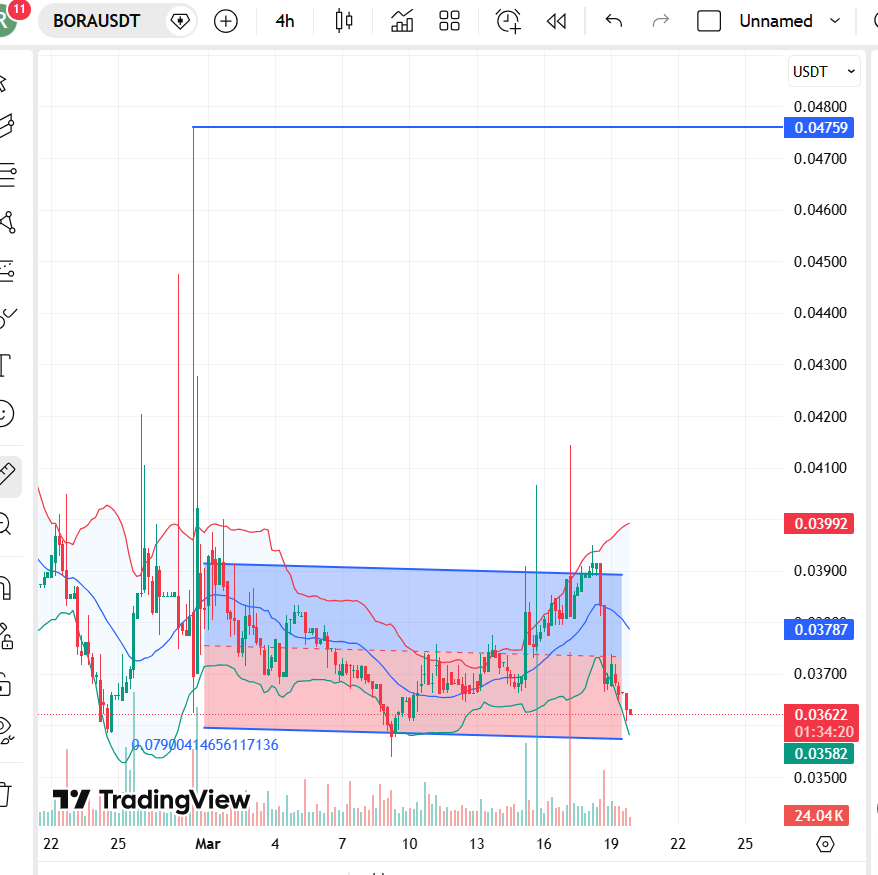
BORA on the 4-hour chart is moving inside a clear range, with price bouncing between support near $0.036 and resistance around $0.040. Recently, the price moved up toward the top of the range but failed to break above and quickly dropped back down.
This shows sellers remain strong near the resistance.
The price is now close to the lower support area again. If this level holds, we could see another bounce back toward the $0.04759.
But if support breaks, price may fall further toward 0.035 or lower.
BORA (BORA) Price Prediction 2026
BORA’s future in 2026 will largely depend on how well it performs within the Kakao–Kaia ecosystem, not on overall crypto market trends. Its growth will come from real usage, not hype alone.
One key factor is the use of Bora infrastructure for game launches. If even one or two games succeed and use Bora Points and rewards, it can attract new users, increase transactions, and create real demand for the token.
Another important factor is the growth of the Kaia ecosystem. After the Klaytn and Finschia merger, Kaia aims to become a strong Web3 hub in Asia. If BORA is more deeply integrated here, it can achieve better liquidity and attract more developer attention.
This means that real users, real activity, and real usage will decide BORA’s future.
| Year | Potential Low ($) | Potential Average ($) | Potential High ($) |
| Bora Price Prediction 2026 | $0.0032 | $0.0475 | $0.12 |
BORA Price Prediction 2026 – 2030
| Year | Potential Low ($) | Potential Average ($) | Potential High ($) |
| 2026 | $0.0032 | $0.0475 | $0.12 |
| 2027 | $0.040 | $0.093 | $0.33 |
| 2028 | $0.090 | $0.35 | $0.65 |
| 2029 | $0.113 | $0.59 | $1.28 |
| 2030 | $0.30 | $0.95 | $2.74 |
BORA (BORA) Price Prediction 2026
If Bora successfully integrates into Kaia and launches usable games, it could test $0.12. Without that, it may stay below $0.07.
BORA Price Prediction 2027
If Kakao-backed platforms push Web3 adoption at scale, BORA could move toward $0.33, driven by regional demand.
BORA Price Targets 2028
This is where survival matters. If Bora is still actively used, not abandoned, it could reach $0.65 as Web3 gaming matures.
BORA Coin Price Prediction 2029
By 2029, if Bora evolves into a backend economy layer for mobile apps, not just games, it could approach $1.28.
BORA (BORA) Price Prediction 2030
In 2030, a move toward $2.74 only happens if Bora becomes invisible infrastructure, used daily without users even noticing the blockchain..
What Does The Market Say?
| Year | 2026 | 2027 | 2030 |
| Priceprediction.net | $0.242 | $0.370 | $ 1.51 |
| CoinCodeX | $0.227 | $0.120 | $0.0078 |
| Digitalcoinprice | $0.32 | $0.43 | $0.92 |
Never Miss a Beat in the Crypto World!
Stay ahead with breaking news, expert analysis, and real-time updates on the latest trends in Bitcoin, altcoins, DeFi, NFTs, and more.
 Subscribe to Price Prediction
FAQs
BORA powers payments, rewards, and transactions in gaming and content apps, helping developers build fast, low-cost Web3 experiences.
BORA’s potential depends on real adoption in gaming ecosystems. If usage grows, it may perform well, but risks remain if demand stays weak.
BORA’s price is driven by app usage, game launches, user activity, and South Korea’s crypto regulations impacting blockchain adoption.
Yes, BORA can benefit if it powers successful games. Real player activity and in-game economies are crucial for sustained demand.
BORA could reach up to $0.12 in 2026 if adoption grows. Without strong usage, it may stay below key resistance levels.
BORA may reach $2.74 by 2030 if it becomes widely used in apps and games. Long-term growth depends on real demand and ecosystem expansion.
You May Also Like

Trump just planted the seed of his destruction

Zoomex Launches Twin Stars Cup Trading Competition with Up to $150,000 Prize Pool