

Trump Lifted Iran Oil Sanctions and Threatened to Bomb Power Plants in the Same Week: Bitcoin’s Drop $68K is the Market Picking a Side

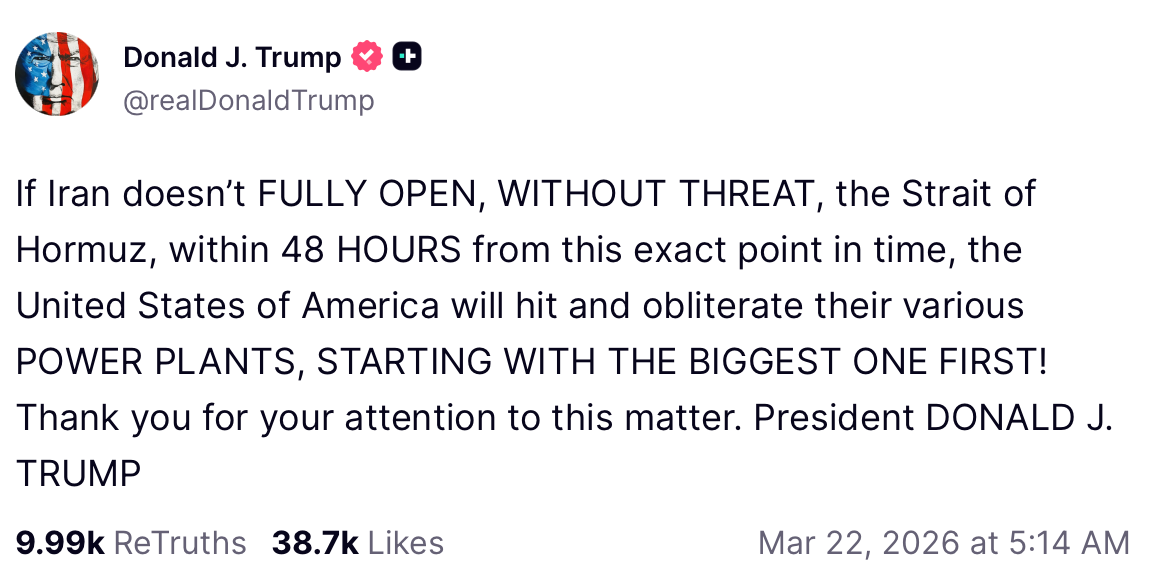
Uncertainty around the Strait of Hormuz and the global energy supply crisis amidst the Iran war has reached new heights this past week. In the span of just 48 hours, the Trump administration made two decisions that basically canceled each other out. On March 20, the Washington Post reported that the U.S. Treasury issued a 30-day sanctions waiver that allows the release of around 140 million barrels of Iranian oil already stranded at sea, with the aim of calming down the energy supply shortages and bringing oil prices down. However, by Saturday night, escalations were thrown back into the mix as President Trump sent out a warning via a Truth Social post stating that Iran had 48 hours to reopen the Strait or face strikes on its power infrastructure.
Iran responded to this escalation quickly by warning that it will completely close the passageway and target U.S. energy infrastructure in the region. This is the contradiction that sits on the table for markets to grapple with. One hand is releasing Iranian oil to calm global markets, while the other is threatening an escalation that, by Iran’s own warning, would permanently shut off the very passageway those barrels need to pass by.
On the back of this duality, Bitcoin has dropped over 5% this past week, from a high of $76K to now trading around $68K. After weeks of outpacing gold, the S&P 500 and major Asian indices, this marks the first real crack in its war outperformance narrative. With the 48 hour window closing in tonight at around 11:45 PM UTC, markets are looking at a binary outcome.
The Sanctions Waiver: Funding Iran’s Oil Sales to Lower Gas Prices
On March 20, the U.S. Treasury’s Office of Foreign Assets Control issued General License U, a 30-day sanctions waiver until April 19 that allows the sale of Iranian oil currently stranded at sea. The waiver covers all transactions necessary for the sale, delivery and offloading of Iranian crude, effectively unlocking roughly 140 million barrels into supply. Treasury Secretary Scott Bessent was quick to frame the move as a tactical decision, going on to say that those barrels were already being “hoarded by China on the cheap” and that the U.S. would now use them “against Tehran to keep the price down” as reported by CNBC. With Brent crude now up over 44% since the conflict began, now trading at $113 per barrel and the Strait of Hormuz only processing 90 ships passing through since March 1, it becomes clear why the administration felt forced into this corner.
The political blowback to this news has been swift. The Foundation for Defense of Democracies described the move as “funding the enemy” accusing the administration of rolling back sanctions without any guardrails during an active conflict. NBC news also framed it in a similar vein, stating that the move gives Iran an economic boost while strikes continue on its military infrastructure.
The fact is that the underlying contradiction is hard to ignore. The same administration that is issuing strikes on Iranian targets is now ensuring Iranian oil revenue flows. The reality is that the alternative, an uncontrolled energy price spiral heading into a domestic economy already dealing with sticky inflation, is a political and economic problem the administration clearly decided it couldn’t afford.
The 48-Hour Ultimatum: Obliterate Power Plants or Back Down
Just as the markets were pricing in a potential ease in supply pressures, escalations reached new heights on March 22. President Trump issued a clear warning with a 48-hour ultimatum via a truth social post indicating that if Iran did not “fully open” the Strait of Hormuz, the U.S. would “hit and obliterate their various power plants, starting with the biggest one first”. Axios described the statement as a “dramatic reversal,” given that just a day before, Trump had hinted at the idea of winding down operations in Iran.
Iran’s response was just as unsettling, stating that any strikes on its power plants would result in retaliatory strikes on U.S. energy infrastructure in the region and warned that the Strait of Hormuz would be completely closed until any struck facilities are rebuilt. What started as a blockade has now gone up the escalation ladder to tolls on ships passing through the region, threats against civilian power infrastructure and the potential of Hormuz closing indefinitely. Each step up this ladder makes the energy crisis a lot more severe.
The timing between these two separate news dropping is what is particularly jarring. Trump’s post comes less than 48 hours after the waiver was issued with the goal of easing the energy crisis. Markets have reacted instantly to the ultimatum with Brent now trading at $113 and WTI climbing back above $100. The contradiction has actually created a duality problem. By trying to solve the energy shock through pressure, the administration risks unleashing the exact outcome it’s trying to prevent.
Bitcoin at $68K: The War Outperformance Thesis Gets Its First Real Test
Since the start of the conflict on February 28, Bitcoin has been resilient especially when compared to the performance of equity markets across the globe and traditional safe havens like Gold. The first three weeks of the war saw Bitcoin rally over 15% from around $66K all the way to a high of $76K on March 17. Since then, however, BTC is down 10% and now trading at $68K region. This marks the largest pullback since the war began and is the first real stress test of its war outperformance narrative.
Currently there are two competing explanations for this drop. The first is that this is a normal dip post-FOMC. BTC has seen pullbacks in the last seven of the eight Fed meetings, irrespective of the macro environment. The second is the more uncomfortable explanation in that the war might have crossed a severity threshold that even BTC cannot look past and the Trump ultimatum on Saturday night was the moment the repricing began.
For now, Bitcoin is holding above the $67K level, which is the pre-breakout level we saw at the start of the moment. In order for the war outperformance narrative to be relevant, this $67K mark is the immediate level BTC needs to hold. If this level breaks, the next support lies around $65K.
Two Scenarios, No Middle Ground: What the Deadline Means for Markets
The two juxtaposing headlines have now set the scene for markets. There are only two paths from here. In scenario A, Trump backs down or postpones the deadline. The waiver on the other hand does what it was designed to do and roughly 140 billion barrels flow into circulation, prices of oil come back down to the $90 to $100 range and passage through the Strait of Hormuz continues in its semi-restricted state. Such a reality playing out would actually avoid the worst case scenario. Bitcoin would likely stabilize and move back closer to the $70K mark, with the odds of a rate cut in the second half this year coming back. Ultimately, in such a scenario, the uncertainty of the war remains but contained.
Scenario B would be the opposite and far more consequential for markets. If the U.S. follows through with strikes on major power plants in Iran, the closure of the strait becomes a real possibility and the energy supply crisis reaches unchartered territories. Such a response will likely send oil prices rising rapidly toward the $120 mark and the risk on trade could begin to unwind fast.
The first tell will come through the price of oil. Watch oil in the hour after the deadline. A spike above $120 signals markets are pricing escalation whereas a move back below $110 suggests de-escalation. For Bitcoin, the reaction may come even faster, its 24/7 nature means it will price the outcome before traditional markets open. The only question is direction: does it catch a safe-haven bid, or does it follow everything else lower in a full risk-off unwind.
Your bank is using your money. You’re getting the scraps. Watch our free video on becoming your own bank
You May Also Like
Trump’s Critical Warning: US Engages Iran’s New Regime in High-Stakes Talks, Threatens Strikes if Diplomacy Fails

CME to launch Solana and XRP futures options on October 13, 2025


