PIP-85: Can a fee fix address Polygon's competitive challenges?
Polygon, the leading Ethereum layer-2 platform, is undertaking a structural overhaul of how it distributes network fees, with some observers viewing it as a move to reverse the fortunes of its native token, POL, which has shed more than 60% of its value over the past year.
The dip in its token price and the rise in activity on other layer-2 platforms have caused Polygon, which used to be the leading L2 on Ethereum between 2021 and 2023, to cede ground to rivals like Base and Arbitrum.
The proposal, which was published on Wednesday, March 25, was authored by the blockchain’s leadership, including the founder and CEO of the Polygon Foundation, Sandeep Nailwal.
The proposal aims to see half of Polygon’s priority fee revenue redirected and shared among the network’s validators and delegators.
POL currently trades around $0.09, giving it a market capitalization of around $1 billion. It hit an all-time high of $1.29 in March 2024 before an extended decline that has pushed it to within touching distance of its all-time low of around $0.085, reached as recently as February 2026.
Why are Polygon’s validators and delegators at odds?
The PIP-85 system is a fee system that has grown to be one-sided, according to the authors of the proposal. Since the launch of its current fee framework, PIP-65, priority fees on the L2 platform have gone up tenfold, with more than 5.4 million POL tokens distributed to validators in February alone.
Despite these commercial successes, delegators who lock up capital to back validations and enable their privileged position on the network do not enjoy any of that windfall.
According to the proposal, “Delegators are not seeing these fees passed on in any meaningful manner, and there is great variability in the reward distribution amongst the validator set.”
What exactly does PIP-85 propose to change?
Under PIP-85, 50% of the validator priority fee pool would be redirected to stakers. The proposal calls on Polygon’s staking interface and third-party integrators to incorporate claiming mechanisms directly into their platforms.
The remaining validator pool would also be restructured with 75% distributed on an equal-weighted, performance-adjusted basis, favoring validators by their contribution instead of their stake size. The remaining 25% will be distributed under the existing stake-weight formula.
The authors mentioned in the proposal that no direct on-chain changes are required to implement the proposal.
Can a fee fix address Polygon’s competitive challenges?
The tokenomics revision arrives against a difficult competitive backdrop not just for Polygon alone but for the entire layer-2 ecosystem.
Base, the network built by Coinbase, has risen to the top in the Ethereum layer-2 sector by total value locked (TVL) at over $4.08 billion, as seen on DefiLlama. Arbitrum comes second with a TVL of about $1.97 billion. Polygon comes fourth with $1.26 billion in TVL, trailing Plasma, which comes third with over $1.45 billion in TVL.
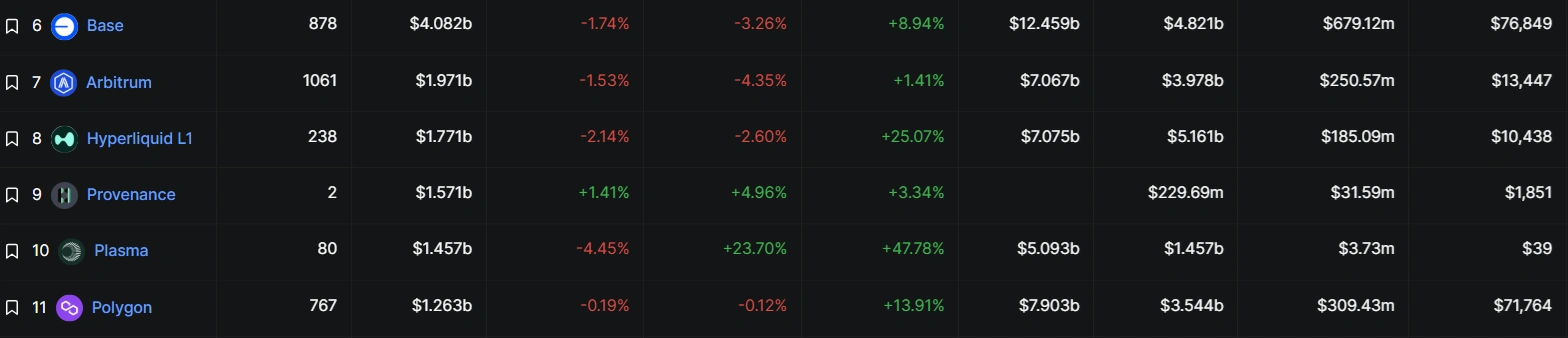 Comparison of Ethereum L2s by TVL. Source: Defillama
Despite its current position, Polygon has not stood still on the technical side, as it announced that it had activated the Lisovo Hardfork on mainnet earlier in March. The hardfork introduces gas subsidies for AI agents and improves transaction reliability.
A series of upgrades through 2025 pushed throughput from approximately 1,000 to a target of 5,000 transactions per second. The network has seen significant growth in its enterprise network, with Revolut and, most recently, Mastercard joining other major financial institutions that have integrated Polygon’s on-chain payment infrastructure.
On Defillama, Polygon seems to be doing well following the proposal’s announcement, as the daily chain fees generated over the past 24 hours have seen a rise. The platform generated over $71,000, trailing only Base, which generated over $76,000, in the L2 space.
How this proposed pivot reverses the fortunes of POL is the question observers will be looking to get answers for soon.
Want your project in front of crypto’s top minds? Feature it in our next industry report, where data meets impact.
You May Also Like
Nvidia Faces Class Action Over Alleged Hidden Crypto GPU Revenue

Next-Gen Payments, Prediction Markets, and the Future of US iGaming Infrastructure