

Bitcoin price is heading for weekend collapse to $61k – will a social media post from Trump save it?
Bitcoin is heading into the weekend with broken near-term structure, elevated macro pressure, and a political catalyst that now sits close to the center of the market’s risk map.
The technical setup has deteriorated in steps over the past two weeks. The macro backdrop has stayed tight as Treasury yields press higher and Middle East risk continues to filter through oil, inflation expectations, and rate-sensitive assets.
Layered on top of both is a familiar variable from recent months, President Donald Trump’s public messaging on Iran, which has repeatedly shifted sentiment across stocks, bonds, oil, and crypto.
His prior weekend social media forays on Tariffs, Venezuela, and Greenland all had similar effects on the market. Trump has done most of his major announcements this year while markets are closed, and right now, things are set up for another intervention.
Within the channel framework tracked since the spot Bitcoin ETF launch period, BTC price has already done the hard part of a bearish rotation. It lost the upper $73,000s, failed to reclaim $71,500 with conviction, rolled through $68,000, and then slipped below $66,900. That sequence leaves the market in a lower value area as Friday trading gives way to the weekend.
In this structure, the next defined support channel lies between $61,700 and $61,100. For now, $61,700 stands out as the next major level that could come into play if macro pressure stays firm and no fresh de-escalation signal arrives from Washington.
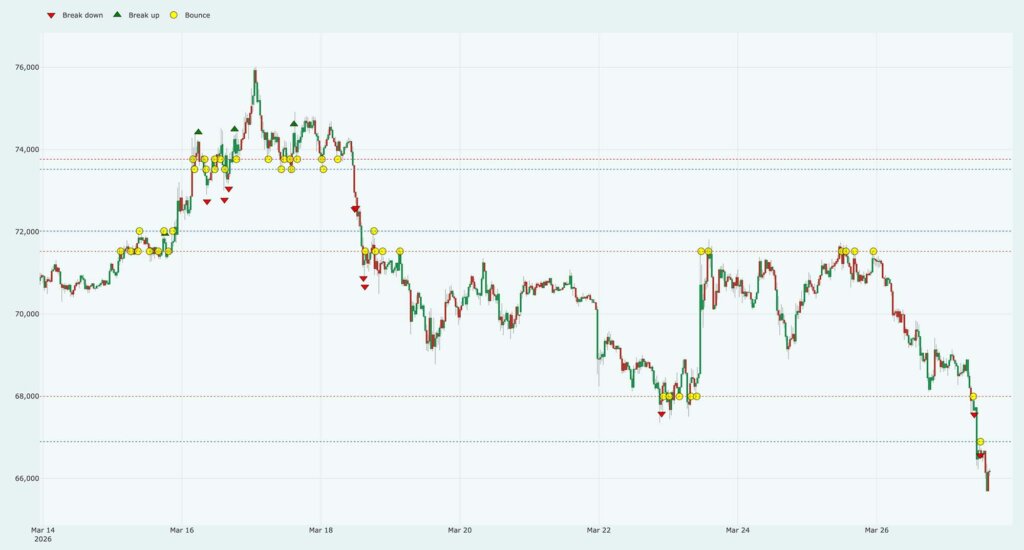 Bitcoin price chart showing a sharp late-week drop toward $61,000 after several days of volatile trading.
Across 400 total interactions with the defined channel boundaries, 304 were bounces, 44 were breaks higher, and 52 were breaks lower. That distribution shows a market that still respects structure. Bitcoin continues to react to these zones in a disciplined way, which gives the current breakdown more analytical value.
The market is not drifting randomly through the map. It is moving from one channel to the next, with each failed reclaim changing the role of the prior boundary.
The clearest example is $71,500. That line served as a key floor during the mid-March sequence, then turned into the strongest visible ceiling once the price broke lower on March 18.
BTC returned to that area several times around March 23 and March 25. Each attempt stalled. That pattern turned $71,500 into the main repair threshold for any bullish recovery. Below it, $68,000 became the next pivot.
BTC briefly re-entered that channel after the first breakdown around March 22, keeping the possibility of stabilization open. That possibility narrowed sharply on March 27 when the price lost $68,000 again, then broke through $66,900 and failed the first retest from below.
That leaves the market with a clean ladder
The first resistance is now $66,900. The next resistance, and the more important reclaim line, is $68,000. Above that sits $71,500, where broader structural repair would begin.
On the downside, the next defined support channel is $61,700 to $61,100. When a market loses one channel and cannot recover its lower boundary, the next channel below becomes the practical draw. That is the state BTC is entering the weekend in now.
The macro overlay has strengthened that downside pull. In its March 18 policy statement, the Federal Reserve kept rates unchanged and said inflation remained somewhat elevated. The central bank’s updated projections preserved a backdrop of restrained policy flexibility and ongoing uncertainty.
Crypto can rally under those conditions, though the burden on market structure increases when long-duration yields are climbing and oil is feeding inflation risk back into the rates complex.
That stress has been visible in the bond market all week. On Friday, the 10-year Treasury yield touched its highest level since July, at 4.48% in early trading before retreating slightly lower.
The precise intraday high matters less than the broader point. Yields have climbed back toward the week’s upper range, and that move has been accompanied by a market that is still pricing geopolitical risk into energy and growth expectations.
That is where Trump’s messaging becomes relevant for Bitcoin over the weekend.
Earlier this week, risk assets responded positively after Trump signaled progress in talks tied to Iran. Stocks rallied, and oil fell after Trump suggested the U.S. and Iran were engaged in talks and hinted at a possible end to the conflict.
Treasury yields also eased briefly on hopes of de-escalation as markets leaned into peace expectations. That relief did not hold for long. Stocks fell again on Friday as markets gave back most of the optimism tied to Trump’s latest delay, and renewed concern over the conflict pushed oil higher.
The pattern is now familiar enough to matter for weekend framing
Trump’s public comments on Iran have repeatedly served as short-term volatility inputs for broader markets, especially when they signal either de-escalation or renewed confrontation.
His social media influence can still sway markets briefly, even as confidence in each new intervention has become more conditional.
For Bitcoin, that means a weekend post that leans toward diplomacy could help produce a relief move into the Monday open. A weekend post that hardens the rhetoric, or no calming message at all, while yields and oil remain firm, would leave the broken structure exposed to another leg lower.
That is the case for keeping $61,700 front and center. The technical path toward that level does not require a new panic event.
The market has already lost the near-term floors that would have contained prices in a higher bracket. The first breakdown through $68,000 around March 22 looked vulnerable to mean reversion, and BTC did in fact re-enter the channel.
The latter break carried more weight because it followed several days of failed recovery attempts. Then came the break through $66,900. Once that level failed and the first retest did not hold, the next support channel below became the relevant destination inside the existing map.
I believe that is also the cleanest way to think about the weekend setup. Bitcoin is no longer trading as though the market is trying to rebuild the damage from March 18. It is trading as though the market is deciding how much lower the next balance area should sit.
I'm not asking whether BTC can rally at all. It can. What I'm looking at now is whether any rally can recover a broken boundary and keep it as support. Until that happens, upside moves serve mainly as tests of resistance.
The thresholds are clear right now
A quick $66,900 reclaim would reduce the immediacy of the latest breakdown. A stronger move back above $68,000 would reopen the argument for a weekend mean-reversion bounce, especially if it coincided with softer yields, calmer oil, or another Trump message that markets read as de-escalatory.
A recovery that reaches $71,500 would carry more significance because that is where the last several rebound attempts failed. Those are the conditions that would force a wider reassessment.
If BTC remains capped below $66,900 and fails to recover $68,000, the lower channel remains active. In that case, $61,700 becomes the next major support to monitor through the weekend, with $61,100 as the deeper boundary of the same bracket.
A move into that zone would fit the logic of the recent structure, the backdrop of present rates, and the political-event risk that now hangs over the weekend.
That also fits the broader character of this decline. The chart shows stepwise deterioration rather than disorder.
First, the market lost the $73,800 to $73,500 zone. Then $72,000 and $71,500 gave way. Then the market spent time failing beneath those levels before slipping through $68,000 and $66,900. Each stage narrowed the market’s room to stabilize higher.
Each failed reclaim added weight to the next lower support channel.
As Friday closes out, Bitcoin is therefore sitting in a narrow but readable setup. Near-term structure is broken. Macro pressure remains elevated as Treasury yields stay near recent highs and Middle East risk continues to influence oil and inflation expectations.
A political catalyst still exists because Trump’s comments on Iran have shown they can move cross-asset sentiment quickly, even if the effect has become less durable with each iteration.
That leaves BTC with a simple weekend map. Reclaim $66,900 and then $68,000, and the market can argue for relief. Stay below them, and $61,700 remains the next obvious level to watch.
The post Bitcoin price is heading for weekend collapse to $61k – will a social media post from Trump save it? appeared first on CryptoSlate.
You May Also Like

USDH Power Struggle Ignites Stablecoin “Bidding Wars” Across DeFi: Bloomberg

Bitcoin Market Faces Renewed Pressure: What Lies Ahead?


