As Bitcoin (BTC) trades below $70,000 following its latest decline, a crypto analyst is watching for a potential market bottom. His analysis suggests that a priceAs Bitcoin (BTC) trades below $70,000 following its latest decline, a crypto analyst is watching for a potential market bottom. His analysis suggests that a price

The Bitcoin Bottom Is Very Close But May Take Months To Play Out, Here’s Why

2026/03/31 07:30
3 min read
For feedback or concerns regarding this content, please contact us at crypto.news@mexc.com

As Bitcoin (BTC) trades below $70,000 following its latest decline, a crypto analyst is watching for a potential market bottom. His analysis suggests that a price floor could be near, as bearish momentum and selling pressure appear to be slowing. The analyst has pointed to a key indicator that has consistently signaled BTC’s bear-market lows for over a decade, reinforcing the view that the prolonged downtrend could be ending soon. However, the expert also cautions that it may take several months for the market to reach this level and fully stabilize. 

Why The Bitcoin Bottom Could Be Closer Than Expected

Crypto market analyst identified as Investor Jordan on X has presented a new Bitcoin price analysis, forecasting where the leading cryptocurrency could finally reach a bottom in this cycle. Over the past few months, BTC has experienced significant volatility and negative sentiment amid the ongoing bear market. 

In the past few weeks, Bitcoin has crashed toward $60,000, climbed back above $70,000, and then slipped again to $67,000 at the time of writing. Throughout this price fluctuation, market analysts have continued to predict a potential price bottom, with some suggesting BTC has already hit its lowest point this cycle. In contrast, others believe further declines could be ahead. 

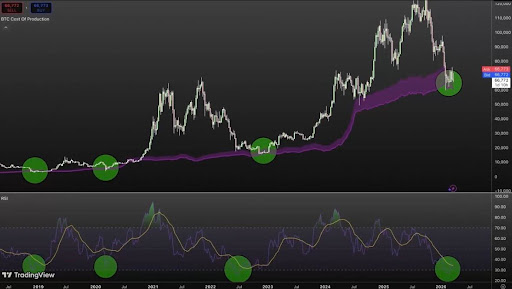
Investor Jordan, however, offers his unique view. In his BTC price analysis, he stated that it is hard to imagine that the market bottom is not already in or at least very close. He says this because of a historical Relative Strength Index (RSI) signal that has consistently marked a price floor for Bitcoin over the past 11 years. 
Bitcoin

Investor Jordan noted that in previous cycles, whenever the Bitcoin RSI dropped below 30 and entered oversold territory, it closely aligned with BTC’s cost of production. The cost of production here refers to the total expense required to mine Bitcoin. He noted that for 11 years, this area has been the bottom before BTC began a move to new highs. 

The analyst’s chart shows that Bitcoin’s RSI is about to break below 30 again and enter oversold territory. If history repeats itself, this could signal that Bitcoin has reached its final bottom. While he emphasizes the strong likelihood of this outcome, Investor Jordan also cautioned that it may take several weeks or even months for the bottom to play out fully.  

Analyst Predicts BTC Bottom By Summer End

In a separate analysis, market expert Titan of Crypto predicted that Bitcoin could reach a price bottom by the end of summer, likely in late August. He noted that BTC has historically found a price floor three to four months after forming an Ichimoku Death Cross.

According to Titan of Crypto, if this Death Cross pattern repeats, Bitcoin could form its highly anticipated price floor before any potential recovery to the upside.

Bitcoin
Market Opportunity
Bitcoin Logo
Bitcoin Price(BTC)
$67,856.62
$67,856.62$67,856.62
+0.33%
USD
Bitcoin (BTC) Live Price Chart
Disclaimer: The articles reposted on this site are sourced from public platforms and are provided for informational purposes only. They do not necessarily reflect the views of MEXC. All rights remain with the original authors. If you believe any content infringes on third-party rights, please contact crypto.news@mexc.com for removal. MEXC makes no guarantees regarding the accuracy, completeness, or timeliness of the content and is not responsible for any actions taken based on the information provided. The content does not constitute financial, legal, or other professional advice, nor should it be considered a recommendation or endorsement by MEXC.

You May Also Like

SEC decisions scrutinized as senator seeks records on crypto enforcement rollbacks

SEC decisions scrutinized as senator seeks records on crypto enforcement rollbacks

The post SEC decisions scrutinized as senator seeks records on crypto enforcement rollbacks appeared on BitcoinEthereumNews.com. U.S. securities regulators have
Share
BitcoinEthereumNews2026/03/31 08:08
Crypto Supercycle in 2025? DeepSeek Ranks the Best Altcoins to Buy Right Now

Crypto Supercycle in 2025? DeepSeek Ranks the Best Altcoins to Buy Right Now

The post Crypto Supercycle in 2025? DeepSeek Ranks the Best Altcoins to Buy Right Now appeared on BitcoinEthereumNews.com. Crypto Supercycle in 2025? DeepSeek Ranks the Best Altcoins to Buy Right Now Sign Up for Our Newsletter! For updates and exclusive offers enter your email. As a crypto writer, Krishi splits his time between decoding the chaos of the markets and writing about it in a way that doesn’t put you to sleep. He’s been at it for nearly two years in the crypto trenches. Yes, he regrets missing the magnificent rallies that came before that (who doesn’t!), but he’s more than ready to put his money where his words are. Before diving headfirst into crypto, Krishi spent over five years writing for some of the biggest names in tech, including TechRadar, Tom’s Guide, and PC Gaming, covering everything from gadgets and cybersecurity to gaming and software. When he’s not scouring and writing about the latest happenings in crypto, Krishi trades the forex market while keeping crypto in his long-term HODL plans. He’s a Bitcoin believer, though he never lets that bias creep into his writing. This website uses cookies. By continuing to use this website you are giving consent to cookies being used. Visit our Privacy Center or Cookie Policy. I Agree Source: https://bitcoinist.com/crypto-supercycle-2025-best-altcoins-to-buy-now-deepseek/

Share
BitcoinEthereumNews2025/09/18 01:45
Cashing In On University Patents Means Giving Up On Our Innovation Future

Cashing In On University Patents Means Giving Up On Our Innovation Future

The post Cashing In On University Patents Means Giving Up On Our Innovation Future appeared on BitcoinEthereumNews.com. “It’s a raid on American innovation that would deliver pennies to the Treasury while kneecapping the very engine of our economic and medical progress,” writes Pipes. Getty Images Washington is addicted to taxing success. Now, Commerce Secretary Howard Lutnick is floating a plan to skim half the patent earnings from inventions developed at universities with federal funding. It’s being sold as a way to shore up programs like Social Security. In reality, it’s a raid on American innovation that would deliver pennies to the Treasury while kneecapping the very engine of our economic and medical progress. Yes, taxpayer dollars support early-stage research. But the real payoff comes later—in the jobs created, cures discovered, and industries launched when universities and private industry turn those discoveries into real products. By comparison, the sums at stake in patent licensing are trivial. Universities collectively earn only about $3.6 billion annually in patent income—less than the federal government spends on Social Security in a single day. Even confiscating half would barely register against a $6 trillion federal budget. And yet the damage from such a policy would be anything but trivial. The true return on taxpayer investment isn’t in licensing checks sent to Washington, but in the downstream economic activity that federally supported research unleashes. Thanks to the bipartisan Bayh-Dole Act of 1980, universities and private industry have powerful incentives to translate early-stage discoveries into real-world products. Before Bayh-Dole, the government hoarded patents from federally funded research, and fewer than 5% were ever licensed. Once universities could own and license their own inventions, innovation exploded. The result has been one of the best returns on investment in government history. Since 1996, university research has added nearly $2 trillion to U.S. industrial output, supported 6.5 million jobs, and launched more than 19,000 startups. Those companies pay…
Share
BitcoinEthereumNews2025/09/18 03:26