Two Democratic senators are pressing the U.S. Securities and Exchange Commission for answers about the agency’s enforcement posture and the events surrounding theTwo Democratic senators are pressing the U.S. Securities and Exchange Commission for answers about the agency’s enforcement posture and the events surrounding the

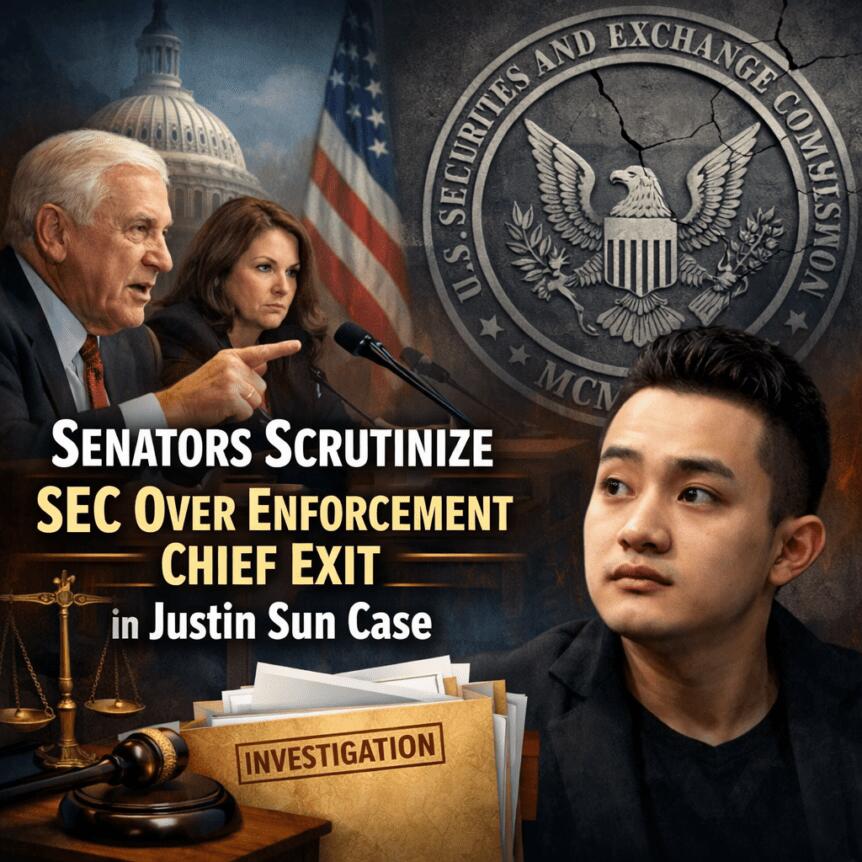
Senators Scrutinize SEC Over Enforcement Chief Exit in Justin Sun Case
For feedback or concerns regarding this content, please contact us at crypto.news@mexc.com
Senators Scrutinize Sec Over Enforcement Chief Exit In Justin Sun Case

Two Democratic senators are pressing the U.S. Securities and Exchange Commission for answers about the agency’s enforcement posture and the events surrounding the resignation of its enforcement chief, Margaret Ryan, in March. A Reuters report cited by the lawmakers alleged she clashed with agency leadership over cases involving individuals tied to then-President Donald Trump. The letters — from Senators Richard Blumenthal and Elizabeth Warren — intensify congressional scrutiny of the SEC’s crypto enforcement choices and potential political influence on investigations tied to Trump’s circle.

In a Monday letter to SEC Chair Paul Atkins, Blumenthal questioned the decision to drop a fraud case against Justin Sun, the Tron founder and a partner of the Trump-backed World Liberty Financial (WLFI) platform, just 11 days before Ryan stepped down. Separately, Warren pressed for information about Ryan’s resignation and whether leadership resisted enforcement actions related to Trump associates. The combined inquiries emphasize lawmakers’ concern that political considerations may intersect with regulatory action in the crypto space.

Key takeaways

  • Lawmakers demand “all records and communications” between the SEC’s Division of Enforcement and SEC senior leadership since January 20, 2025, related to potential enforcement actions against crypto companies.
  • Blumenthal’s letter targets the decision to drop the fraud case against Justin Sun, a Tron founder connected to WLFI, occurring shortly before Ryan’s March resignation.
  • Warren’s letter characterizes Ryan’s tenure and resignation as troubling, signaling ongoing political scrutiny of how enforcement decisions may interact with the Trump orbit.
  • The broader backdrop includes heightened Democratic scrutiny of Trump-era crypto ventures, including WLFI and related campaigns, amid concerns about conflicts of interest and enforcement consistency.
  • SEC officials have said enforcement decisions are grounded in facts, the law, and policy rather than politics, a stance echoed in public statements after Ryan’s departure.

Resignation, clashes, and the enforcement question

The core of the dispute centers on a Reuters report that alleged Margaret Ryan clashed with senior SEC leadership over several cases tied to individuals in Trump’s orbit. Internal tensions reportedly culminated in Ryan’s resignation, which the agency publicly confirmed as effective mid-March. The timing — with Sun’s tie to WLFI and Trump’s circle at issue — prompted Blumenthal to demand a clearer accounting of how decisions on politically charged crypto cases are made, and whether external partners influenced those choices.

Blumenthal’s letter to Atkins requests comprehensive access to internal communications and decision-making records from the enforcement division dating back to January 2025. The senator also sought correspondence between SEC leadership and members of the Trump and Witkoff families, noting WLFI’s leadership includes Zach Witkoff and that Trump’s sons were among its early participants. The aim, according to Blumenthal, is to understand whether enforcement actions favored certain political or financial allies.

Context: Trump-affiliated crypto ventures and regulatory oversight

The letters sit within a broader pattern of political and regulatory attention on Trump-associated crypto ventures. WLFI, TRUMP-themed crypto assets, and related technology ventures have drawn continued scrutiny from lawmakers who argue that political considerations could shape enforcement trajectories. In this framing, Ryan’s resignation becomes a touchpoint for conversations about the SEC’s independence when dealing with prominent political actors and their business interests.

From a separate vantage, the legal and regulatory narrative around crypto enforcement has persisted even as the SEC publicly defends its approach. A spokesperson for the agency told Cointelegraph that enforcement decisions are based on facts, the law, and policy rather than politics, signaling a commitment to procedural integrity even amid high-profile political entanglements. The discussions that followed Ryan’s departure underscore the demand for transparent records about how the SEC evaluates complex cases at the intersection of crypto and politics.

The numbers game: illicit activity, Tron, and the politics of enforcement

Blumenthal’s filing also advances a quantitative angle: he cites a surge in illicit crypto activity, pegging the figure at about $154 billion in 2025, the year Trump returned to political prominence. The senator contends that Sun’s Tron ecosystem played a disproportionate role in this dynamic. He cites data suggesting Tron accounted for roughly a third of all payment tokens by certain measures, and that 58% of illicit finance in crypto occurred on Tron’s network in 2024. These figures are deployed to argue that enforcement choices could have national-security and consumer-protection implications when they involve networks with perceived ties to political power.

Coincident with these claims, Trump’s orbit—through WLFI and other ventures—remains a focal point for critics who warn of potential conflicts of interest that could influence regulatory outcomes. Tron’s response to these allegations was not immediately available for comment at press time, while the broader policy debate continues to unfold.

The road ahead: what readers should watch next

As the SEC continues to navigate the fallout from Ryan’s resignation and the ensuing scrutiny from lawmakers, investors and crypto participants should monitor whether the agency releases the requested records, how it clarifies its enforcement rationale in high-profile cases, and whether it reframes its engagement with crypto firms that carry political associations. The next steps may include formal responses from the SEC about internal decision-making processes, as well as any new enforcement actions or policy shifts in crypto-related matters.

With the political spotlight on Trump’s crypto ventures unlikely to fade soon, observers should watch for additional congressional letters, potential hearings, and any SEC statements that delineate the boundaries between geopolitical considerations and regulator impartiality. The outcome could influence how market participants assess regulatory risk, compliance requirements, and the likelihood of future enforcement actions in cases touching political figures or their business associates.

What remains uncertain is the degree to which records will be disclosed and how the SEC will balance its internal deliberations with the public’s demand for transparency. For market observers, the unfolding narrative suggests a crypto enforcement regime increasingly scrutinized through a political lens, with implications for how firms navigate regulatory expectations and legitimate political entanglements in the months ahead.

Readers should stay tuned for any official responses from the SEC and for further disclosures from lawmakers as they seek to illuminate the intersections of enforcement, politics, and crypto business partnerships.

This article was originally published as Senators Scrutinize SEC Over Enforcement Chief Exit in Justin Sun Case on Crypto Breaking News – your trusted source for crypto news, Bitcoin news, and blockchain updates.

Market Opportunity
OFFICIAL TRUMP Logo
OFFICIAL TRUMP Price(TRUMP)
$2.999
$2.999$2.999
+0.63%
USD
OFFICIAL TRUMP (TRUMP) Live Price Chart
Disclaimer: The articles reposted on this site are sourced from public platforms and are provided for informational purposes only. They do not necessarily reflect the views of MEXC. All rights remain with the original authors. If you believe any content infringes on third-party rights, please contact crypto.news@mexc.com for removal. MEXC makes no guarantees regarding the accuracy, completeness, or timeliness of the content and is not responsible for any actions taken based on the information provided. The content does not constitute financial, legal, or other professional advice, nor should it be considered a recommendation or endorsement by MEXC.

You May Also Like

Dow Jones futures gain on easing risk aversion, lower oil prices

Dow Jones futures gain on easing risk aversion, lower oil prices

The post Dow Jones futures gain on easing risk aversion, lower oil prices appeared on BitcoinEthereumNews.com. Dow Jones futures rise, up by 0.81%, above 45,800
Share
BitcoinEthereumNews2026/03/31 17:14
Brent Crude Forecast: Societe Generale Issues Stark $150 Risk Warning Amid Market Turbulence

Brent Crude Forecast: Societe Generale Issues Stark $150 Risk Warning Amid Market Turbulence

BitcoinWorld Brent Crude Forecast: Societe Generale Issues Stark $150 Risk Warning Amid Market Turbulence Global energy markets face renewed volatility as Societe

Share
bitcoinworld2026/03/31 16:50
Revolutionary: CME SOL XRP Futures Options Set to Transform Crypto Trading

Revolutionary: CME SOL XRP Futures Options Set to Transform Crypto Trading

BitcoinWorld Revolutionary: CME SOL XRP Futures Options Set to Transform Crypto Trading Exciting news is rippling through the cryptocurrency world! The U.S. Chicago Mercantile Exchange (CME), a titan in traditional finance, is reportedly planning to launch CME SOL XRP futures options. This significant development, initially reported by Walter Bloomberg, marks a pivotal moment for institutional involvement in the altcoin market. It signals a new era for how Solana (SOL) and Ripple (XRP) might be traded, potentially opening doors to broader adoption and increased market maturity. What Does the Launch of CME SOL XRP Futures Mean for Crypto? When an institution like CME, known for its rigorous standards and vast trading volume, enters a new market, it brings a wave of legitimacy. The introduction of CME SOL XRP futures options indicates a growing acceptance of these digital assets within mainstream finance. This move could fundamentally change how investors perceive and interact with SOL and XRP. Futures options are financial derivatives that give traders the right, but not the obligation, to buy or sell an underlying asset at a specific price on or before a certain date. For SOL and XRP, this means: Enhanced Price Discovery: More participants and trading volume can lead to more efficient and accurate pricing. Institutional Access: It provides regulated avenues for large institutional investors to gain exposure to SOL and XRP without directly owning the underlying assets. Risk Management: Traders can use these options to hedge against potential price fluctuations in their existing SOL and XRP holdings. Why Are SOL and XRP Chosen for CME SOL XRP Futures? The selection of Solana (SOL) and Ripple (XRP) for these new futures options is not arbitrary. Both cryptocurrencies hold significant positions in the market and offer distinct value propositions: Solana (SOL): Known for its high-performance blockchain, offering fast transaction speeds and low costs. Its robust ecosystem supports numerous decentralized applications (dApps), NFTs, and DeFi projects, attracting considerable developer and user interest. Ripple (XRP): Primarily focused on facilitating fast, low-cost international payments for financial institutions. Despite ongoing regulatory discussions, XRP maintains a strong market presence and a dedicated community, highlighting its potential for cross-border transactions. Their substantial market capitalization and existing liquidity make them attractive candidates for institutional-grade derivative products. This choice reflects a strategic assessment by CME of assets that can sustain significant trading interest and volume. Navigating the Landscape: Opportunities and Considerations for CME SOL XRP Futures The introduction of CME SOL XRP futures options presents a wealth of opportunities, yet it also comes with important considerations. On the opportunity front, we can expect increased liquidity, which benefits all market participants by making it easier to buy and sell without significant price impact. Moreover, it could attract new capital from traditional financial players who prefer regulated products. However, traders and investors should also consider the implications: Market Volatility: While derivatives can offer hedging, they can also amplify market movements. Regulatory Clarity: The regulatory landscape for cryptocurrencies, particularly for XRP, continues to evolve. CME’s move might encourage further clarity but also means ongoing scrutiny. Learning Curve: Understanding futures options requires a certain level of financial literacy, which new entrants to the crypto market may need to develop. These products offer sophisticated tools for managing exposure and speculating on price movements, but they demand a careful approach. What’s Next for the Crypto Market with CME SOL XRP Futures? The reported launch of CME SOL XRP futures options is more than just a new product offering; it represents a significant milestone in the ongoing convergence of traditional finance and the digital asset space. It underscores the growing maturity of the cryptocurrency market and its increasing integration into global financial systems. As institutional interest continues to surge, we can anticipate further innovation and a broader range of regulated products for other altcoins. This development is poised to offer sophisticated tools for investors and traders, potentially stabilizing market dynamics while simultaneously introducing new avenues for growth and investment. The crypto market is evolving rapidly, and CME’s latest initiative is a clear indicator of this exciting trajectory. To learn more about the latest crypto market trends, explore our article on key developments shaping the cryptocurrency market institutional adoption. Frequently Asked Questions (FAQs) What is the Chicago Mercantile Exchange (CME)? The CME is one of the world’s largest and most diverse derivatives marketplaces, offering a wide range of futures and options products across various asset classes, including equities, commodities, and now, expanding into specific cryptocurrencies. What are futures options in the context of SOL and XRP? Futures options for SOL and XRP are financial contracts that give the holder the right, but not the obligation, to buy or sell SOL or XRP futures contracts at a predetermined price on or before a specific date. They allow for hedging and speculation on price movements. Why are Solana (SOL) and Ripple (XRP) chosen for these new options? SOL and XRP were likely chosen due to their significant market capitalization, established liquidity, and distinct use cases within the crypto ecosystem, making them attractive for institutional-grade derivative products. How might CME SOL XRP futures options affect the prices of SOL and XRP? The introduction of these options could lead to increased liquidity and institutional participation, potentially influencing price discovery and stability. However, like all derivatives, they can also contribute to market volatility. When are these CME SOL XRP futures options expected to launch? While Walter Bloomberg reported CME’s plans, an official launch date has not yet been publicly announced by CME. Market participants should monitor official CME channels for updates. If you found this article insightful, please consider sharing it with your network! Help us spread the word about the exciting developments in the crypto space by sharing this article on your social media platforms. This post Revolutionary: CME SOL XRP Futures Options Set to Transform Crypto Trading first appeared on BitcoinWorld.
Share
Coinstats2025/09/18 00:45