After TechCabal report, UTME candidate who had never used a computer gets new laptop, smart phone
When TechCabal first spoke with Tamunotonye, the 16-year-old United Tertiary Matriculation Examination candidate from Borokiri in Bonny Island, Rivers State, southern Nigeria, his fear had a shape.
It was not the exam itself; it was the machine. He had never used a laptop.
The UTME, Nigeria’s gateway into universities and other tertiary institutions, has been computer-based since 2015, but to Tamunotonye, the keyboard, mouse and screen represented a hurdle far more immediate than any question JAMB could set.
“I have no idea how to use a mouse,” he had said quietly then.
Weeks later, that fear has begun to loosen its grip.
A laptop now sits in his dark room, with a mouse beside it, a smartphone within reach and a portable hard drive nearby. More importantly, he has started learning. For the first time, the technology that once stood between him and his future is no longer a stranger.
A call from an unknown number
The change began quietly, with a phone call to this writer.
Unknown numbers rarely carry comfort. They arrive with a certain tension, the possibility of bad news, of scams, of interruptions better left unanswered. This one could easily have been ignored.
It was not. On the other end of the line was a man who introduced himself as the Executive Assistant to a stakeholder connected to the Boys to MEN Foundation. He said his boss had read the TechCabal story about Tamunotonye, about a boy preparing for one of the most important exams of his life without ever having touched a computer.
Then he paused.
His boss, who said he wanted to remain anonymous for personal reasons, said he had grown up in a different world, one of paper, pencils, chalk, and crayons. A world where access, even if modest, was assumed. He could not quite remember sitting JAMB. At some point, he had been sent abroad by his parents. Life had moved on. When he returned, he went for National Service, serving at an oil servicing firm in Port Harcourt, Rivers State.
Now, decades later, he is a father to two boys, the first, roughly the same age as Tamunotonye, and something about the story unsettled him.
“It’s shocking that a young man that age would exist in this century with that kind of disadvantage,” he said, his voice steady but weighted. “It was heartbreaking, to say the least.”
He noted that although he could not fix the country’s deep and uneven digital reality – that gap, he acknowledged, was far bigger than one person – he could begin somewhere: with Tamunotonye.
“Send me an address,” he said. “My EA will arrange everything he needs to succeed.”
The plan was simple. Give the boy what he had never had. A laptop. The tools. The exposure. Enrol him in a computer training centre in Bonny Town. Let him learn properly, before he sits for an exam that assumes he already knows.
There was only one condition. He did not want his name mentioned.
“I would like you to be the liaison,” he added. And just like that, a story that began with fear started to shift.
A package arrives
Days later, Tamunotonye told TechCabal he received a call from a computer training institute in Bonny.
A package had arrived. Inside was a brand-new HP laptop, a wireless mouse and a Samsung Galaxy smartphone. There was also a one-terabyte external hard drive. All brand new.
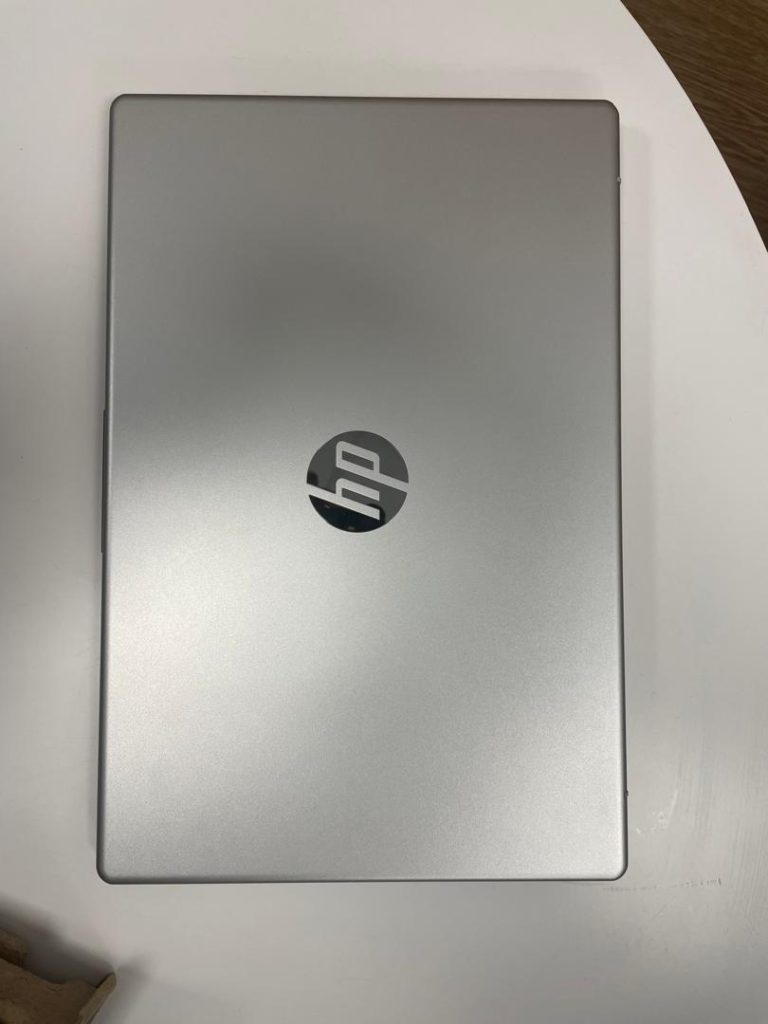 Tamunotonye’s new laptop
 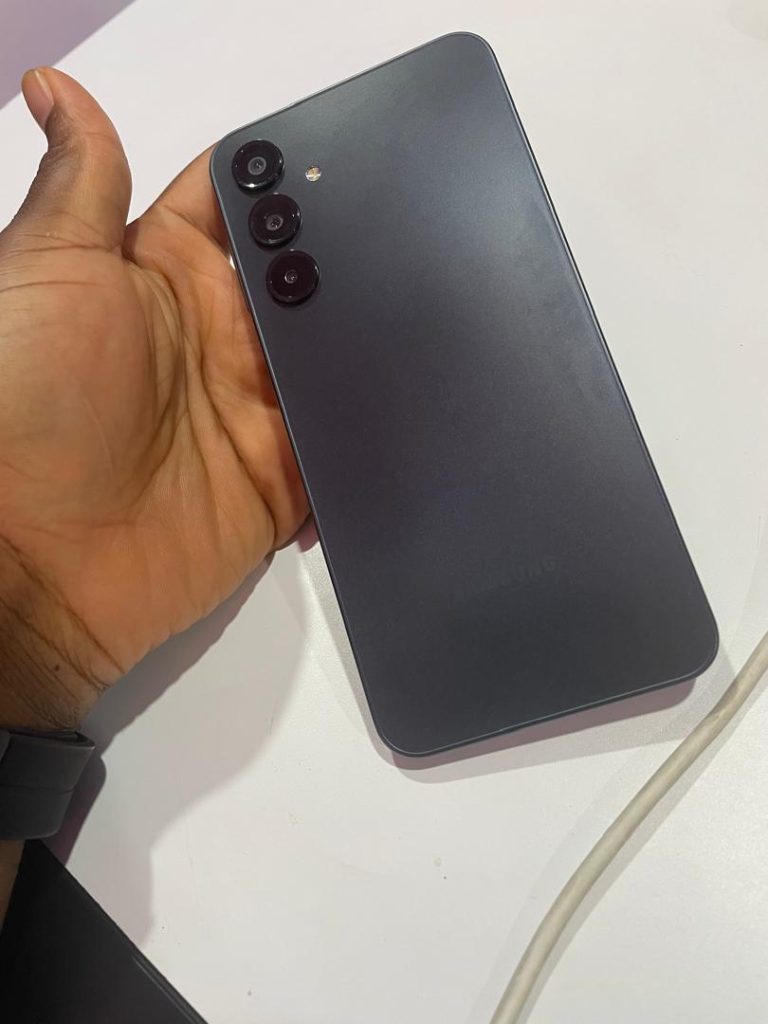 Tamunotonye’s new phone
The laptop alone, his computer teacher told him, costs more than N700,000 ($500).
For a boy who had once worried about how to move a mouse during the UTME, the moment felt unreal.
“I cannot believe that a simple story will give me this much fortune,” he said, his voice beaming with childlike wonder. “It is like I am dreaming.”
But the dream was tangible. He picked up the laptop himself at the training centre where he has now begun learning the basics of computer use: typing, navigating interfaces, opening software, and understanding how a computer works.
“It’s new,” he said, still sounding stunned. “I will start my training on Monday. My teacher said I have a lot to learn, but he wants to focus on the basics, at least, so I can pass this exam.”
For the first time, the device that once frightened him has started to become familiar.
Gratitude and a larger question
Tamunotonye is grateful. But even as he adjusts to his new reality, he cannot stop thinking about the others who remain where he once stood.
“It feels like a win for me,” he said. “But there are several others like me. It’s not just me. Two of my friends are just like me. I am sure if we look, there are many who are just like us, but may not have the good fortune of getting their stories to a larger audience. Some are even ashamed.”
He believes the conversation should extend beyond his personal story.
“I wish the Ministry of Education and JAMB would start looking at initiatives or training where people can begin to be conversant with computers before the actual CBT.”
JAMB encourages candidates to take mock examinations before the UTME. But Tamunotonye wonders if that alone is enough.
“I know JAMB will say we should take a mock examination,” he said. “But is that really okay? Does it solve the problem?”
He notes that discussions about digitising examinations are already expanding.
“I heard that, next year, WASSCE and NECO will also be CBT by next year,” he said.
For him, that transition will come too late to worry about, as he had finished his WASSCE under the old system.
But the next generation of students may not be as fortunate.
“I am thankful I won’t face that,” he added. “But what about other boys like me?”
A mother’s disbelief
For his mother, Evelyn, the shift in her son’s life has been difficult to fully take in.
Her world has long been shaped by survival. A small business. Daily sales that rise and fall without warning. Children to raise, needs to meet, and, often, opportunities that pass by simply because there is not enough to hold on to them.
So when Tamunotonye told her what had happened, she told TechCabal that she was not sure it was true.
“You know these children; they play too much. But when he came home with it, I was even more worried. That was why I insisted I wanted to speak to you.”
There was a pause, the kind that carries both gratitude and disbelief.
“But I still cannot believe that there are good people in the world. I thank you people [TechCabal] for bringing my son’s story to light, and for the Good Samaritan, may God bless him,” she said. “We will be eternally grateful.”
At the Boys to MEN Foundation, the story had travelled beyond a single intervention.
Mrs Ifeoma I. Idigbe, the organisation’s Founder and Executive Vice Chairman, said the report struck a necessary chord, not just because of Tamunotonye, but because of what he represents.
She also urged JAMB to fix the loopholes identified in the report.
‘This is man’s inhumanity to man’
Nigeria’s shift to CBT for the UTME has exposed a deep digital divide, according to Ben Goong, a former Director of Information and Public Affairs at the Federal Ministry of Education, who retired in October 2025.
Speaking to TechCabal last Wednesday in a telephone interview, Goong said the ministry had no special programme for candidates who were digitally disadvantaged.
“While I was in the system, I was very concerned, as you are, if not more, about candidates in the rural areas facing CBT,” he said.
“A good number of them have never seen a computer, yet suddenly they have to travel kilometres from home to sit an exam on a machine they do not know. These are candidates whose voices are never heard.”
Goong highlighted the plight of students in riverine areas and remote northern communities, arguing that the system actively hinders their success.
“As long as this system does not make room for them, they will continue to fail exams, not because they are not brilliant, but because the machinery with which they are being examined does not accommodate them. Many have graduated for years, facing CBT, and are going nowhere.”
He called for structural interventions to prevent what he described as “man’s inhumanity to man.”
“There should be a process to the CBT, not just taking candidates to centres to write UTME on a computer they have never seen in their lives,” Goong said. He suggested that every school graduating student who would sit for CBT exams must have access to computers, and that students in schools without such infrastructure should be trained at neighbouring schools for several years before taking the test.
Reflecting on his own experience, Goong said: “I have finished from one of the remotest areas in Benue State. If they had introduced computers then, I would have ended up becoming a villager without going to the university if they had introduced CBT.”
While he acknowledged the efforts of JAMB to implement CBT, he stressed that “we shouldn’t end it at takeoff. Efforts should be made to train these candidates properly.”
For many students across Nigeria, particularly in rural and underserved communities, Goong’s warnings underscore a growing concern: technology meant to modernise education can also entrench inequality when access to it and training are lacking.
Federal Ministry of Education mum
When the current Director of Information and Public Affairs of the FME, Mrs Folashade Boriowo, was contacted for a response, she asked our correspondent to send a WhatsApp message containing the questions, which was done.
Those messages were delivered and read, but a reply had yet to come as of press time.
Several calls also went unanswered at the time of filing this report.
Meanwhile, JAMB has stated that candidates scheduled for the Mock UTME spent more time on the examination than in previous years.
In its bulletin published on its website on March 23, the board noted that the Mock UTME, traditionally conducted for two hours, was extended to four hours for the 2026 exercise.
This adjustment, according to the board, is designed to give ample opportunity to familiarise themselves with the CBT environment.
You May Also Like

Metaplanet raises $1.4B to fuel BTC purchases and U.S. subsidiary launch

New Crypto Investors Are Backing Layer Brett Over Dogecoin After Topping The Meme Coin Charts This Month